How to find competitor pricing, even when the price is not on the page
· 10 min read · by the Competite team
How to find competitor pricing depends on where the price is printed, and it is printed in more places than the pricing page. This guide covers nine sources in order of trust, what “contact sales” tells you, how to record a price so it can be used later, and what not to do to get one.
How do you find competitor pricing?
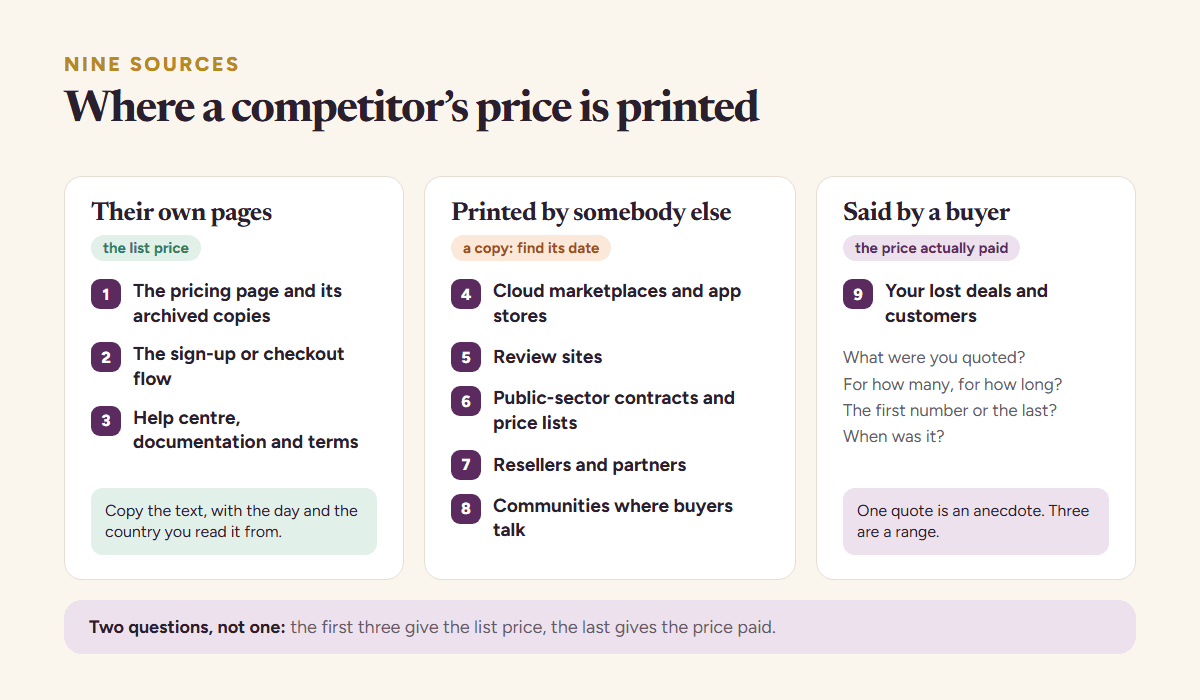
Read the competitor’s own pricing page first, then its archived copies, its sign-up flow and its help centre. If the number is still missing, look where somebody else prints it: marketplaces, review sites, public contracts and resellers. The figure closest to the truth is the one a buyer was quoted, so ask your customers and lost deals.
| Source | What it gives | How far to trust it |
|---|---|---|
| 1. The pricing page and its archived copies | the list price today and on earlier dates | fully, for the list price |
| 2. The sign-up or checkout flow | what a new customer is shown before paying | fully, for self-serve plans |
| 3. Help centre, documentation and terms | overage rates, add-ons, seat minimums | high; check the article’s date |
| 4. Cloud marketplaces and app stores | a public price on the listing | medium; listings lag |
| 5. Review sites | a starting price or a plan list | low to medium; often old |
| 6. Public-sector contracts and price lists | what one named buyer agreed to pay | high, for that buyer and year |
| 7. Resellers and partners | a list price per licence or seat | medium; date unknown |
| 8. Communities where buyers talk | one person’s figure for one deal | low alone |
| 9. Your lost deals and customers | the quote a buyer like yours was given | highest, for the price paid |
The first three give the list price. The last gives the price actually paid. The five in between are only as good as their date.
What do a competitor’s own pages say about its prices?
More than the plan cards. The pricing page gives today’s list price, its archived copies give the history, the sign-up flow shows what a new customer is asked to pay, and the help centre holds the numbers that never make the plan card: overage rates, add-ons and seat minimums.
- The pricing page. Read it from your buyers’ country, with the annual toggle both ways, and copy the text with the day. Competitor pricing analysis covers the eight things to read on it.
- Its archived copies. The Internet Archive’s Wayback Machine keeps dated copies of public pages: paste the address, pick a date, and see what a plan cost then. Not every page is captured. It also saves a page on request, so save a rival’s pricing page the day you first read it.
- The sign-up or checkout flow. Many products show prices only once an account exists, on the plan picker or upgrade screen. Sign up as yourself, and read the terms first, because some forbid use by competitors. How to detect competitor trial changes covers the trial terms on the same screens.
- The help centre, documentation and terms. Search them for “billing”, “overage”, “additional seat” and “price change”. This is where a company says what an extra seat costs and when a new price takes effect.
Where else are a competitor’s prices published?
In five kinds of place, each printed by somebody other than the competitor: marketplaces and app stores, review sites, public-sector contracts, resellers, and communities where buyers talk. Any of them can be out of date, so find the date before you believe the number.
- Cloud marketplaces and app stores. Listings on AWS Marketplace generally carry public pricing, though some show only a request for a private offer, and the Shopify App Store shows each app’s pricing on its listing. A listing can lag behind the vendor’s own page.
- Review sites. G2 has a pricing page for many products and says the figures come from the vendor or its public pricing materials, so read its date first. In August 2025 it said it had begun showing estimated ranges for some products with no public price, in exchange for a work email that may be passed to the vendor as a lead, so the rival may learn you looked.
- Public-sector contracts and price lists. If the competitor sells to governments, some of its prices are public records. In the United States, suppliers with a GSA Schedule contract list ceiling prices on GSA Advantage, and the UK’s Find a Tender service publishes award notices with each contract’s value.
- Resellers and partners. A reseller or agency often publishes a price list, per licence or per seat. Its margin and date are unknown, so treat it as a rough guide.
- Communities where buyers talk. Forums carry sentences such as “we pay about this much a year for twenty seats”. Each is one memory of one deal; three that agree are a range. Vendr, which negotiates software purchases for companies, publishes price benchmarks for thousands of products, drawn, it says, from deals it has handled.
The sites named here were checked in November 2026; any of them can change, so check the page.
What does “contact sales” tell you about a competitor’s pricing?
That the price depends on the buyer. A company hides its price when deals are large enough to pay for a salesperson, when the figure changes with seats, usage or contract length, or when a published number would anchor every negotiation. The missing price is itself a fact about who the product is for.
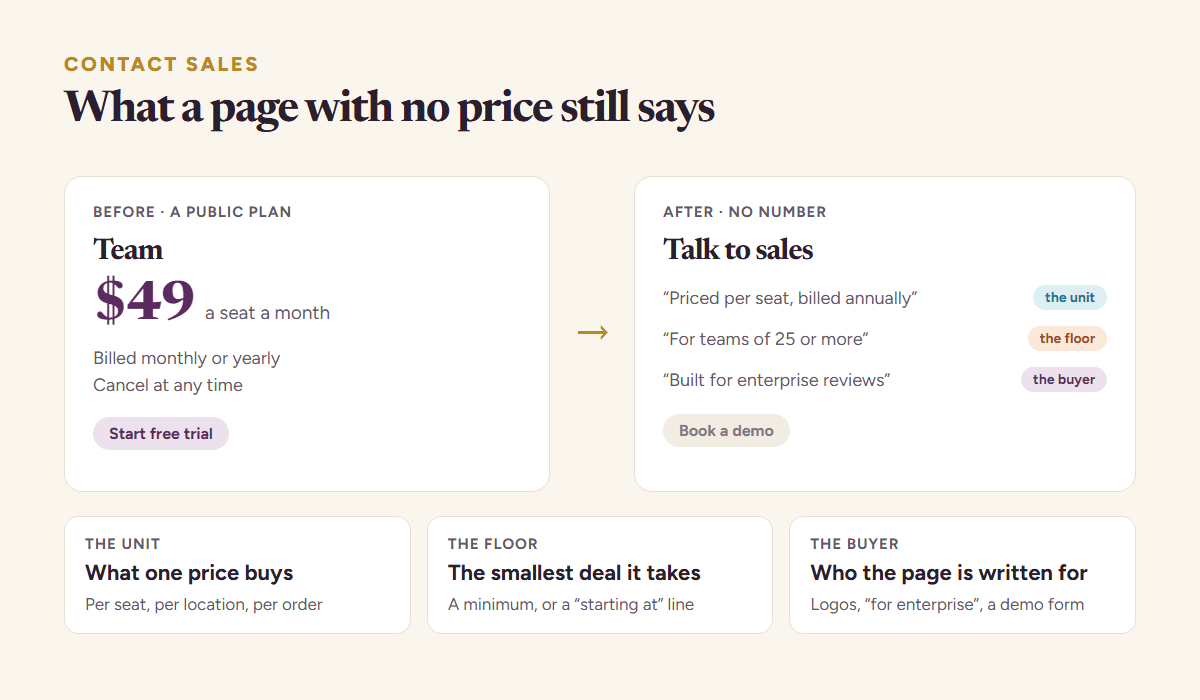
Three things can still be read from a page with no number. The unit: per seat, per location, per order. The floor: a “starting at” line or a minimum number of seats. And the buyer: the logos, the words “for enterprise”, a demo form as the only button.
A competitor that used to publish a price and now hides it is telling you more: usually a move to larger deals, one of the changes competitor price tracking exists to catch. The last published price is still in the archive.
How do you find out what a competitor actually charges?
Ask the people who were quoted. A list price is what a company prints; the price it charges is what a buyer agreed to after the discount, and only buyers know it. Your lost deals, customers who looked elsewhere first, and prospects comparing you today have all seen a number you have not.
- What were you quoted, and for what? The figure, the seats or locations, and the contract length. A price without its unit cannot be compared.
- Was that the first number or the last? A first quote and a signed price are often far apart.
- When was it? A quote from last spring describes last spring.
One answer is an anecdote and three are a range, so ask after every lost deal, and do not press a buyer whose quote was confidential. How to find your competitors’ customers covers who buys from a rival. With nobody to ask yet, buyer interviews are the part of competitor analysis services worth paying for.
How should you record a competitor’s price?
With six fields, every time: the plan, the price with its billing period, the currency and region, the day you read it, the source, and the sentence it came from. A price without a date and a source cannot be checked, and will be argued with the first time it matters.
| Field | What to write |
|---|---|
| Plan | the name on the page |
| Price and period | the figure and what it buys: a month, a seat |
| Currency and region | the currency, and the country you read it from |
| Day read | the date |
| Source | the page or the person, findable again |
| Quote | the line as printed, or the buyer’s words |
Add one word of your own: “read” for a page you opened, “quoted” for a figure a buyer gave you, “reported” for anything second-hand. When two sources disagree, the label says which wins. The same fields fill the pricing part of a competitor audit, and a direct competitor comparison covers making two price lists comparable.
A worked example: finding the price of a competitor that hides it
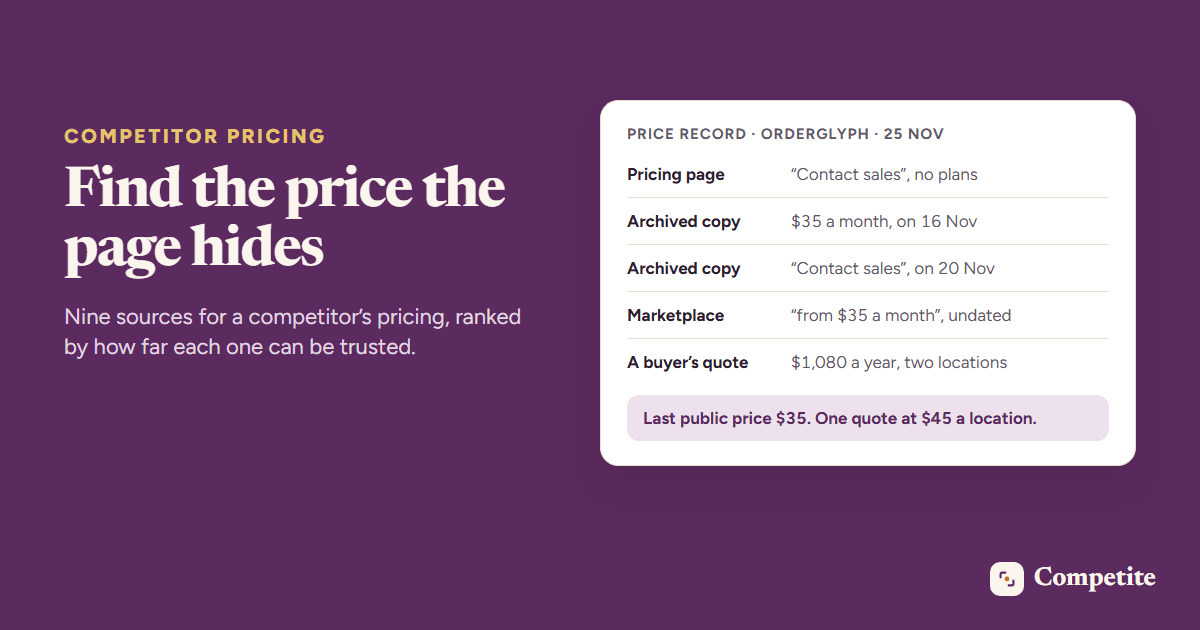
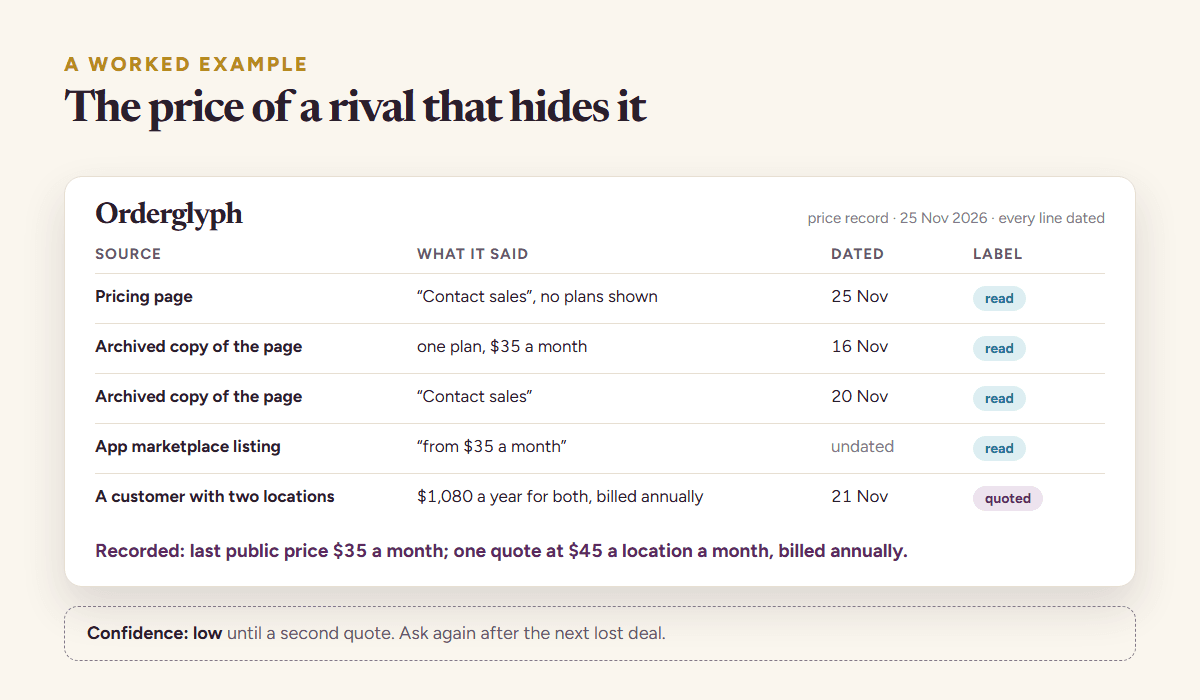
Forkvane, the fictional menu-photo startup used across this blog, keeps Orderglyph on its list as an adjacent product. On 25 November its pricing page showed no plans, only a button reading “Contact sales”. Three other sources produced a usable figure in under an hour.
| Source | What it said | Dated | Label |
|---|---|---|---|
| Pricing page | “Contact sales”, no plans shown | 25 November | read |
| Archived copy of the page | one plan, $35 a month | 16 November | read |
| Archived copy of the page | “Contact sales” | 20 November | read |
| App marketplace listing | “from $35 a month” | undated | read |
| A Forkvane customer with two locations | $1,080 a year for both, billed annually | 21 November | quoted |
The archive dates the change to within four days and gives the last public price; the undated marketplace listing only repeats it. The quote is the new information: $1,080 a year for two locations is $45 a location a month, $10 above the last public price, on an annual contract.
Forkvane recorded it as “last public price $35 a month; one quote at $45 a location a month, billed annually; confidence low until a second quote”. Its own $29 a month stayed where it was, and its list gained a dated note: Orderglyph now sells by quote.
What should you not do to get a competitor’s price?
Do not pretend to be a buyer, and do not accept a number nobody can trace. A quote obtained under a false name prices a customer who does not exist, and a figure with no page and no date behind it is a rumour.
- Posing as a customer. It may breach the terms you accepted, and the answer describes a buyer you invented. To get a quote, ask as yourself and say why.
- Trusting a price an AI recalled. An assistant that did not open the pricing page while answering is reciting what it once read, perhaps two price changes ago. Ask for the page and the sentence, then open it. How to find competitors with ChatGPT covers the same check for names.
- Quoting an old review or comparison. An article from two years ago records two years ago. Use it for the history, never for today’s price.
How do you keep competitor prices current?
Re-read on a schedule, because a price is true for the day it was read: weekly for the two or three rivals you meet in deals, monthly or quarterly for the rest. A buyer’s quote is refreshed by asking again after the next lost deal.
Competite reads the pricing page you confirm, weekly on Build and Launch and monthly on the free Idea plan, and records every plan with its name, price, currency and billing period, each with the sentence it came from. A tier that says “contact us” is recorded as contact us, never as a guessed number. Prices are kept as a history from the day you add the competitor, and a changed price or a plan added or removed reaches you as an alert. It reads public pages only, so a buyer’s quote is still yours to ask for. Start free with one competitor, then use the range you found to price your own product.
Questions people ask
- How do I find a competitor’s pricing if it is not on their website?
- Start with archived copies of the pricing page, which often show the price before it was removed. Then check the sign-up flow, the help centre, marketplace listings and review sites. The most reliable figure comes from a buyer who was quoted, so ask your lost deals and customers.
- Why do some companies hide their pricing?
- Because the price depends on the buyer. When a deal varies with seats, usage and contract length, and is large enough to pay for a salesperson, a published figure would anchor every negotiation. A hidden price usually means a sales-led product and larger contracts.
- Is it legal to research what competitors charge?
- Reading public pages and asking buyers what they were quoted is ordinary market research. Two lines are worth knowing: do not misrepresent who you are to obtain a quote, and do not exchange price information with the competitor itself, which competition law restricts in many countries. Beyond that, ask a lawyer.
- How accurate is competitor pricing on review sites?
- Treat it as a dated copy. The figures are usually supplied by the vendor or taken from its public pricing page at an earlier date, so they can be a price change behind. Read the date of last update, and confirm against the vendor’s own page.
- Can ChatGPT find a competitor’s pricing?
- Only if it opens the pricing page while answering and shows you the link. A figure given from memory may be several price changes old, or may never have been on any page. Ask for the page and the sentence, open it yourself, and note the day.
See it on your own competitors
Add your product, or just describe the idea. Competite finds the competitors, reads their pages, and writes the comparison with a quote behind every claim. Free, in about three minutes, no card.
Keep reading
Competitor pricing analysis: how to read a pricing page like a buyer
Competitor pricing analysis in an afternoon: the eight things to read on a pricing page, how to compare plans that are not alike, and how to set your price.
15 September 2026 · 9 min read
Competitor price tracking: what to do the week a competitor cuts a price
Competitor price tracking for founders: what to watch on a pricing page, how to track it by hand or automatically, and the four moves when they cut a price.
15 September 2026 · 8 min read
How to price a SaaS product: a first price you can defend
How to price a SaaS product as an early founder: choose the value metric, find the range buyers already pay, pick the number, package it, test it in 30 days.
6 November 2026 · 10 min read
How to detect competitor trials: when a rival changes its free trial, and what it means
How to detect competitor trials and changes to them: six terms to record, four ways to spot a change, how to tell a test from a decision, and what each means.
25 November 2026 · 10 min read
How to find competitors’ customers: eight public sources, and what to do with them
How to find competitors’ customers from public sources: case studies, reviews, marketplaces and job adverts, how to test a customer count, and the legal line.
25 November 2026 · 10 min read