How to price a SaaS product: a first price you can defend
· 10 min read · by the Competite team
To price a SaaS product, decide what you charge for, find the range buyers already pay for the alternatives, pick a number in the upper half of that range, package it into two or three plans, and test it with real buyers within a month. Most first prices are set the other way round: a competitor’s price minus a fifth, chosen in an afternoon and never looked at again.
How do you price a SaaS product?
In five steps: choose the value metric, the unit you charge for; find the range from what buyers pay for the alternatives and what the problem costs them; pick a number in the upper half; package two or three plans around it; and test it on the next twenty buyers. Each step has one common mistake, and the sections below take them in order.
The order matters. Founders who start with the number end up defending a figure nobody can explain, themselves included. Founders who start with the metric find the number easier to choose, because the range is set by things they can look up: competitors’ published prices, what the buyer spends on the problem today, and what solving it is worth.
The examples below use Platewise, a fictional tool that turns phone photos of dishes into menu photos, launching into a market where two other fictional products from this blog already sell: Forkvane at $29 a month billed yearly, and Dishlumen AI, whose Starter plan is $29 a month and whose Pro plan is $99.
Choose the value metric: what you charge for
The value metric is the unit the price is attached to: per user, per unit of use, per account, or per outcome. A good one grows as the customer gets more value, is easy for the buyer to predict, and is easy for you to count. Get it right and your revenue grows with your customers’ success; get it wrong and your best customers pay the least.
| Metric | Fits when | Watch out for |
|---|---|---|
| Per user, or seat | value grows with the number of people using it | teams sharing one login to save money |
| Per unit of use | value grows with volume: images, messages, calls | bills buyers cannot predict, which slows the sale |
| Per account, flat | every customer gets roughly the same value | large customers paying the same as small ones |
| Per outcome | the result is countable and clearly yours | arguments about what counts as an outcome |
Two products at $29 a month are not the same price if one charges per user and the other per workspace, which is why the metric comes before the number. For Platewise, the metric is dishes a month. A restaurant has one person ordering photos, so a per-user price would charge every customer the same; dishes grow with the menu, which is what the restaurant is paying to fix.
SaaS pricing models compared
Most SaaS products combine a model with a metric: flat-rate, tiered, per-seat, usage-based, freemium, or a hybrid of two. Early on, a tiered subscription with two or three plans is the shape that is easiest to sell and easiest to change. Usage-based pricing fits when use varies a lot between customers, and freemium only when free users bring in paying ones.
| Model | How it works | A good first choice when |
|---|---|---|
| Flat-rate | one price, one plan | buyers are alike and the product is simple |
| Tiered | two to four plans at rising prices | buyers differ in size or need, which is most markets |
| Per-seat | a price for each user | value is the number of people who use it |
| Usage-based | pay for what you use | use varies widely and is easy to count |
| Freemium | a free plan with paid upgrades | free users invite or attract paying ones |
| Hybrid | a base fee plus seats or usage | you need predictable revenue and a metric that grows |
A free trial and a free plan are different tools. A trial lets a buyer see the value before paying, and then it ends; a free plan is permanent, and the users who upgrade pay for everyone who does not. For an early product with few users, a trial is usually the safer choice: it tells you within weeks whether people pay, while a free plan can hide the answer for months.
Find the price range: what buyers already pay
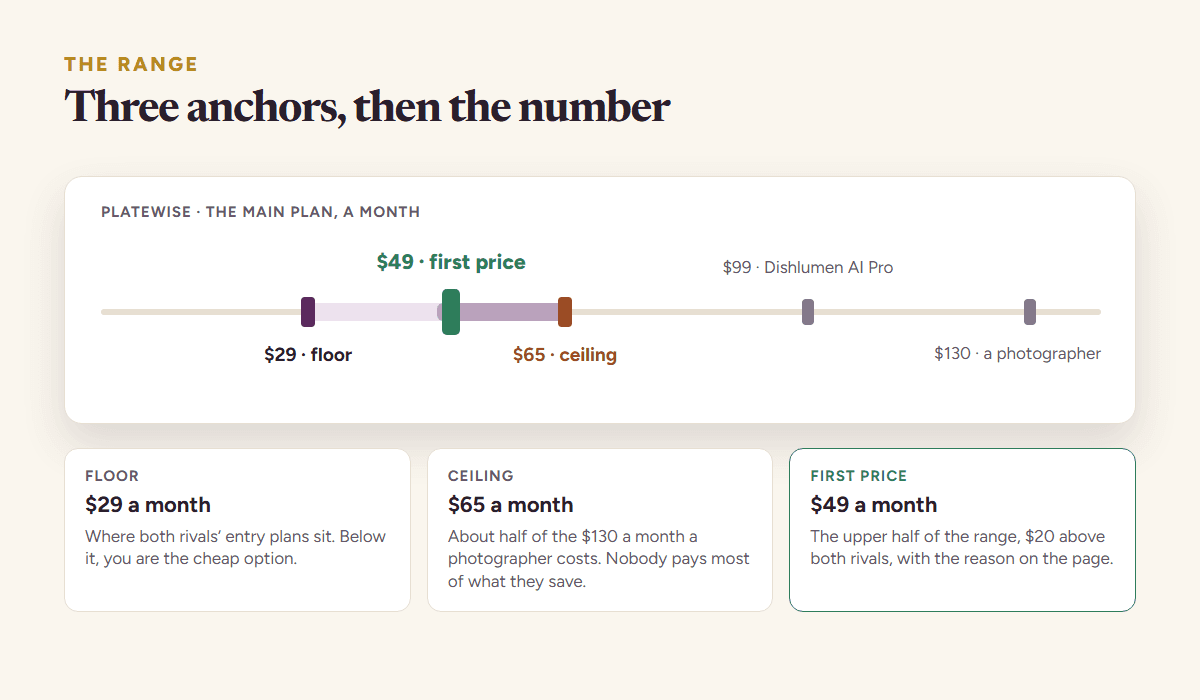
The range has three anchors you can look up: what competitors charge on their pricing pages, what the buyer spends on the problem today, and what solving it is worth to them. The floor is the cheapest credible alternative. The ceiling is a fraction of the value, because nobody pays most of what they save, and your number goes between the two.
- Competitors’ prices. Read their pricing pages and write each plan down with the date: the name, the price, what it includes, the billing period. Compare like with like, per the same unit, for the same buyer. Competitor pricing analysis covers how to read them.
- The cost of doing it today. A spreadsheet and two hours of someone’s week, an agency’s fee, a freelancer. A buyer compares you with this at least as often as with competitors.
- What solving it is worth. Hours saved times what those hours cost, or revenue the buyer would not otherwise get. Rough is fine: you need the order of magnitude, not the decimals.
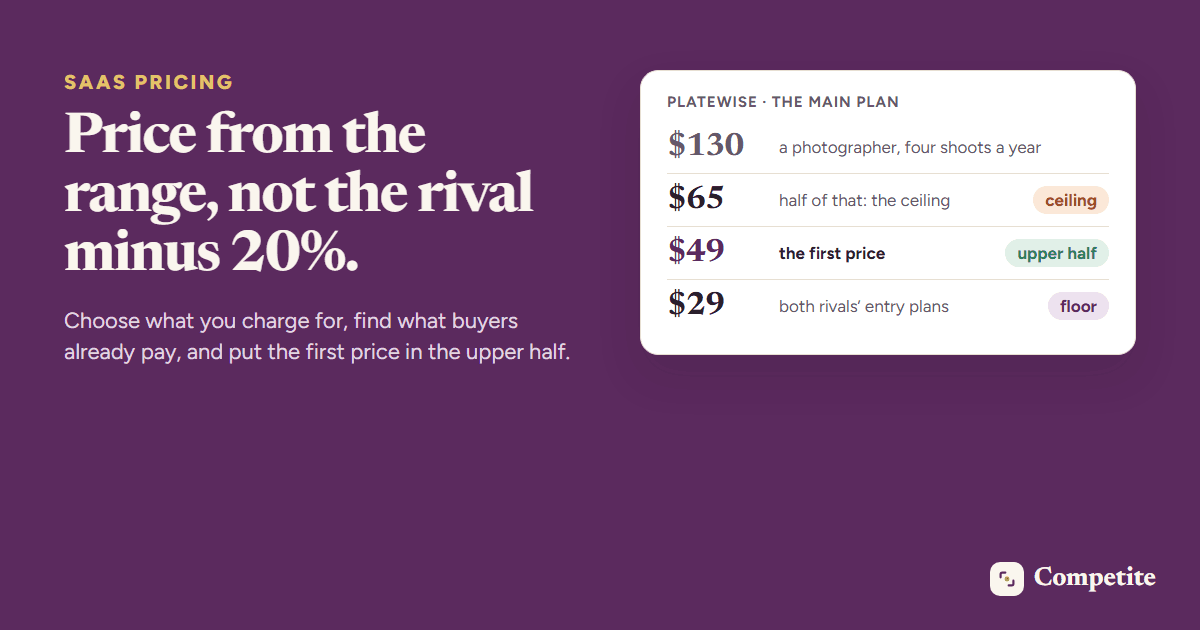
For Platewise, the floor is $29 a month, where both rivals’ entry plans sit, and Dishlumen AI’s $99 Pro plan shows how far up the category goes for heavy users. The alternative is a photographer: a restaurant quoted $400 a shoot, which it would need four times a year as the menu changes, pays about $130 a month. Half of that, around $65, is a ceiling a buyer can accept, which makes the range for the main plan $29 to $65.
For a product with no direct competitor, the second and third anchors carry the whole range, and they are usually enough. Ask five buyers what they spend on the problem now, in money and in hours, and the floor appears; ask what fixing it would be worth, and you have a ceiling to stay well under.
How much should you charge for your SaaS?
Pick a number in the upper half of the range, rounded the way prices in your category are rounded, and resist pricing a fixed share under your closest competitor. A low price reads as a weaker product, draws buyers who leave for the next discount, and is far harder to raise later than a high price is to discount.
The reflex to undercut has a cost that does not show at first. Selling at $19 against a competitor’s $39 means you need twice the customers for the same revenue, at a stage when every customer costs you hours of support. And the buyers who chose you for being cheaper are the first to leave when someone cheaper appears.
Platewise chose $49, in the upper half of its $29 to $65 range and $20 above both rivals’ entry plans. The reason has to be on the page, and here it is: photos come out sized for the delivery apps, which neither competitor offers. A price above a competitor is easy to defend when the page says what the extra money buys, and hard to defend when it does not.
A rough check before committing is the four questions of the Van Westendorp price sensitivity method, asked of ten to twenty target buyers: at what price would this be so expensive you would not consider it, expensive but still worth considering, a bargain, and so cheap you would doubt the quality? Where the answers cluster is a range you did not have to guess.
Package the price: two or three plans
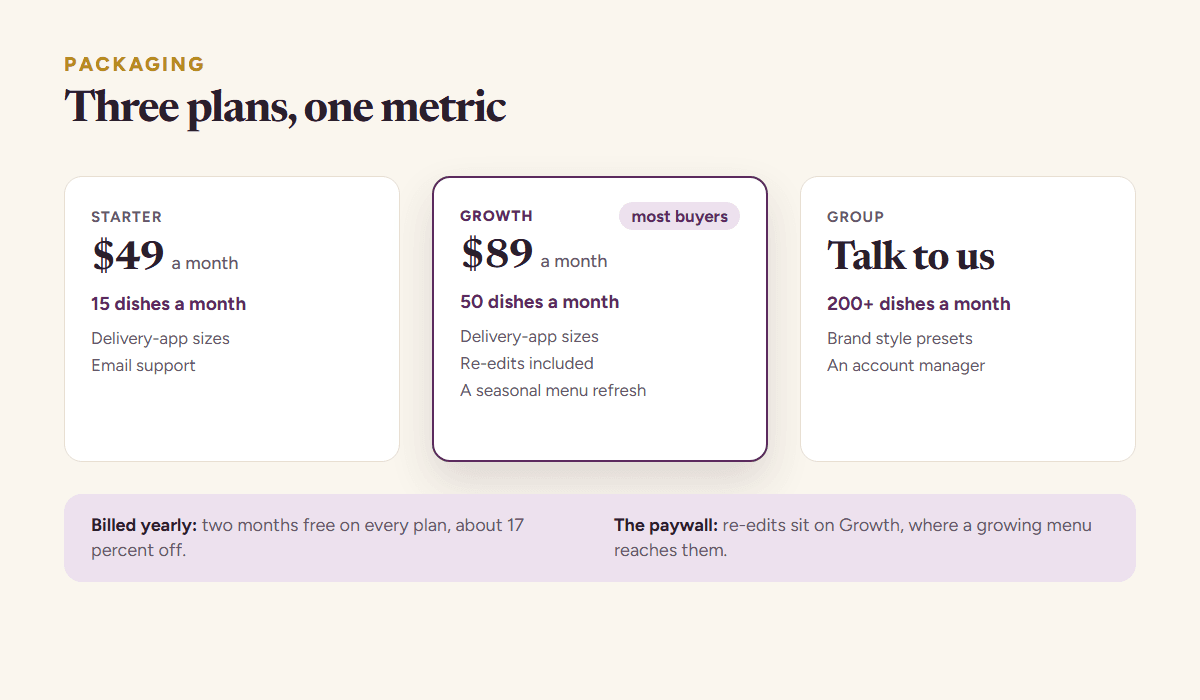
Two or three plans are enough at the start: an entry plan priced on your metric, a middle plan that is the one you want most buyers on, and if needed a top plan or a “talk to us” for buyers who need more. What sits behind each plan matters as much as its price, because it decides when a customer has a reason to upgrade.
- One metric across every plan. Plans that change the unit, per user on one and per project on the next, make buyers do arithmetic instead of choosing.
- Limits that match real buyers. Set the entry plan’s limit where a small buyer fits comfortably and a growing one does not.
- An annual price. Two months free for paying yearly, about 17 percent off, is an offer you will see on many SaaS pricing pages, and it brings cash in early, when you need it most.
- At most one plan you do not expect to sell. A top plan can exist mainly to make the middle one look reasonable; two such plans make the page look padded.
The paywall map, which feature sits on which plan, is where packaging goes wrong most quietly. Put the feature that makes a customer successful on the entry plan and nobody upgrades; put it on the top plan and nobody starts. The test is whether a customer who is getting value reaches the entry plan’s limit within a few months.
Test your SaaS price in the first 30 days
Quote the new price to the next twenty buyers and count three things: how many buy, how many say it is too expensive, and how many say not now. If nobody objects to the price, it is probably too low. If most objections are about price rather than timing or fit, it is probably too high, or the page has not made the value clear.
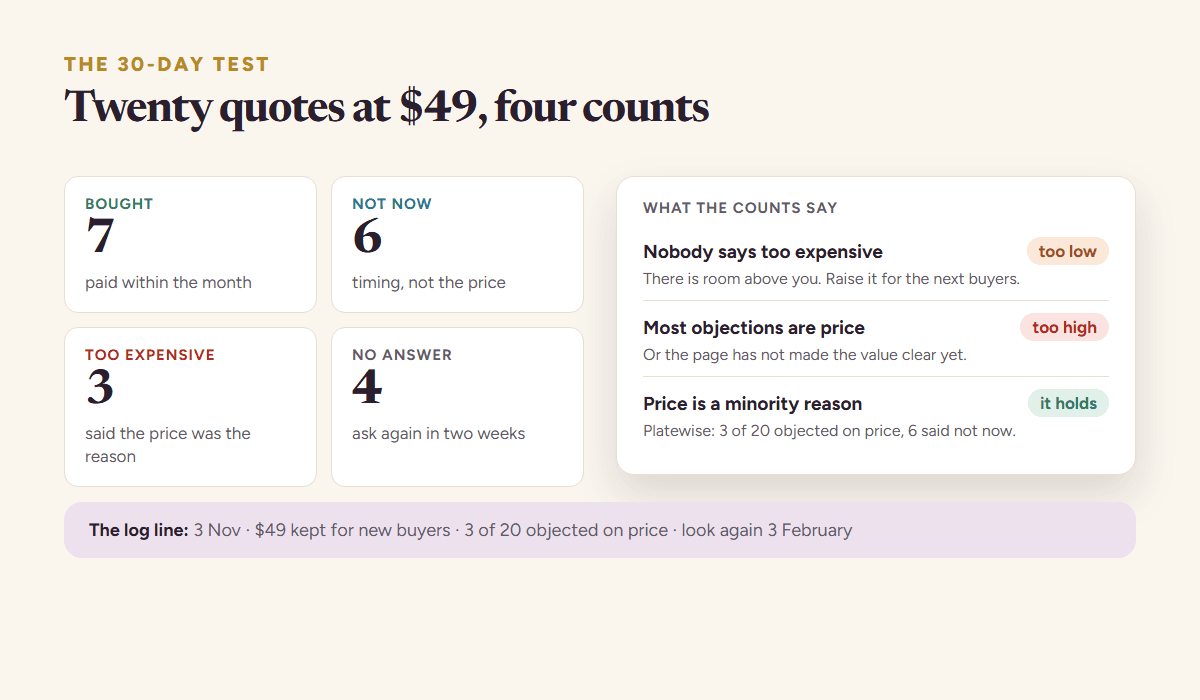
Change the price for new buyers only, and keep existing customers on the price they signed up for, at least for a while: it costs little at this stage and makes raising the price far less risky. Write each change down with the date and the reason, because six months from now you will want to know why the price is what it is.
Then look again every quarter, and whenever a competitor changes its pricing. A first price is a hypothesis, not a decision you have to live with, and a price that was right at launch can be too low a year later simply because the product does more.
When competitors change their prices
A competitor’s price change is a reason to look again, not a reason to follow. Check whether it moved your range: a cut on their entry plan can pull the floor down for buyers who compare on price, and a rise on their main plan can mean the ceiling was higher than you thought. Then decide whether your number still sits where you meant it to.
The competitor price tracking guide covers the week a competitor cuts or raises a price, and what each of the four responses costs you.
Competite does the reading: it reads the pricing pages of the competitors you confirm, writes a pricing call, what to charge, in what range and why, with the sentence from each page behind it, and emails you when a competitor’s pricing changes in a way that matters. Start free with one competitor.
Questions people ask
- How much should I charge for my SaaS?
- Somewhere in the upper half of the range set by three things: what competitors charge for the same job, what the buyer spends on the problem today, and what solving it is worth to them. Round it the way your category rounds prices, and test it on the next twenty buyers before deciding it is right.
- What is the best pricing model for a new SaaS?
- For most early products, a tiered subscription with two or three plans and one value metric across them. It is easy for buyers to understand and easy for you to change. Usage-based pricing suits products whose use varies widely between customers, and freemium suits products whose free users bring in paying ones.
- Should a new SaaS product have a free plan?
- At the start, a free trial is usually safer than a free plan. A trial shows within weeks whether people pay; a free plan is permanent, costs money to run, and can hide for months that nobody upgrades. A free plan makes sense when free users bring in paying ones, through invitations or visible use.
- How do you price a SaaS product with no competitors?
- From the other two anchors: what buyers spend on the problem today, in money and hours, and what solving it is worth to them. Ask five target buyers both questions. The first gives you a floor and the second a ceiling to stay well under. Every buyer solves the problem somehow, and that is your real competitor.
- When should you raise your SaaS prices?
- When almost nobody objects to the price, when customers reach the entry plan’s limits and stay, or when the product does clearly more than when you set the price. Raise it for new buyers first, keep existing customers on their price for a while, and write down the date and the reason.
See it on your own competitors
Add your product, or just describe the idea. Competite finds the competitors, reads their pages, and writes the comparison with a quote behind every claim. Free, in about three minutes, no card.
Keep reading
Competitor pricing analysis: how to read a pricing page like a buyer
Competitor pricing analysis in an afternoon: the eight things to read on a pricing page, how to compare plans that are not alike, and how to set your price.
15 September 2026 · 9 min read
Competitor price tracking: what to do the week a competitor cuts a price
Competitor price tracking for founders: what to watch on a pricing page, how to track it by hand or automatically, and the four moves when they cut a price.
15 September 2026 · 8 min read
Competitor analysis for startups: a founder’s guide
How to do a competitor analysis as an early-stage founder: find the real competitors, read their pricing, quote their claims, and keep it alive every week.
9 September 2026 · 8 min read
How to validate a startup idea with AI before you build it
Validate a startup idea with AI using a seven-day research plan for buyer pain, competitors, demand, pricing, interviews, and a paid test.
7 October 2026 · 7 min read
How to find competitor pricing, even when the price is not on the page
How to find competitor pricing: nine sources ranked by how far to trust them, what “contact sales” tells you, and how to record a price you can use.
25 November 2026 · 10 min read
How to detect competitor trials: when a rival changes its free trial, and what it means
How to detect competitor trials and changes to them: six terms to record, four ways to spot a change, how to tell a test from a decision, and what each means.
25 November 2026 · 10 min read