How to find your competitors, even before you have a product
, updated · 6 min read · by the Competite team
How to find competitors is the first question in any competitor analysis and the one most founders answer wrong, by naming the biggest company in the space. A competitor is the product a buyer would pick instead of yours, which is often smaller, stranger and closer than the famous one. This guide covers who counts, six ways to find them, including from an idea with no product behind it, how to score the overlap so the list is honest, and how many to keep.
Who counts as a competitor
The test is a buyer with your problem and a budget: what do they compare you with before they pay? Three kinds of answer come back, and a useful list has at least one of each.
| Kind | What it is | Example for a menu-photo product | Why it belongs on the list |
|---|---|---|---|
| Direct | the same job, the same buyer, a similar price | another AI dish-photo service | the buyer sees you side by side |
| Adjacent | a different job that solves the same need | a food photographer, a generic image editor | the buyer might not need your category at all |
| The status quo | what they do today without buying anything | a phone photo and a filter | most deals are lost to it, not to a rival |
The biggest company in the category is usually not on the list at all. It sells to a different buyer, at a different price, through a sales team you do not have. Putting it in the deck flatters the market size and ruins the analysis, because every row comes back “they have more”. Compare with the products your buyer actually shortlists.
Six ways to find competitors
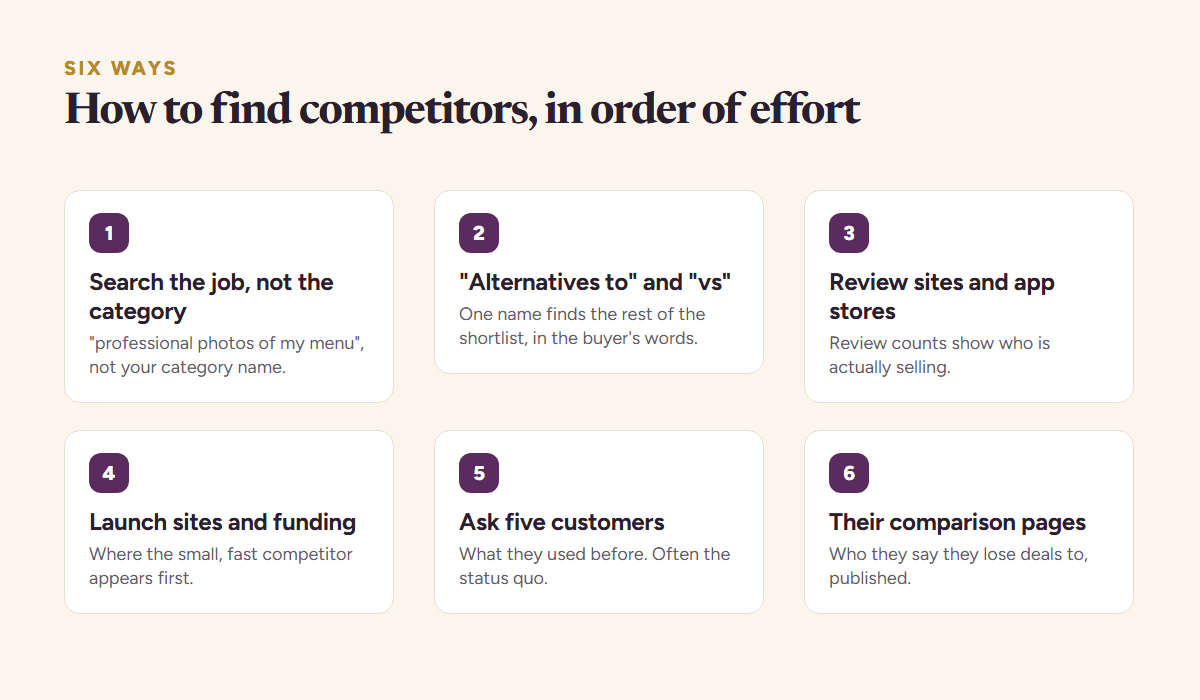
- Search the job, not the category. A buyer does not type your category name; they type the problem. “professional photos of my menu”, “make food photos look better”, “restaurant menu pictures”. The products on the first two pages, and the ads above them, are your direct competitors as the buyer meets them.
- Search “alternatives to” and “vs”. Once you have one name, search “<name> alternatives” and “<name> vs”. Comparison pages and forum threads list the rest of the shortlist for you, in the buyer’s words.
- Read the review sites and app stores. G2, Capterra and the app stores group products by category and show the count and the pace of reviews, which is a better guide to who is actually selling than any traffic estimate.
- Check launch sites and funding databases. Product Hunt and the startup directories show who launched this year; a funding database shows who has money to spend on the same buyer. This is where the small, fast competitor turns up before it ranks anywhere.
- Ask five customers what they used before. The most reliable source and the least used. The answer is often the status quo, and sometimes a product you have never heard of.
- Read who the adjacent products compare themselves with. A competitor’s own comparison pages and “switch from” landing pages name the companies they lose deals to. That list is their competitor analysis, published.
Finding competitors before you have a product
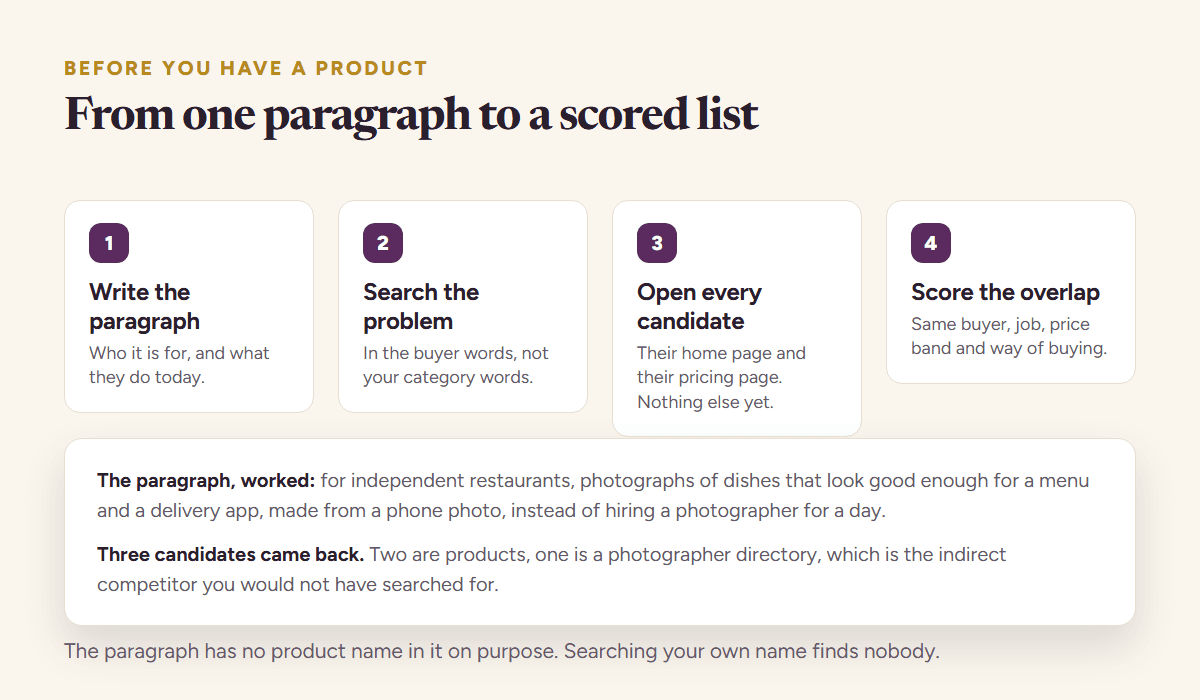
The methods above work from a product. Before one exists, the input is a paragraph: who it is for, what it does, what it would cost. Written plainly, that paragraph is enough to search from, because every method above starts from the job and the buyer, not from your name.
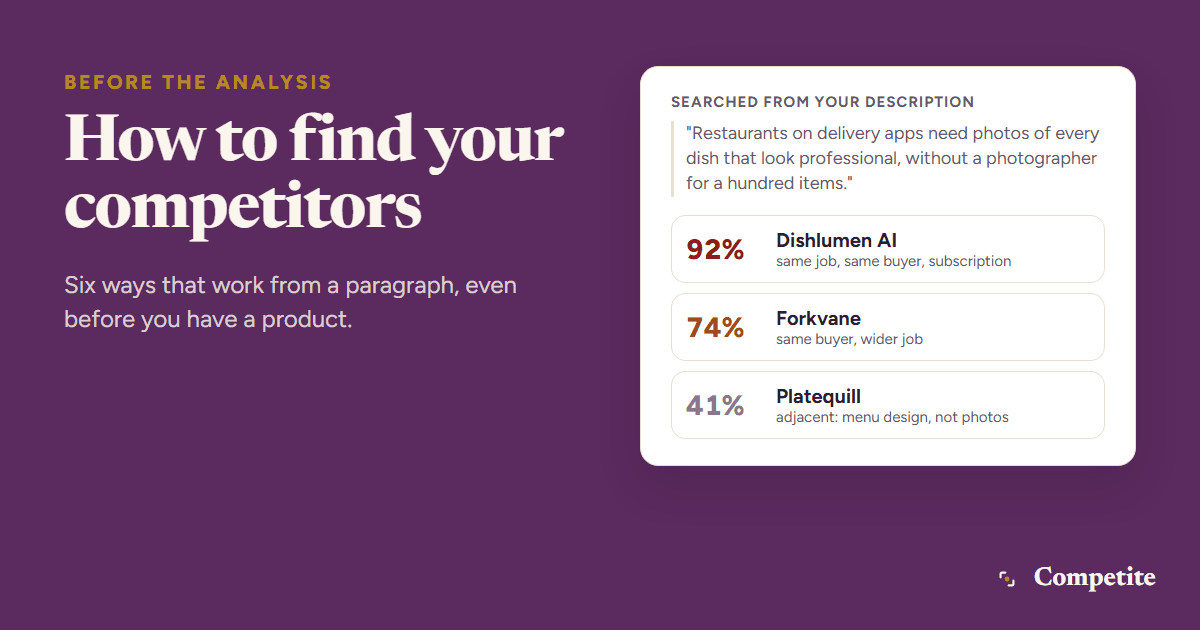
Write the paragraph the way a customer would describe the problem, not the way a pitch describes the solution. “Restaurants that sell on delivery apps need photos of every dish that look professional, and cannot afford a photographer for a hundred items” finds competitors; “an AI-powered visual commerce platform for hospitality” finds nothing. Then run the six ways with that paragraph’s words.
The output at this stage is a list of candidates, not competitors. A candidate becomes a competitor when its own pages confirm the overlap, which is the next step.
Scoring the overlap, from their own pages
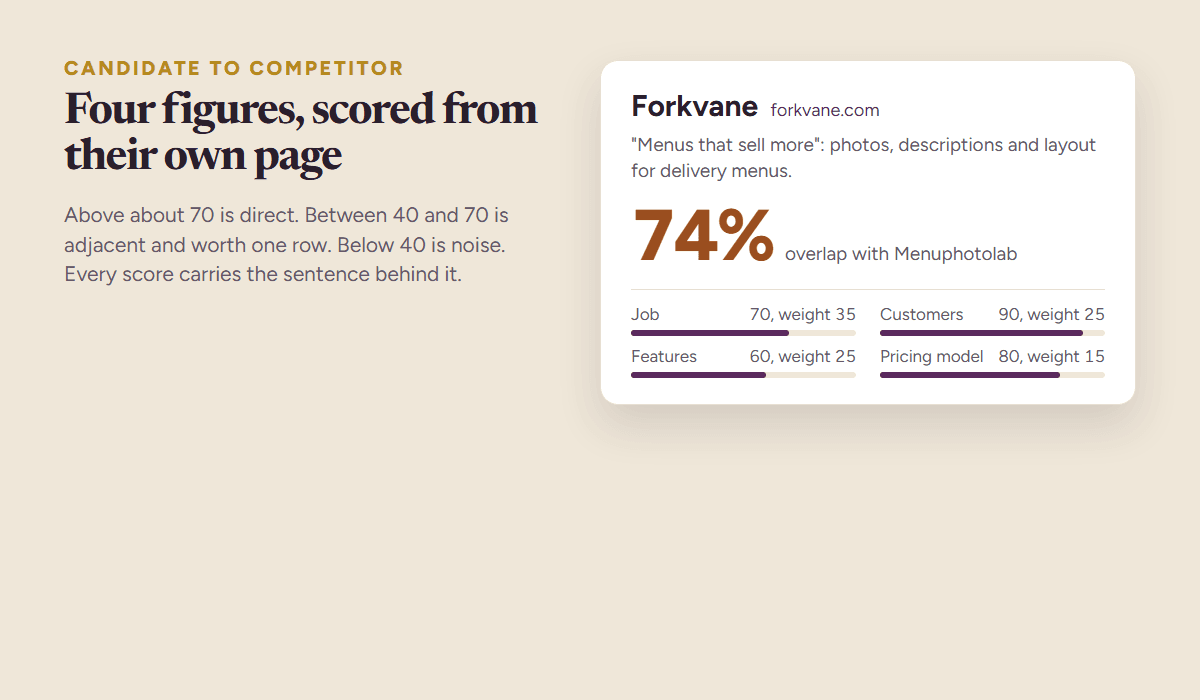
A name on a list is a guess. To keep the list honest, read each candidate’s pages and score four things, each from what the pages say rather than what you assume.
| Figure | Question | Weight | Where to read it |
|---|---|---|---|
| Same job | Does the page promise the same outcome to the buyer? | 35 | the home page headline and the first paragraph |
| Same customers | Is it written for the same kind of buyer, at the same size? | 25 | the audience line, the logos, the case studies |
| Same features | Does it do the three things your buyer cares about most? | 25 | the features page, the changelog |
| Same pricing model | Does it charge the same way, at a comparable entry price? | 15 | the pricing page, including the free tier |
Score each from 0 to 100, weight them, and the sum is the overlap. Anything above about 70 is a direct competitor; 40 to 70 is adjacent and worth one row in the analysis; below 40 is noise. The weights are a starting point, not a law: a pricing-led product should weigh the pricing model more. What matters is that every score has a sentence from the page behind it, so two people scoring the same candidate land in the same place.
How many competitors to keep
Three to five. Below three, the analysis is a comparison with one company and inherits all of that company’s quirks. Above five, nobody re-reads it, and the weekly tracking that keeps it alive becomes a job. A good list is two direct competitors, one or two adjacent ones, and the status quo written out as if it were a product, with its price (usually “free, plus your time”) and its weaknesses.
The list is not finished when it is written
New entrants launch every month and the closest competitor in a year may not exist today. Re-run the search quarterly with the same paragraph, and keep a note of who appeared. The competitor that matters most is often the one that appears on a launch site the same month you do.
What to do with the list
A list of competitors is the input to two things. The first is the one-time comparison: the competitor analysis, with the template if you want the table ready-made, and the pricing analysis as its core. The second is keeping the comparison true, which is competitor tracking.
Competite does the finding as well as the reading: describe your product in a paragraph, or give it your website, and it searches the web, drops the names that are not really competitors, scores the four figures above from each candidate’s own pages and shows the sentence behind every score. Add one with a click, confirm its pages, and the first report runs. It is free to start: describe your product and the search takes a couple of minutes.
Questions people ask
- How many competitors should a startup analyse?
- Three to five: two direct competitors, one or two adjacent products that solve the same need a different way, and the status quo written out as if it were a product. Fewer than three makes the analysis a comparison with one company; more than five stops getting re-read.
- Is the biggest company in my market my competitor?
- Usually not. It sells to a different buyer, at a different price, through a sales team. A competitor is the product your buyer would pick instead of yours, which is normally smaller and closer. Put the big company in the market-size slide, not in the analysis.
- What if I cannot find any competitors?
- Then look for the status quo and the adjacent products. Nobody has a problem worth paying for and no way of dealing with it today; the way they deal with it, a spreadsheet, a freelancer, a phone photo, is the competitor. If the search really returns nothing, the problem may not be one buyers recognise yet, which is a finding in itself.
- How do I find competitors for an idea with no product yet?
- Write one paragraph in the customer’s words: who it is for, what it does, what it would cost. Search the job that paragraph describes, then “alternatives to” the first name you find, then the review sites and launch sites. Score each candidate from its own pages before calling it a competitor.
See it on your own competitors
Add your product, or just describe the idea. Competite finds the competitors, reads their pages, and writes the comparison with a quote behind every claim. Free, in about three minutes, no card.
Keep reading
How to find the competitors of a company, from its own pages
How to find competitors of a company: six sources that name rivals, what its own pricing page gives away, and how to tell a real competitor from a long list.
17 September 2026 · 7 min read
How to identify early-stage competitors, before anyone has named the category
How to identify early-stage competitors before the category has a name: seven places a rival shows up first, and the signal that it just became direct.
19 September 2026 · 6 min read
A competitor analysis template that fits on one page, with the table
A free competitor analysis template on one page: the twelve-row table, the rules for filling it with quotes and dates, a scoring key, and a worked example.
15 September 2026 · 7 min read