Competitor analysis for startups: a founder’s guide
· 7 min read · by the Competite team
Competitor analysis for startups is not a slide with five logos on it. It is a short list of the products a buyer would pick instead of yours, what each one charges, what each one claims, and where you already win. Done properly it takes an afternoon, and it changes your price before it changes your deck.
Why most startup competitor analyses are useless
The classic version is a 2×2 matrix made for investors. Every competitor is bottom-left, you are top-right, and nobody has read a pricing page. It answers the question “are we different?” with a picture instead of evidence, and it goes stale the week it is made.
A competitor analysis that helps a founder answers narrower questions: what does a buyer see when they compare us, what do they pay elsewhere, and what happened last week that changes our answer. Those questions have sources. The competitor’s own pricing page, feature list, changelog and press releases contain almost everything you need, and each answer should carry the quote it rests on. If you cannot point at the sentence on their site, you are guessing.
The five questions a competitor analysis must answer
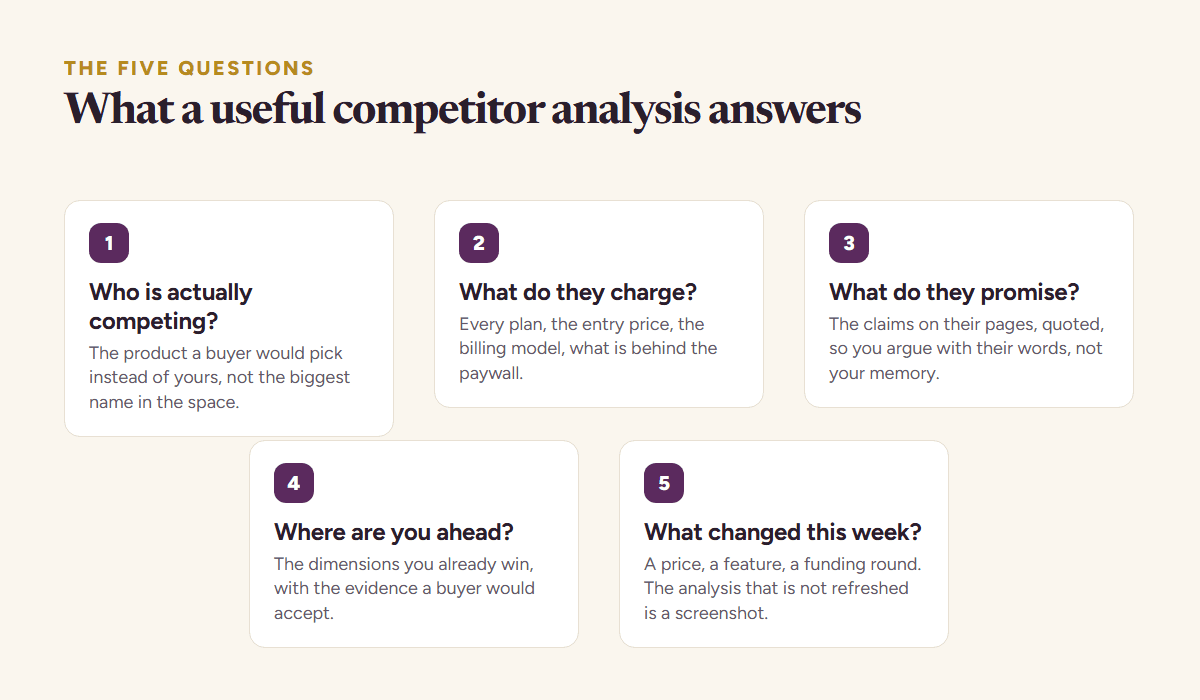
- Who is actually competing? The products a buyer shortlists against yours, which is rarely the biggest name in the category.
- What do they charge? Every plan, the entry price, the billing model, and what sits behind the paywall.
- What do they promise? Their headline, their feature claims and their audience, quoted from their pages.
- Where are you ahead? The dimensions you win today, with evidence a buyer would accept.
- What changed this week? A price, a feature, a funding round. An analysis that is not refreshed is a screenshot.
Step 1: find the competitors a buyer would actually pick
Start from the job, not the category. A buyer looking for “menu photos for a delivery listing” does not search for “AI food photography platform”; they search for the job in their own words. Search that phrase, look at what ranks, look at the ads, then check the “alternatives to” pages and the review sites (G2, Capterra, the app stores) for the names that keep appearing. Ten minutes of this produces a list of ten to fifteen names.
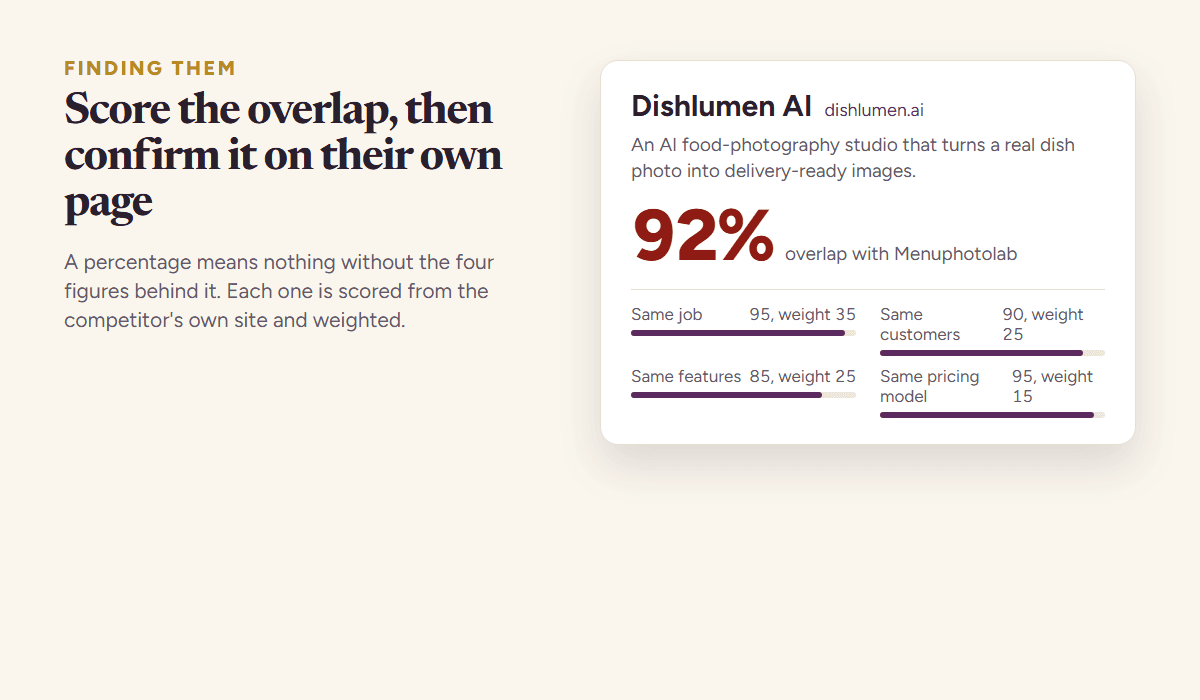
Then cut it. Open each candidate’s own site and score four things: do they do the same job, do they sell to the same customers, do they have the same core features, and do they price the same way. A competitor that scores high on the job and the customers but sells enterprise contracts is not your competitor this year. Three to five direct competitors is the right number for an early-stage product; more than that and the analysis becomes a spreadsheet nobody reads.
Step 2: read their pricing page like a buyer
Pricing is where a competitor analysis earns its keep. Write down, for each competitor: the entry price (the cheapest paid plan, not the free tier), the billing model (subscription, one-time, usage, seats), the annual discount, what the free tier withholds, and which features are behind the top tier. Write the numbers exactly as their page states them, with the date. “Starter, $39 a month, billed monthly, 25 photos” is a fact; “they are cheaper” is not.
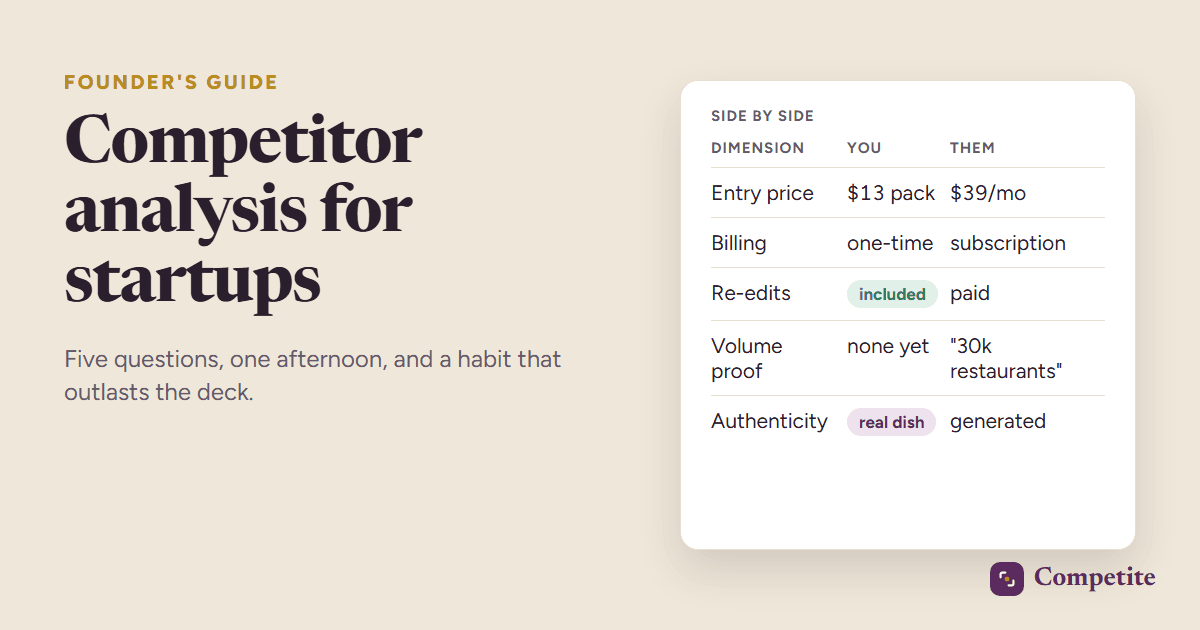
Now place yourself on that ladder. If their cheapest paid plan is $39 and your one-time pack is $13, a buyer sees a cheap way to try you and no way to keep paying you. That is not a positioning problem, it is a packaging problem, and it is the kind of thing a competitor analysis is supposed to surface. A pricing call at this stage usually reads like “keep the $13 pack as the entry point, add a monthly plan at $29 to $35, and sit visibly under their $39 Starter”, with the quotes from both pages beside it.
Write the quote, not the summary
Every price and every claim in the analysis should be a quote from the competitor’s page with the date you read it. When the page changes, and it will, you will know exactly what moved. This is the difference between an analysis and an opinion.
Step 3: quote their claims, then check them
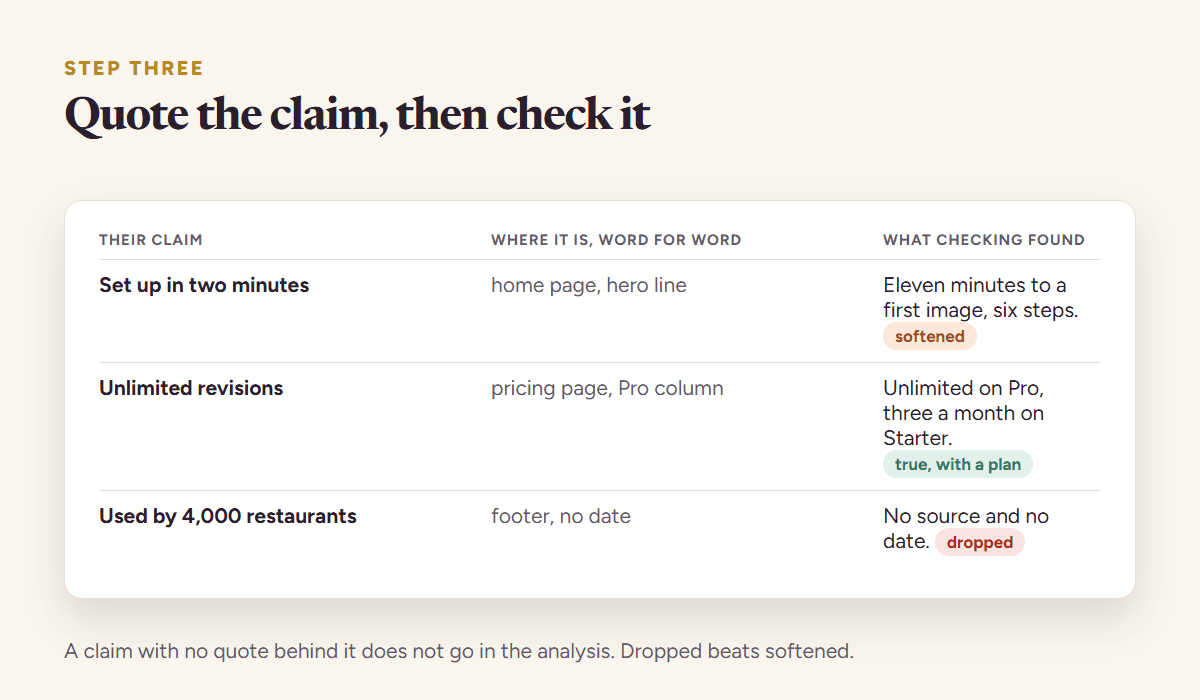
Their headline tells you who they think they are for. Their feature page tells you what they think matters. Their proof (“30,000 restaurants”, logo walls, case studies) tells you how they sell. Quote all three. Then check the claims a buyer would test: sign up for the free tier, run the core workflow once, and note where the promise and the product diverge. Two hours in a competitor’s product teaches more than a week of reading about it.
| Dimension | You | Them | Verdict |
|---|---|---|---|
| Entry paid price | $13 one-time pack | $39 a month | you are cheaper to try, they earn more |
| Billing model | one-time | subscription | they have recurring revenue |
| Re-edits | included | paid per edit | you are ahead |
| Volume proof | none yet | “30,000 restaurants” | they are ahead |
| Authenticity | real dish photo required | generated images | you are ahead with the right buyer |
Step 4: find where you are ahead, with evidence
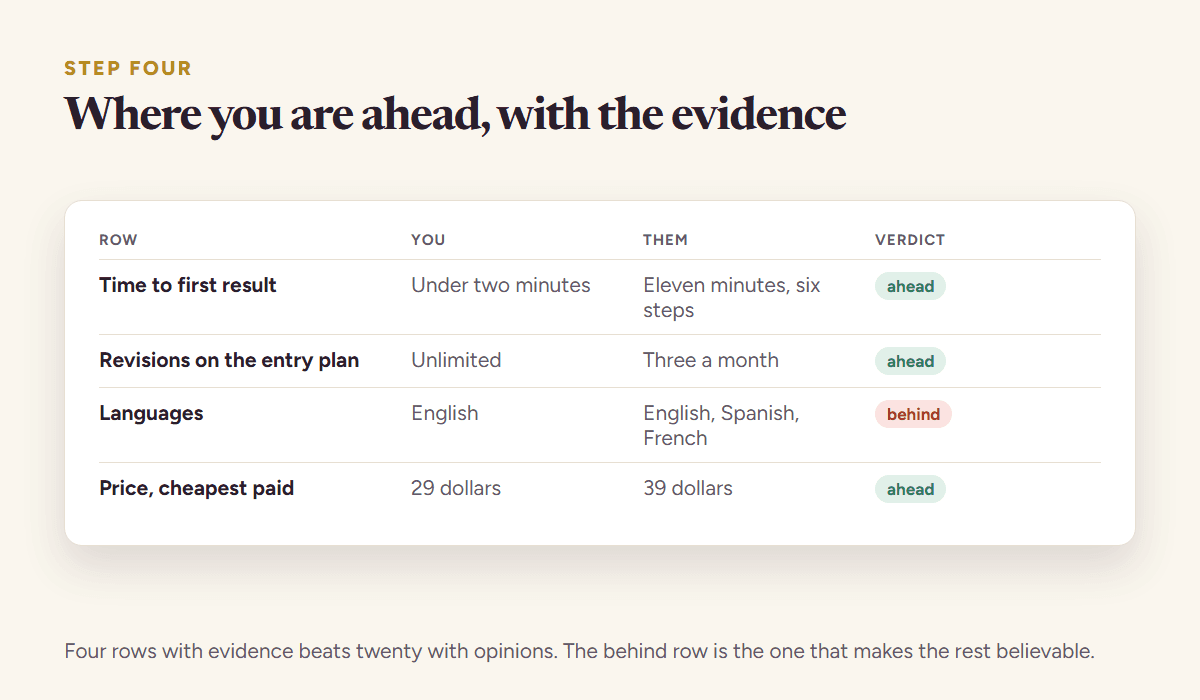
A scorecard like the one above is the whole deliverable. Each row is one dimension a buyer compares, your side and theirs in their own words, and a verdict. Resist the urge to invent rows you win. Three honest rows where you are ahead, backed by quotes, are worth more than ten rows of adjectives, because they become your landing page copy and your sales answer.
The rows where they are ahead matter just as much. “They have volume proof and we do not” is a task, not a weakness to hide: get three customers to say something quotable and the row flips.
Step 5: keep it alive every week
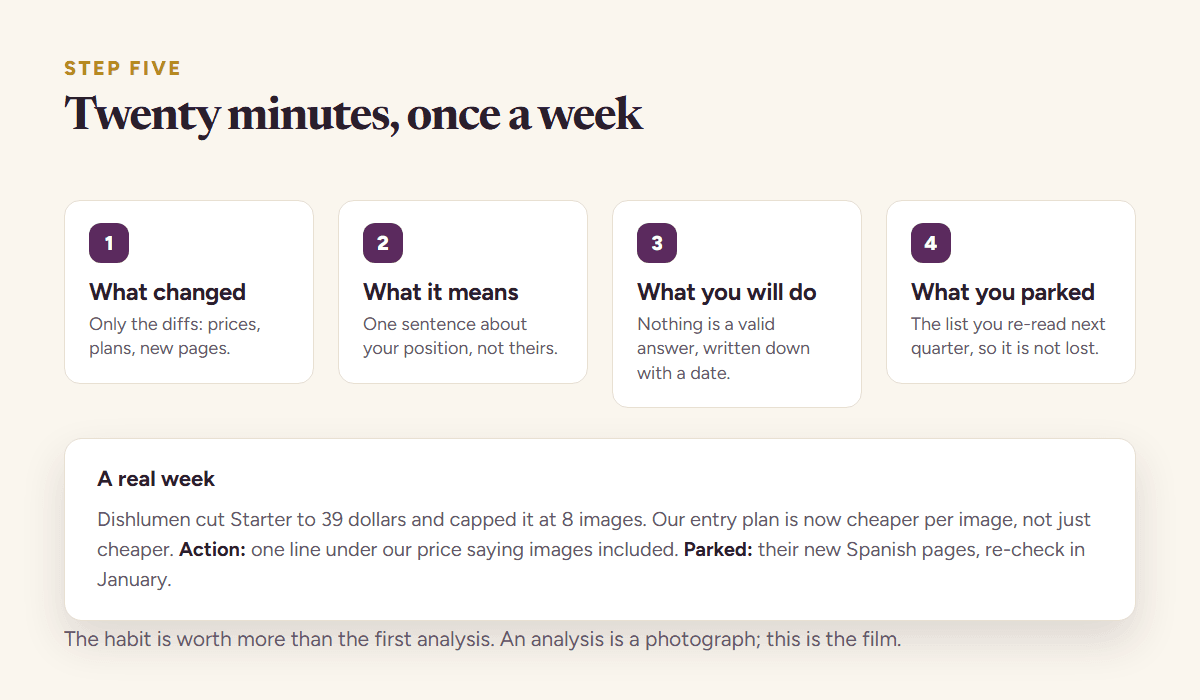
Pricing pages change more often than founders expect, funding rounds land on a Wednesday, and a competitor’s changelog is the most honest roadmap you will ever read. A competitor analysis that is refreshed weekly stays a decision tool; one that is refreshed at the next board meeting becomes a history document. Put the pricing, features and changelog pages of each competitor on a weekly re-read, keep a note of what changed and when, and re-check your pricing call when a price moves.
This is the part that does not fit in a founder’s week, which is why it is the part that gets automated. Competite reads the pages you confirm every week, follows funding, launches and press beyond the site, writes the comparison with a quote behind every claim, and emails you only when something changes. The first report is free: add your product or describe the idea, confirm a competitor, and it comes back in about three minutes.
A template you can copy
- Header: your product, the competitor, the date read, the pages read (pricing, features, changelog, careers).
- Overlap: same job, same customers, same features, same pricing model, each scored 0 to 100 with a sentence of why.
- Pricing ladder: every plan on both sides, entry price, billing model, annual discount, paywalled features, quoted.
- Scorecard: five to eight dimensions, you and them, verdict, evidence.
- Pricing call: one sentence, a range, and the two quotes that justify it.
- Next steps: three actions, each with an effort estimate and the row of the scorecard it changes.
- Changes since last time: what moved, when, and whether it changes the call.
Mistakes that make the analysis worthless
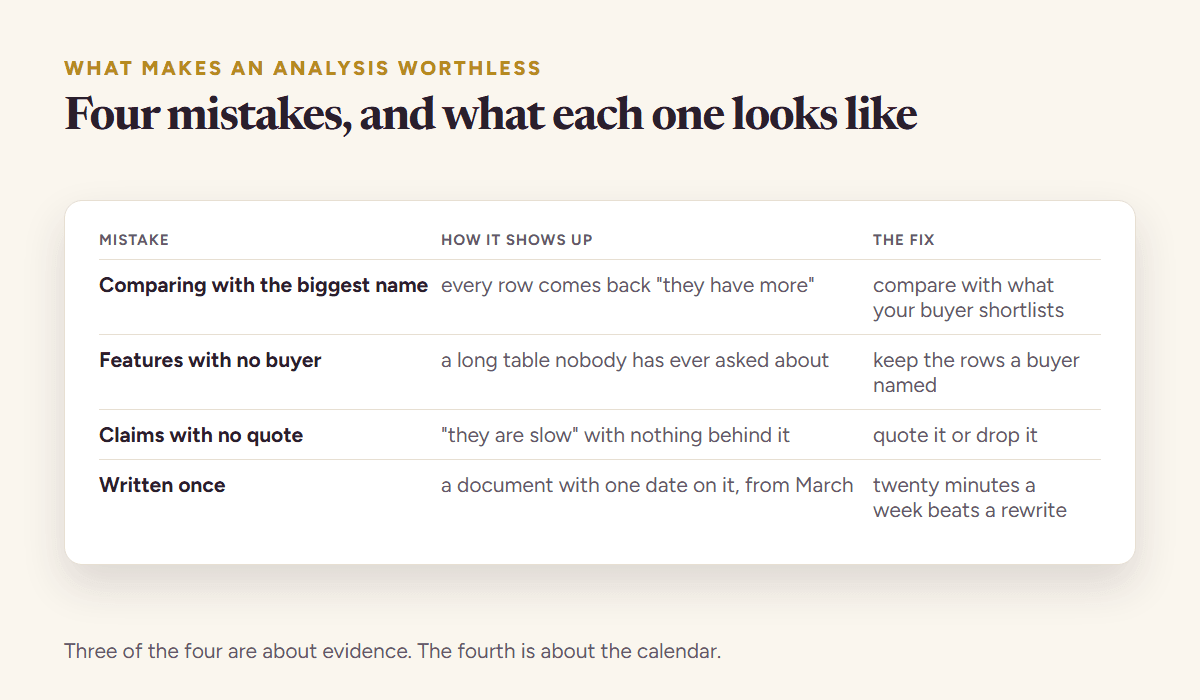
- Comparing yourself to the category leader instead of the product a buyer actually shortlists.
- Writing “they are expensive” instead of the number, the plan and the date.
- Inventing scorecard rows you win and skipping the ones you lose.
- Reading a competitor’s marketing instead of using their product for two hours.
- Doing it once. The pricing page you copied in March is wrong by June.
Questions people ask
- How many competitors should a startup analyse?
- Three to five direct competitors, chosen by overlap: the same job, the same customers, similar features, a similar pricing model. Keep a longer list of ten to fifteen names for the annual review, but track only the ones a buyer would actually shortlist against you.
- How often should a competitor analysis be updated?
- Pricing and feature pages weekly, positioning monthly, funding and press as they happen. Weekly is the cadence at which a price change still changes your decision; quarterly is history.
- Can I do a competitor analysis before I have a product?
- Yes, and it is the best time. Describe the idea in a few sentences, find the products that do the same job today, read their pricing and their claims, and you will know the price band and the packaging you are walking into before you write code.
- What is the difference between competitor analysis and competitor tracking?
- Analysis is the comparison at one moment: who they are, what they charge, where you stand. Tracking is the habit of re-reading the same pages every week and noticing what changed. The first without the second goes stale in weeks.
See it on your own competitors
Add your product, or just describe the idea. Competite finds the competitors, reads their pages, and writes the comparison with a quote behind every claim. Free, in about three minutes, no card.
Keep reading
Competitor tracking: how to monitor competitors’ prices, features and funding every week
Competitor tracking for founders: the six signals to monitor, how often each one moves, where they live, and what a good alert looks like.
9 September 2026 · 6 min read
Competitor analysis tools in 2026: which kind you actually need
The five kinds of competitor analysis tools, what each answers, who it is for and what it costs, from traffic estimators to founder-focused tracking.
9 September 2026 · 6 min read