How to find competitors’ customers: eight public sources, and what to do with them
· 10 min read · by the Competite team
How to find competitors’ customers has a better answer than most founders expect: a competitor publishes some of them itself, and the rest leave traces in reviews, marketplaces, job adverts and their own websites. Twenty or thirty names show who a rival really sells to, which is often not who its home page says. This guide covers eight public sources, how to test a customer count, a worked example and where the legal line sits.
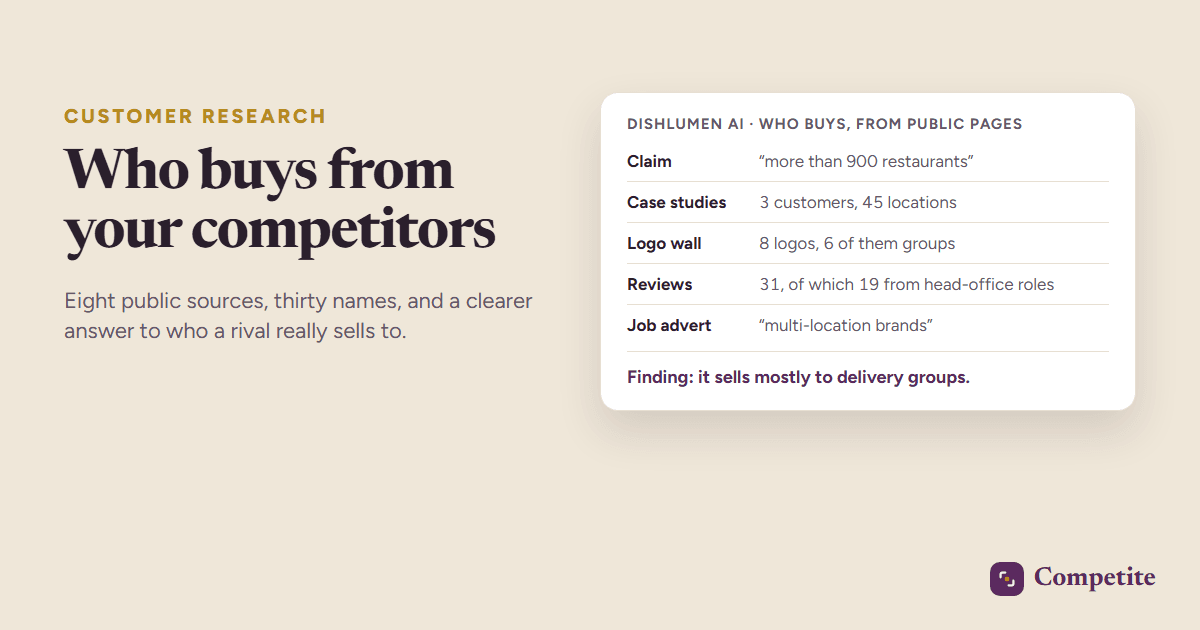
Can you find out who your competitors’ customers are?
In part, and the part you can find is the useful part. No public source holds the full customer list of a private company. But a rival names some customers on its own site, and others appear in reviews, marketplaces and job adverts. Twenty or thirty names show the pattern: what kind of company buys, at what size, and why.
| What you want to know | Can public sources answer it? | Where |
|---|---|---|
| Who they sell to: industry, size, role | yes | case studies, review sites |
| Which named companies use them | some of them | their site, marketplaces, job adverts |
| How many customers they have | a band, not a number | their claim, against what can be counted |
| The full list, contract values, renewals | no | not public, and not worth the ways of getting it |
How to find competitors’ customers: eight public sources
Eight sources, in order of how much each tells you for the time it takes: the competitor’s own case studies and logos, review sites, marketplace reviews, partner directories, job adverts, footprints on customers’ websites, press releases and talks, and public-sector contract awards. The first two usually produce most of the sample inside an hour.
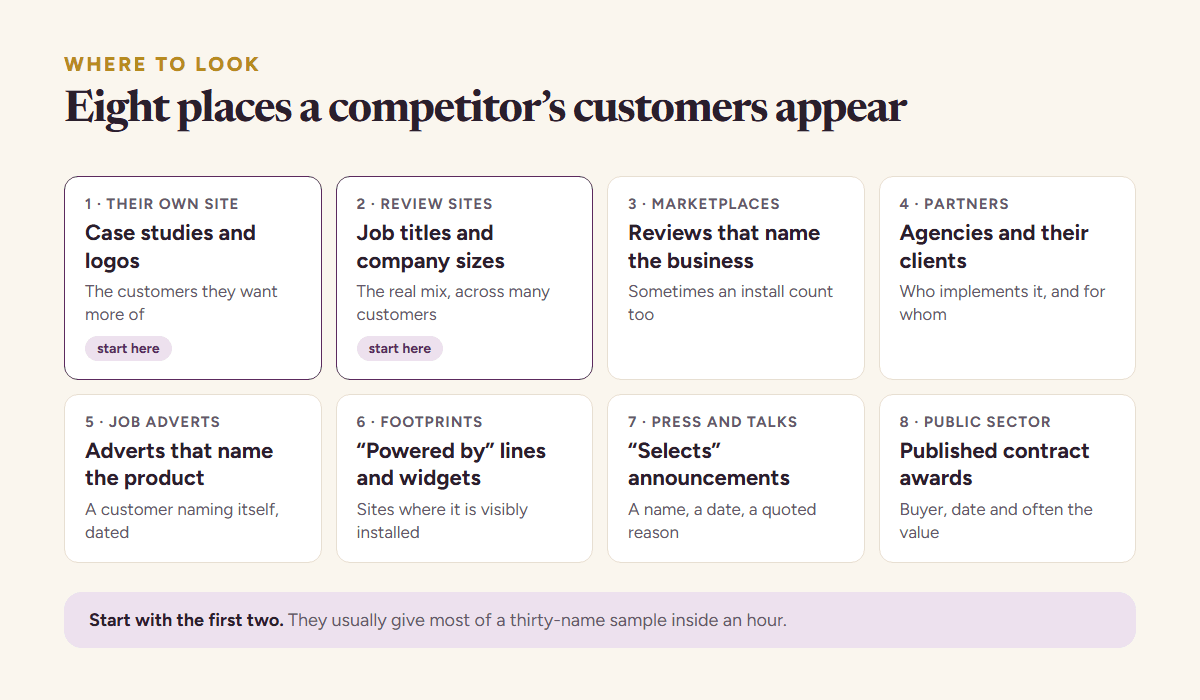
- Their own case studies and logos. Read the customers page, the case studies and the logos under the headline. Note each name with its industry, its size and the date. A case study that names the tool a customer left has also named a rival: see how to find the competitors of a company.
- Review sites. As of November 2026, a review on G2 shows a job title or an industry with a company-size band, and Capterra shows job title, industry and number of employees. Sort fifty reviews by size.
- Marketplace and app-store reviews. Reviews in a marketplace often name the business: in the Shopify App Store they show the store’s name and country. A printed install count is the nearest thing to an independent customer number.
- Partner and integration directories. Agencies and resellers on a competitor’s partners page publish their own client work. One that rolled the product out for a named client has named a customer.
- Job adverts that name the tool. Search a job site for the product name in quotation marks. An advert asking for experience with it is a customer naming itself, with a date.
- Footprints on customers’ own websites. Search for the “powered by” line a product leaves on its customers’ sites. Technology lookup services such as BuiltWith detect tools from a site’s public code, automatically and imperfectly.
- Press releases and conference talks. An announcement that a company “selects” or “chooses” a vendor names a customer, a date and a reason. So does a customer speaking at the vendor’s event.
- Public-sector contract awards. USAspending.gov lists United States federal awards by recipient, and the European Union’s TED publishes the results of tenders, usually with the winner. Search the vendor’s legal name.
| Source | What you learn | The caveat |
|---|---|---|
| Case studies and logos | the customers they want more of, and why each bought | chosen by marketing: the best, not the typical |
| Review sites | job title, industry and company size across many customers | reviews are often invited, sometimes rewarded |
| Marketplace reviews | named businesses, sometimes an install count | only customers who came through that marketplace |
| Partner directories | which agencies sell it, and to whom | a partner’s client may have used it once |
| Job adverts | companies using it today, and which team | large companies advertise more |
| Website footprints | sites where the product is visibly installed | nothing behind a login; can be out of date |
| Press releases and talks | a named customer, a date, a quoted reason | only deals large enough to announce |
| Public-sector awards | the buyer, the date and often the value | public bodies only |
The source that beats all eight
Your own conversations. A prospect who says “we use them today” and a customer who came from a rival know what a logo wall cannot tell you: what they paid and why they left. Count the names in your last ten lost deals. A rival’s customers are also the best source when you need to find competitor pricing that no page shows.
How do you check a competitor’s customer count?
Ask what the number counts, then set it against what you can count yourself. “More than 900 restaurants” could mean paying accounts, locations, sign-ups or everyone ever served. Named customers, review totals and install figures give a floor. The honest result is a band with the claim quoted beside it, not a single number.
- The unit. Customers, users, locations and sign-ups are different numbers, and “trusted by” counts everyone ever. A vendor picks the largest figure that is true: a restaurant group with twenty sites is one customer and twenty restaurants.
- What can be counted. Named customers, review totals, an install count: each is a floor, since only some customers are named or leave a review.
- The history. The Internet Archive’s Wayback Machine keeps dated copies of many public pages. The same number a year ago means the claim is not updated, or the base is not growing.
Write the claim down as a quote with its date, beside the band you would defend. Competitive benchmarking covers which competitor numbers can be read from a page and which are guesses.
A worked example: who really buys from Dishlumen AI?
Forkvane, the fictional menu-photo product used across this blog, sells to independent restaurants and has 40 of them. Its closest rival, Dishlumen AI, says “more than 900 restaurants” on its home page. An hour with the sources above produced the sheet below, and a different picture of who the 900 are. Every company and customer named is invented.
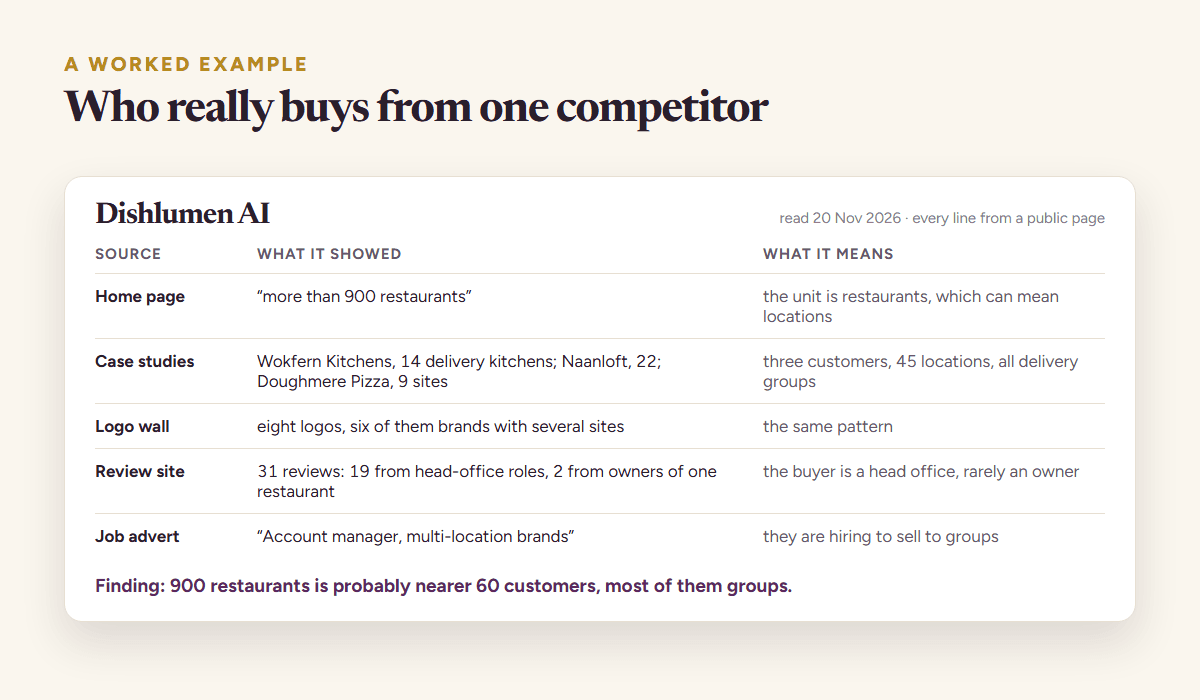
| Source | What it showed | What it means |
|---|---|---|
| Home page | “more than 900 restaurants” | the unit is restaurants, which can mean locations |
| Case studies | Wokfern Kitchens, 14 delivery kitchens; Naanloft, 22; Doughmere Pizza, 9 sites | three customers, 45 locations, all delivery groups |
| Logo wall | eight logos, six of them brands with several sites | the same pattern |
| Review site | 31 reviews: 19 from head-office roles at companies of 11 to 200 people, 2 from owners of one restaurant | the buyer is a head office, rarely an owner |
| Job advert | “Account manager, multi-location brands” | they are hiring to sell to groups |
The finding is in the unit. If the rest of the base looks like the three case studies, about fifteen locations each, 900 restaurants is around sixty customers; if most are single sites, it is closer to 900. The reviews and the hiring point to the first, so Forkvane wrote down “60 to 900 customers, probably nearer 60”.
It changed two things. Forkvane stopped setting its 40 owners against a headline of 900, and it rewrote its home page line to say who it is for, because Dishlumen AI’s proof speaks to head offices.
What do you do once you know who their customers are?
Use it to decide who you are for. The sample shows the segment a competitor really serves, the segment it leaves open, and the reasons customers gave for choosing it. Those change your positioning, your proof and sometimes your price. It is research for your home page, not a list of people to email.
- Name the segment they really serve. Sort the sample by industry, size and the role that bought, and set it beside the audience their home page claims.
- Find the segment they leave open. Look for who is missing: a size, an industry, a kind of buyer. Whether a rival with a different buyer still counts as direct is covered in direct vs indirect competitors.
- Collect the switch stories. Case studies say what a customer used before and why it moved; two-star and three-star reviews say why somebody would leave.
- Compare proof like for like. Set your customers against theirs in the same unit. Where you are ahead, with evidence, is step four of a competitor analysis for startups.
- Put it on the record. One line per competitor: who they sell to, the evidence, the date. It fits the proof row of a competitor audit and a column in your competitor list.
It is not an outreach list, and not only for the legal reasons below: a company that has just bought from a rival is the least likely buyer this year. Better prospects look like those customers and have bought nothing yet.
Is it legal to research a competitor’s customers?
Reading what a company and its customers have published is ordinary research. The line is crossed in three places: collecting people’s contact details, pretending to be someone you are not, and using a list that was never public. This is general guidance and not legal advice, and the rules differ by country.
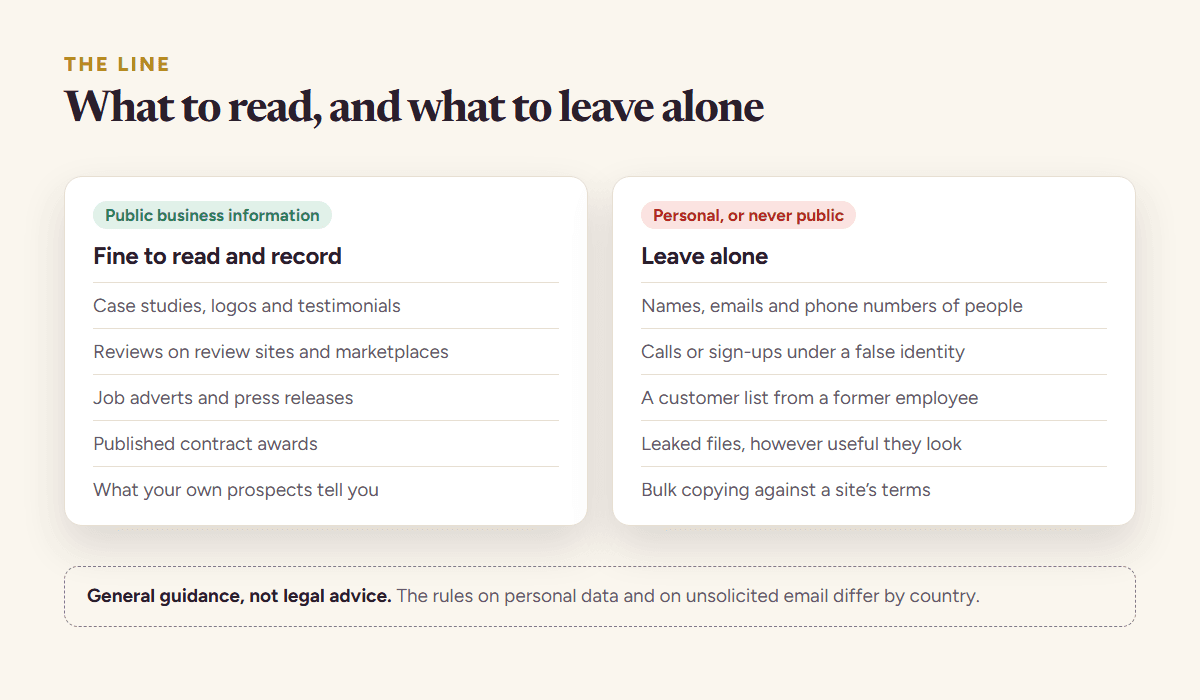
- Personal data. A company name on a logo wall is business information. The name, email address or phone number of a person who works there is personal data, and laws such as the GDPR in the European Union and its United Kingdom equivalent govern how it is used.
- False pretences. Calling a competitor’s customer as a “researcher”, or posing as a buyer to be sent a reference list, is getting information by deception.
- Lists that were never public. A customer list brought by a new hire from a former employer, or found in a leaked file, is confidential and often protected as a trade secret. Do not accept it.
Stay with what companies have published, read review sites within their terms, keep the page and the date for each fact, and none of this arises.
How often should you look again?
Once a quarter, and whenever a competitor changes its headline. Customers are added to a site a few at a time, and a run of new case studies from one industry is among the earliest public signs that a rival is moving into it, often before the home page says so.
The quarterly pass is short: re-read the customers page, read the new reviews, and compare the logos with an archived copy of the page, since a logo that disappears is sometimes a customer that left. Where this sits in a weekly routine is covered in competitive intelligence for startups.
Competite does the part of this that sits on a competitor’s own pages. On the pages you confirm, it reads the customer logos a competitor shows and its numeric claims, such as a customer count, keeps each claim with the sentence it came from, and its reports quote them. On the Build and Launch plans it also scans the open web for a competitor’s partnerships, launches, funding and press coverage, monthly on Build and weekly on Launch, each with its source. It does not build customer lists, look anyone up or read anything behind a login, and a change in the logos shown is treated as noise, not as an alert. Start free with one competitor.
Questions people ask
- How do I find out who my competitors’ customers are?
- Start on the competitor’s own site: its case studies, logos and testimonials name the customers it is proudest of. Then read its reviews on a software review site, where a review usually shows a job title, an industry or a company size.
- Can I get a full list of a competitor’s customers?
- Not from public sources, and not safely from anywhere else. A private company’s full customer list is confidential, and often protected as a trade secret. What is public is a sample: the customers a rival names, the ones who review it and the ones whose job adverts mention it.
- How many customers does my competitor have?
- Usually you can only bracket it. Quote the number the competitor claims, check whether it counts customers, users, locations or sign-ups, and whether it means everyone ever or today. Then set it against named customers, review totals and marketplace install figures, and write down a band with the date.
- Is it legal to contact a competitor’s customers?
- Selling to a company that buys from a rival is ordinary competition. What is regulated is how you got the contact and what you say: personal contact details fall under data protection law such as the GDPR, unsolicited email has its own rules in most countries, and false statements about a competitor can be unlawful. This is general guidance, not legal advice.
- How do I win customers from a competitor?
- Learn why customers chose the rival and why some leave: both are in its case studies and its two-star and three-star reviews. Then say plainly who your product is for, make switching cheap, and show proof from customers like the one in front of you.
See it on your own competitors
Add your product, or just describe the idea. Competite finds the competitors, reads their pages, and writes the comparison with a quote behind every claim. Free, in about three minutes, no card.
Keep reading
How to find the competitors of a company, from its own pages
How to find competitors of a company: six sources that name rivals, what its own pricing page gives away, and how to tell a real competitor from a long list.
17 September 2026 · 9 min read
Competitive benchmarking: the metrics worth tracking, and the ones that lie
How to benchmark against competitors without inventing numbers: which metrics are readable, which are modelled guesses, and how often each one actually moves.
26 September 2026 · 7 min read
A competitor audit in one day: the checklist, and what it costs to have one done
How to run a competitor audit in a day: what to read on each competitor, a six-part checklist, what the audit should produce, and what a paid audit costs.
15 November 2026 · 7 min read
How to find competitor pricing, even when the price is not on the page
How to find competitor pricing: nine sources ranked by how far to trust them, what “contact sales” tells you, and how to record a price you can use.
25 November 2026 · 10 min read
A competitor list template: what to record about each rival, with a filled example
A free competitor list template: the twelve columns to record for each rival, how many names to keep, a filled example, and a CSV for Sheets or Excel.
25 November 2026 · 10 min read