Competitor analysis tools in 2026: which kind you actually need
· 6 min read · by the Competite team
There is no best competitor analysis tool, because “competitor analysis” is five different jobs sold under one name. Traffic estimators answer how big a competitor is. SEO suites answer which keywords they rank for. Enterprise intelligence platforms arm a sales team. Page watchers tell you a URL changed. And a founder’s tool answers what to charge and what moved this week. This guide sorts the tools by the job so you buy the one that answers your question.
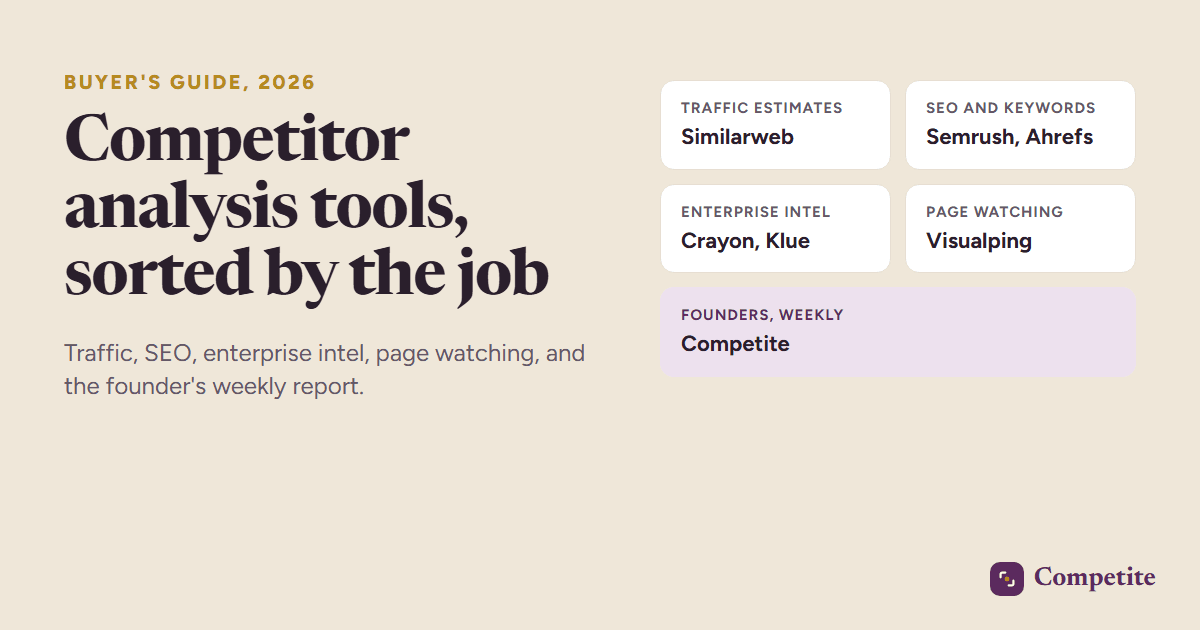
The five kinds of competitor analysis tools
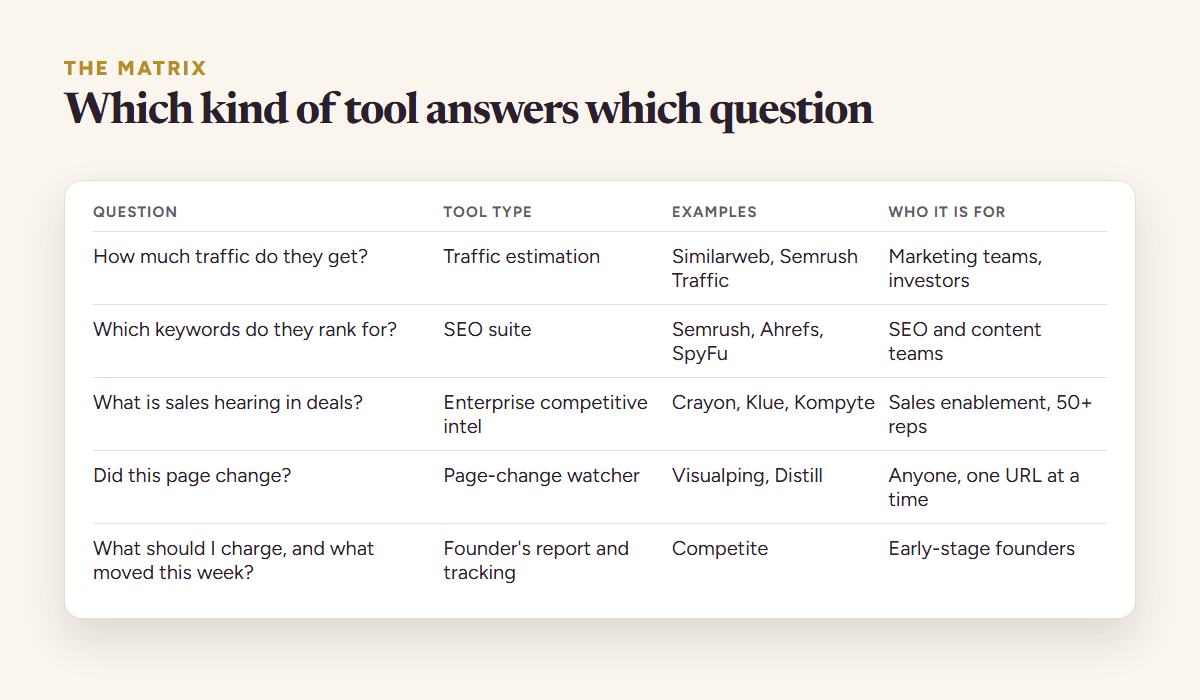
1. Traffic estimators
Similarweb and Semrush’s Traffic and Market are the names here. They model a site’s visits, sources and audience from panels and clickstream data. They answer “how big are they” and “where does their traffic come from”. Independent tests put their error at roughly 50 percent on average, closer on large sites and unreliable below a few thousand visits a month, which is where most early-stage competitors live. Self-serve plans start around the low hundreds of dollars a month; API access is an enterprise contract. Right for marketing teams and investors sizing a market; wrong for a founder with three small competitors.
2. SEO suites
Semrush, Ahrefs and SpyFu answer “which keywords do they rank for, and which backlinks do they have”. They are excellent at that job and it is a real job, if search is a channel you are investing in. They do not read a pricing page, they do not notice a funding round, and their “traffic” numbers are search-only estimates. Plans start around $100 to $140 a month. Right for content and SEO teams; a distraction for a founder still deciding what to charge.
3. Enterprise competitive intelligence
Crayon, Klue and Kompyte monitor a wide set of signals (site changes, pricing, job postings, news, review sites) and turn them into battlecards for sales teams. Crayon and Klue are quoted per company and typically land in the tens of thousands of dollars a year; Kompyte, now part of Semrush, has a lower entry tier. They are built for a company with a sales floor and a product-marketing manager who owns the battlecards. Right for 50 or more reps; heavy for a team of four.
4. Page-change watchers
Visualping and Distill watch a URL and tell you when it changed. They are cheap, some have a free tier, and they work on any page. What they do not do is tell you what the change means: a watcher fires on a copy tweak and on a price cut with the same enthusiasm, and it never reads a press release. Right as a backstop on two or three pricing pages; not an analysis on their own.
5. Founder-focused competitor tracking
The newest category answers the founder’s two questions, what to charge and what moved this week, and does it with the competitor’s own pages as evidence. Competite is our entry: it finds the competitors that overlap with your product, reads the pricing, features and changelog pages you confirm every week, follows funding and launches beyond the site, writes a comparison with a quote behind every claim and a pricing call, and emails you only when something changes. It starts free with one competitor and the paid plans are $49 and $99 a month. Right for an early-stage founder with three to fifteen competitors; wrong for a sales team that needs battlecards or a marketer who needs keyword data.
What none of them do well: small competitors
Every traffic and SEO tool has the same blind spot: a competitor with two thousand visits a month produces too little data to model. Their number is either missing or invented. For a founder, the competitors that matter most are often exactly that size. The honest signals for a small competitor are on their own pages (pricing, plans, customer claims, the careers page, the changelog) and on the review sites (count and velocity). A tool that reads pages sees them; a tool that models panels does not.
Six questions to ask before you pay
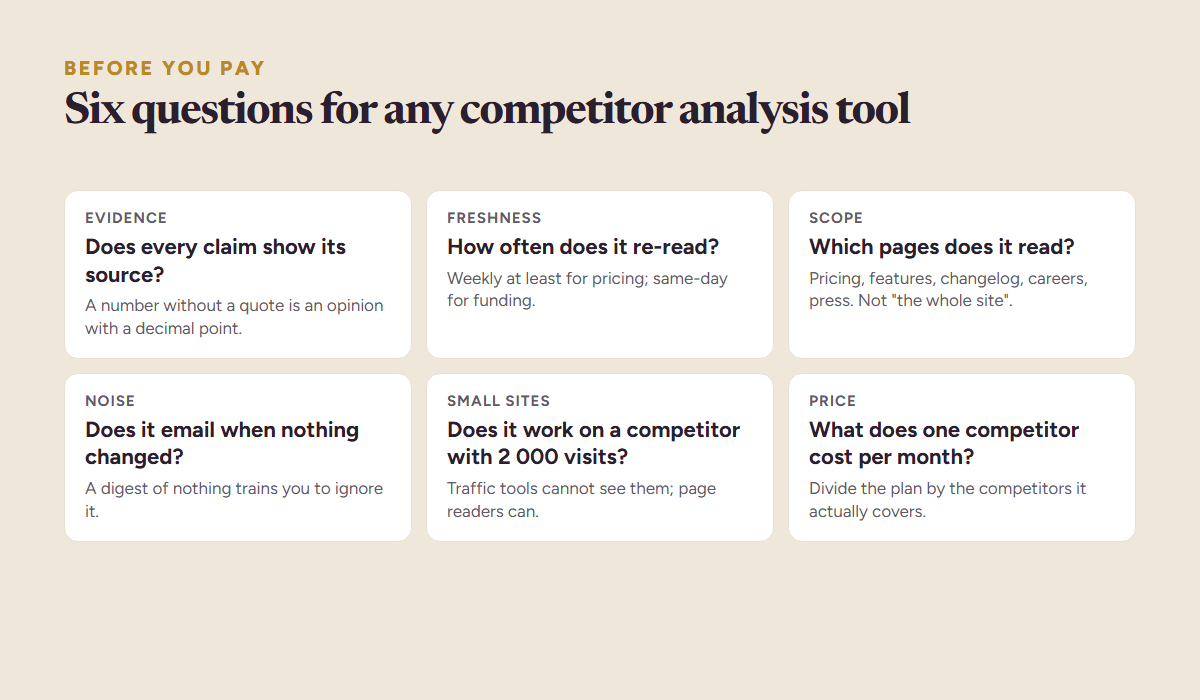
- Does every claim show its source? A number without a quote is an opinion with a decimal point.
- How often does it re-read? Weekly at least for pricing; the same day for funding.
- Which pages does it read? Pricing, features, changelog, careers, press. “The whole site” means none of them carefully.
- Does it email when nothing changed? A digest of nothing trains you to ignore it.
- Does it work on a competitor with 2,000 visits? Ask for a demo on your smallest competitor, not on Notion.
- What does one competitor cost per month? Divide the plan by the competitors it actually covers; the answer ranges from cents to hundreds of dollars.
How to combine them
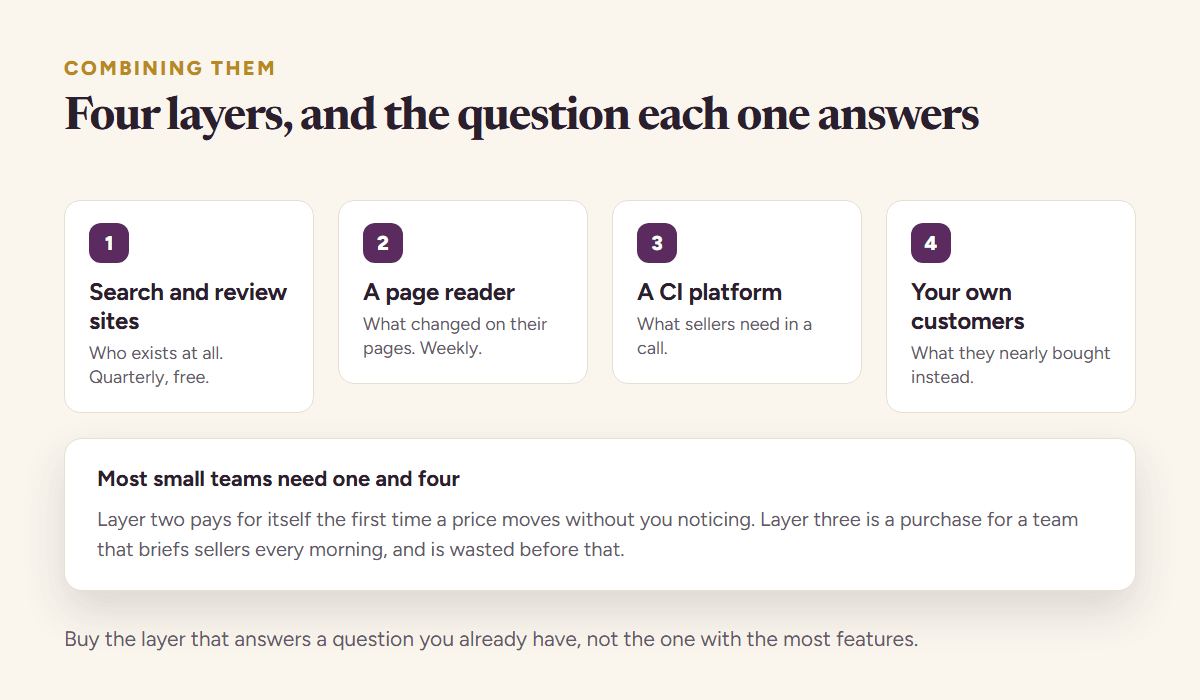
Most teams need two tools, not five. A founder before product-market fit needs the founder’s tracker and, if search matters, a month of an SEO suite to map the keywords. A marketing team at a growing company adds a traffic estimator for market sizing. A sales-led company with a real floor adds Crayon or Klue when the battlecards become a full-time job. Buying the enterprise tool first is the most common mistake in this category, and the second is buying a page watcher and calling it competitor analysis.
| You are | Start with | Add later |
|---|---|---|
| a founder before product-market fit | a founder’s tracker (Competite) and your own reading | an SEO suite for one month if search is a channel |
| a marketer at a growing product | an SEO suite | a traffic estimator for market sizing |
| a sales-led company with a floor | enterprise intel (Crayon, Klue) | a founder’s tracker for the pricing signal |
| anyone watching two pages | a page-change watcher | nothing, until it fires on a copy tweak |
Prices move; check the page
The price bands above were read from the vendors’ pages in September 2026. Every one of them changes, which is rather the point of this site. Treat them as bands and confirm on the vendor’s pricing page before you decide.
If the question you are trying to answer is “what should I charge, and what did they do this week”, the tool is the smallest one on this list. Start with a competitor analysis, keep it alive with weekly tracking, and run the first report free to see what the evidence looks like.
Questions people ask
- What is the best free competitor analysis tool?
- For a small competitor, the competitor’s own pricing page, changelog and careers page, read weekly, beat any free tool. Google Alerts on the company name and a page-change watcher with a free tier cover the rest. Competite’s free plan reads one competitor monthly and writes one report a month with the quotes behind it.
- How accurate are Similarweb and Semrush traffic estimates?
- Independent tests put the average error of the major estimators near 50 percent, better on large sites and unreliable below a few thousand visits a month. Treat their numbers as a band, and do not use them for a competitor smaller than that.
- Do I need Crayon or Klue as a startup?
- Almost never before you have a sales team. They are built to route competitive intelligence into live deals and cost tens of thousands of dollars a year. A founder needs the pricing signal and the weekly change, which a much smaller tool provides.
- What should a competitor analysis tool show as evidence?
- The exact sentence from the competitor’s page or press release, with the date, next to every claim and every number. If a tool cannot show the quote, you cannot check it, and you cannot argue with it in a pricing discussion.
See it on your own competitors
Add your product, or just describe the idea. Competite finds the competitors, reads their pages, and writes the comparison with a quote behind every claim. Free, in about three minutes, no card.
Keep reading
Competitor analysis services: what they cost, and when to buy one
What competitor analysis services cost, from a 300 dollar audit to 30,000 a month, what lands in the deliverable, and the three times it is the wrong purchase.
19 September 2026 · 7 min read
Competitor analysis for startups: a founder’s guide
How to do a competitor analysis as an early-stage founder: find the real competitors, read their pricing, quote their claims, and keep it alive every week.
9 September 2026 · 7 min read
Competitor tracking: how to monitor competitors’ prices, features and funding every week
Competitor tracking for founders: the six signals to monitor, how often each one moves, where they live, and what a good alert looks like.
9 September 2026 · 6 min read