A competitor audit in one day: the checklist, and what it costs to have one done
· 7 min read · by the Competite team
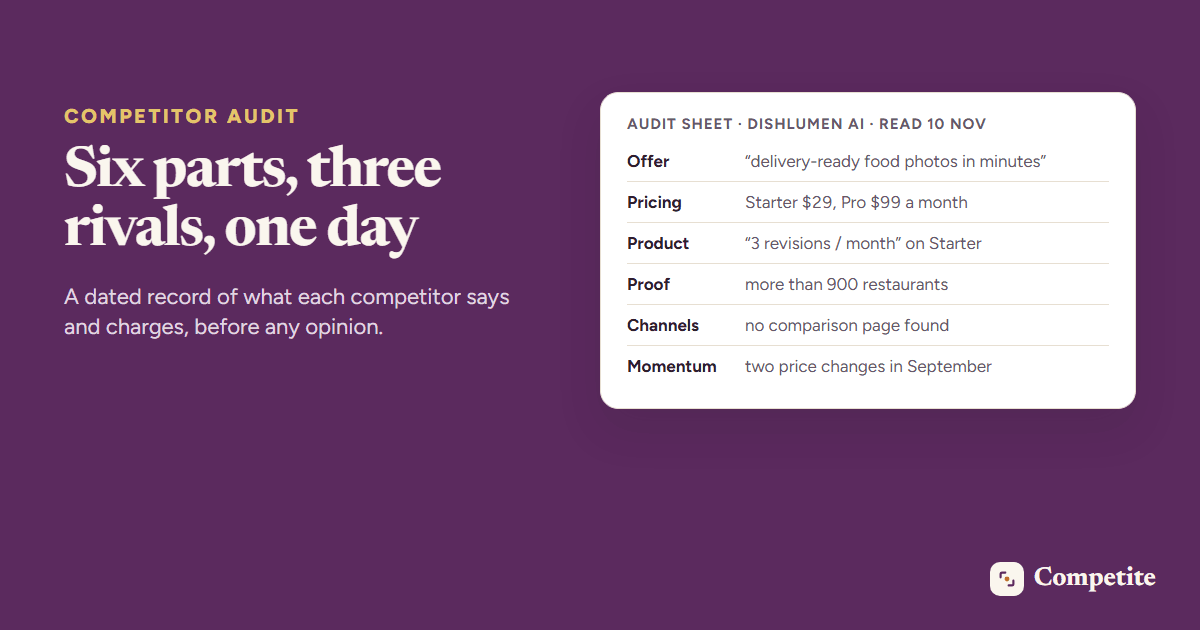
A competitor audit is a dated, evidence-first read of what each competitor says and charges in public today. It is the part of competitor analysis that comes before any opinion: what is on their pages, quoted, with the day you read it. This guide covers what an audit includes, a six-part checklist, how to finish one for three competitors in a day, what it should produce, and what it costs if you pay somebody to do it.
What is a competitor audit?
It is a systematic read of each competitor’s public pages, written down as facts with their sources: the offer, the prices, the features, the proof, the channels and what changed lately. An audit records and an analysis decides. Keeping the two apart is what stops a conclusion from being written first and the evidence found to fit it.
| Competitor audit | Competitor analysis | Competitor tracking | |
|---|---|---|---|
| What it is | a dated record of what each rival says and charges | what that record means for your price and your product | noticing when the record changes |
| How often | once, then each quarter | after each audit, and before a decision | every week |
| What it produces | one sheet per competitor, with quotes | a short list of decisions | alerts worth acting on |
A market landscape audit is the same work at a wider angle: more names, fewer rows for each, and a map at the end instead of a sheet per competitor. Competitive landscape analysis covers the map; this guide stays with the close read of three to five rivals.
What does a competitor audit cover? The six-part checklist
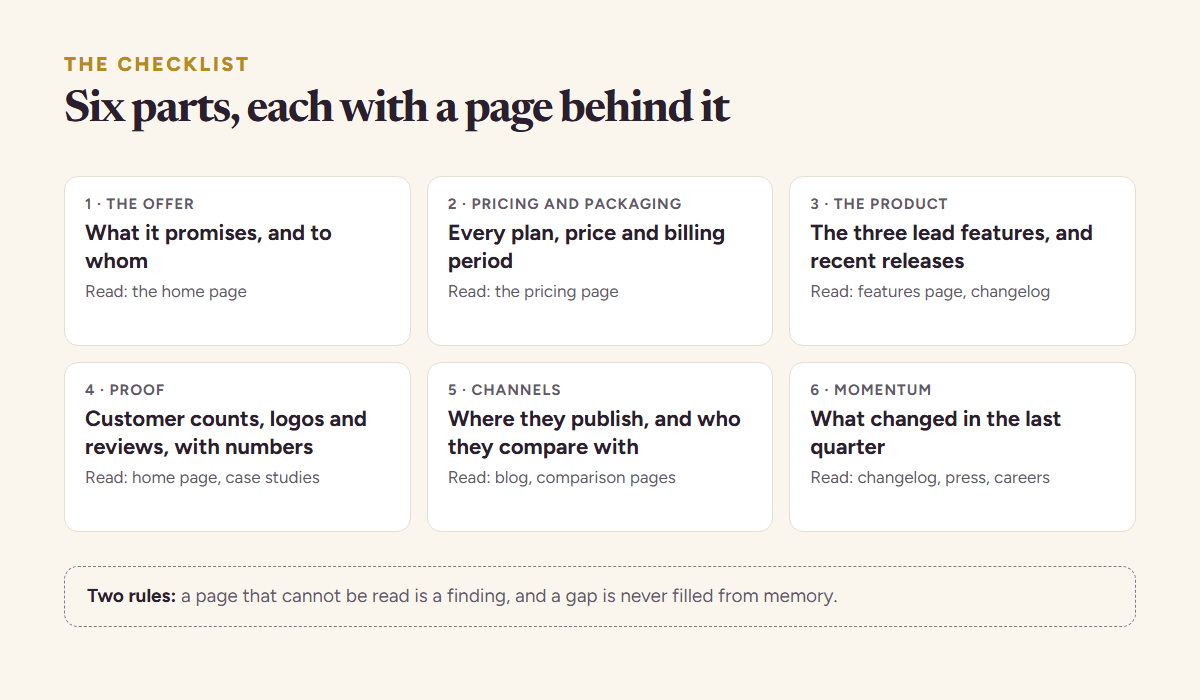
Six parts, each answered from a page you can link to: the offer, pricing and packaging, the product, proof, channels, and momentum. Every answer is a quote or a number with its source and the date, never a summary from memory. Six parts for three competitors is eighteen short answers, which is why an audit fits in a day.
| Part | What to record | Where to read it |
|---|---|---|
| 1. The offer | the headline promise and who it says it is for, quoted | home page |
| 2. Pricing and packaging | every plan, its price and billing period, and what the free tier withholds | pricing page |
| 3. The product | the three features the pages lead with, and what was released lately | features page, changelog |
| 4. Proof | customer counts, named logos and review counts, with the numbers | home page, case studies, review sites |
| 5. Channels | where they publish, and what they compare themselves with | blog, comparison pages, newsletter |
| 6. Momentum | what changed in the last quarter: prices, plans, funding, hiring | changelog, press page, careers page |
The rows overlap on purpose with the competitor analysis template, which holds the same facts side by side once the audit is done. The audit is the collecting; the template is where the collected facts are compared.
Two rules keep it honest. If a page cannot be read, because it sits behind a login or says “contact us” where a price should be, write that down as the finding. And never fill a gap from memory: an empty cell is information, and a remembered price is a guess that looks like a fact.
How do you run a competitor audit in a day?
Give it a fixed shape: half an hour to choose three competitors and open their pages, an hour and a half on each, and an hour at the end to write what you found. The time limit matters more than the tool. An audit with no deadline becomes a research project, and a research project is out of date before it is finished.
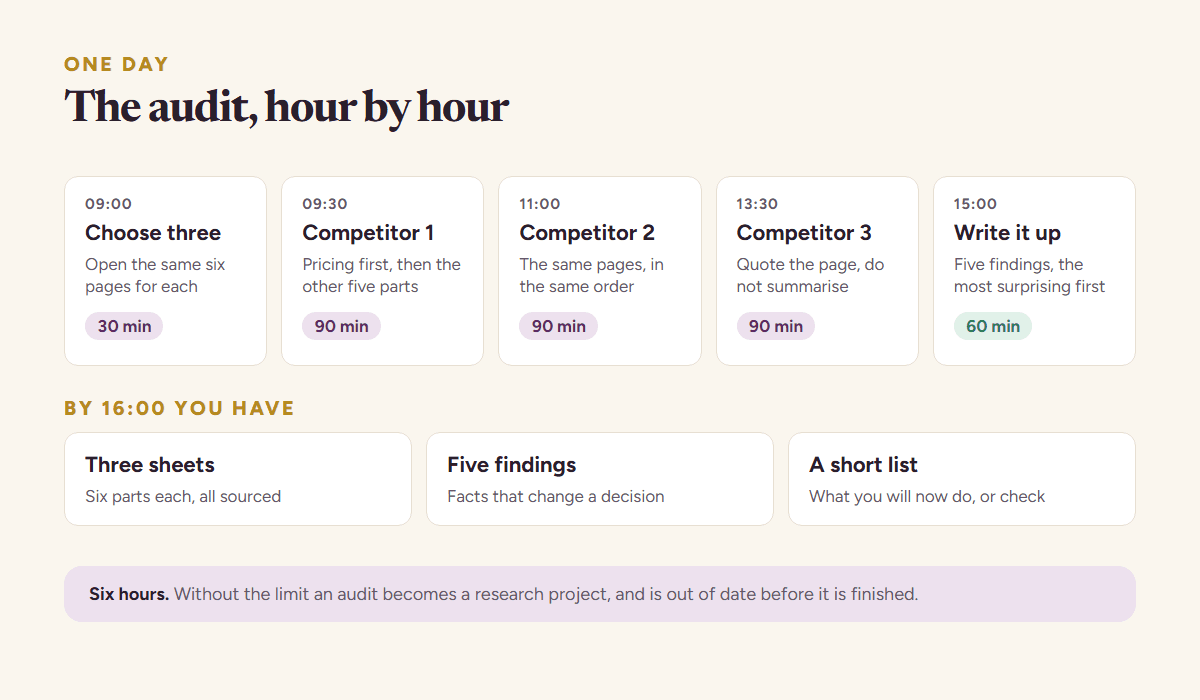
- Choose three, and write why. The rivals buyers actually pick, not the biggest names. Primary, secondary and tertiary competitors covers how to rank a longer list.
- Open the same pages for each. Home, pricing, features, changelog, one comparison page, careers. The same six for every competitor, so the sheets can be laid side by side.
- Read pricing first. It is the page most likely to change your own decision, and competitor pricing analysis covers what to read on it.
- Quote, do not summarise. Copy the sentence and note the page. A summary is already an opinion.
- Date every sheet. The audit describes one day. Without the date, nobody can tell later whether a fact was wrong or has changed since.
- Write five findings. One line each, the most surprising first. If nothing surprised you, the audit confirmed what you knew, which is also a result.
What should a competitor audit produce?
Three things: one sheet per competitor with the six parts filled in and sourced, a single page of five findings, and a short list of what you will now do or check. Anything longer is not read. The sheet is the evidence, the findings are what changed your mind, and the list is the reason the day was worth spending.
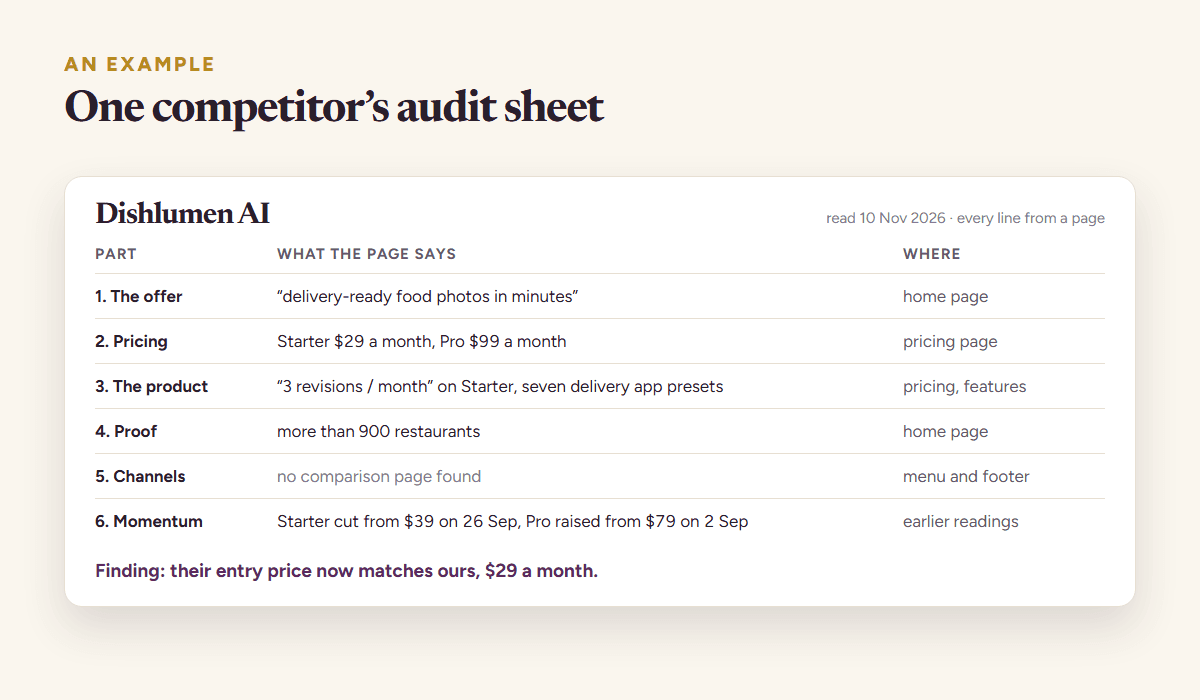
A finding is a fact that changes a decision, written so that somebody who was not there can check it: “Dishlumen AI cut its Starter plan from $39 to $29 a month on 26 September, so our entry price is no longer below theirs.” A statement such as “their pricing is aggressive” is an impression, and it does not belong on the page.
From there the work passes to analysis: what to charge, what to build, what to say. Competitor analysis for startups covers the five questions the findings should answer, and a competitor analysis example runs the whole method on one company.
What does a competitor audit cost?
Done yourself, about a day for three competitors, or half that for a first rough pass. Bought, the figures published in September 2026 start at about 300 dollars for a one-off audit of three competitors delivered in around 72 hours, and a research firm’s report on a wider market runs from 5,000 to 15,000 dollars. The price follows who does the reading and how wide the field is.
| Route | What it costs | What you get | When it fits |
|---|---|---|---|
| Do it yourself | about a day for three competitors | the sheets, and the knowledge of having read the pages | most early teams, most of the time |
| A one-off audit from a service | from about 300 dollars for three competitors | a report in around 72 hours | a decision with a deadline and no day to spare |
| A research firm report | 5,000 to 15,000 dollars | a wide landscape, usually with interviews | a board paper, a fundraise, a new market |
The figures, and what arrives for each, are set out in competitor analysis services. The part worth paying for is the part you cannot do from a desk: interviews with buyers who chose somebody else. The desk reading is the part to keep, because whoever reads the pages is the one who learns the market.
How often should a competitor audit be repeated?
Once a quarter, on the same pages, with the last audit open beside it. Between audits the facts keep moving, and most of what changes is on two pages: pricing and the changelog. Those two deserve a weekly read, which is tracking, not auditing. The quarterly audit resets the whole record; the weekly read keeps the part of it that matters current.
The second audit is where the method pays off. Laid beside the first, it shows what each competitor changed in three months, which says more about where they are going than any single reading. Competitive benchmarking covers comparing two readings taken ninety days apart.
Competite does the reading between audits. It reads the pricing, features and changelog pages you confirm for each competitor on a schedule, keeps every fact with the sentence it came from and the day it was read, and emails you when something notable changes, so the next audit starts from a record that is already current. Start free with one competitor.
Questions people ask
- What is the difference between a competitor audit and a competitor analysis?
- An audit records what competitors say and charge today, with sources and a date. An analysis decides what that means for your own price, product and message. Doing the audit first, and keeping it separate, stops the conclusion from being written before the evidence is in.
- How long does a competitor audit take?
- About a day for three competitors: half an hour to choose them and open their pages, an hour and a half on each, and an hour to write five findings. A first rough pass can be done in half that. Without a time limit it tends to turn into a research project.
- How much does a competitor audit cost?
- A day of your own time, or from about 300 dollars for a one-off audit of three competitors from a service, in figures published in September 2026. A research firm’s report covering a whole market landscape is published at 5,000 to 15,000 dollars.
- What should a competitor audit include?
- Six parts for each competitor: the offer and who it is for, pricing and packaging, the product and its recent releases, proof such as customer counts, the channels it uses, and what changed in the last quarter. Each answer is a quote or a number, with the page it came from and the date.
- How many competitors should an audit cover?
- Three to five. Three can be read closely in a day; past five the sheets stop being read. Choose the ones buyers actually pick instead of you, and give the rest one line each in a wider list.
See it on your own competitors
Add your product, or just describe the idea. Competite finds the competitors, reads their pages, and writes the comparison with a quote behind every claim. Free, in about three minutes, no card.
Keep reading
A competitor analysis template that fits on one page, with the table
A free competitor analysis template on one page: the twelve-row table, the rules for filling it with quotes and dates, a scoring key, and a worked example.
15 September 2026 · 8 min read
Competitor analysis services: what they cost, and when to buy one
What competitor analysis services cost, from a 300 dollar audit to 30,000 a month, what lands in the deliverable, and the three times it is the wrong purchase.
19 September 2026 · 8 min read
Competitor pricing analysis: how to read a pricing page like a buyer
Competitor pricing analysis in an afternoon: the eight things to read on a pricing page, how to compare plans that are not alike, and how to set your price.
15 September 2026 · 9 min read
Competitive benchmarking: the metrics worth tracking, and the ones that lie
How to benchmark against competitors without inventing numbers: which metrics are readable, which are modelled guesses, and how often each one actually moves.
26 September 2026 · 7 min read
Competitor analysis for startups: a founder’s guide
How to do a competitor analysis as an early-stage founder: find the real competitors, read their pricing, quote their claims, and keep it alive every week.
9 September 2026 · 8 min read