How to find competitors using ChatGPT, and how to check every name it gives you
· 10 min read · by the Competite team
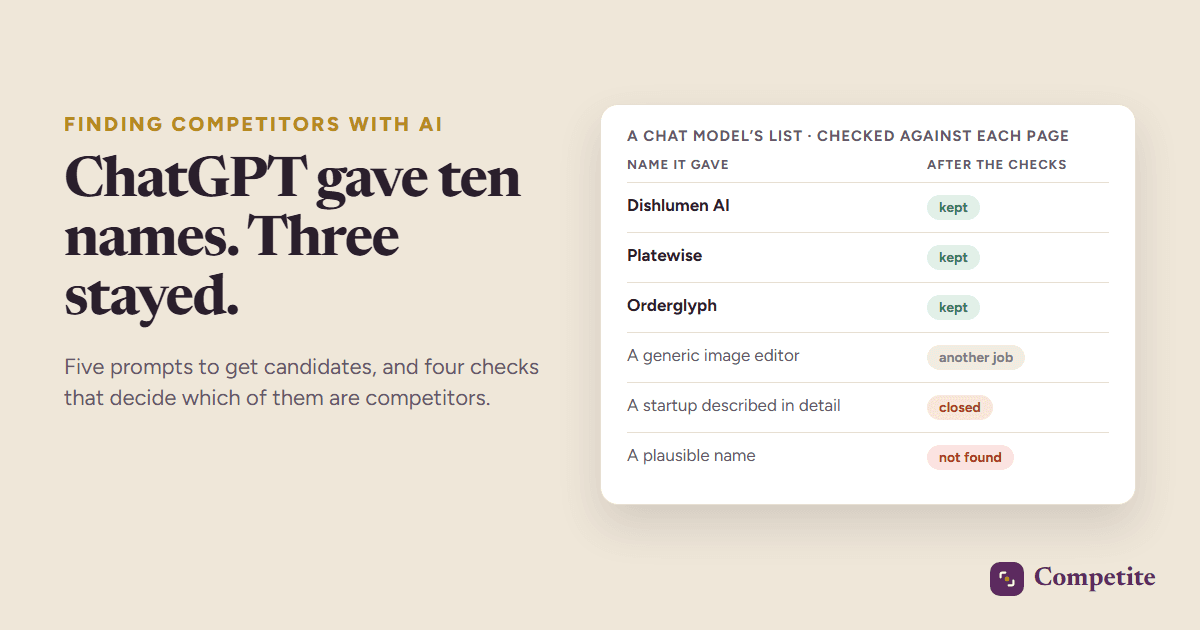
To find competitors using ChatGPT, ask it for candidates and treat every name as unconfirmed until the company’s own page says the same thing. A chat model is quick at what is slow by hand: the words buyers use, the neighbouring categories, the names you had not heard. It is unreliable on whether each company exists, is still trading and sells to your buyer. This guide gives five prompts to copy, four checks for every name, and a worked example in which ten names become three.
Can ChatGPT find your competitors?
It can find candidates, quickly, and it cannot tell you which of them are real competitors. Asked who competes with a product, ChatGPT returns a confident list in seconds, and so do Claude, Gemini and Perplexity. Some of the names will be right. The answer gives no sign of which ones, so the checking is your half of the work.
A model that does not search writes from what it learned before its training stopped, fluently, even when it learned nothing about your market. One that searches reads a few pages first. The answer shows which happened: a searched one carries links to the pages it read, and a recalled one carries none.
The wider method, six ways that need no model at all, is in how to find competitors.
What is ChatGPT good at when you look for competitors?
Three things, and none of them is the final list. It is good at the words buyers use for the problem, at naming the neighbouring categories you had not thought to search, and at producing names you had never heard, which you then check. Each of the three gives you something to look up, not something to believe.
| What you ask for | How well a chat model does it | What to do with the answer |
|---|---|---|
| The words buyers use for the problem | very well | search those words yourself |
| Neighbouring categories, and other routes to the same outcome | well | keep one row for each route buyers really take |
| Names of companies in the space | unevenly: some are wrong | run the four checks on every name |
The first row is the one founders undervalue, because a buyer types the problem and not your category. Ask for ten ways a restaurant owner would say “my menu photos look bad”, and each is a search that finds competitors without the model naming one. Company competitor search covers that second pass.
Where does ChatGPT go wrong when it lists competitors?
In five ways, and each one reads exactly like a correct answer. It names companies that have closed, companies that never existed, and the famous instead of the relevant. It states prices and features it recalled and did not read. And it knows nothing that happened after its training ended, unless it searches.
- Companies that closed. A model remembers a startup from its launch posts. Nobody writes a post when one quietly stops, so the name outlives the product.
- Companies that never existed. Asked for ten names, a model gives ten. When the real ones run out, it can supply a plausible one, marked no differently from the rest.
- The famous over the relevant. The companies written about most are the ones a model knows best. Those big names are rarely the ones your buyer shortlists against you.
- Prices and features recalled, not read. A recalled price is the price on the day the model last read about it. Read the page instead: how to find competitor pricing covers where.
- Nothing newer than what it learned. The rival that launched three months ago is missing from a recalled answer. Identifying early-stage competitors covers where such companies show up first.
Which ChatGPT prompts find competitors? Five to copy
Five, each asking for something a model does well, and none asking it to decide who your competitors are. Start from the problem, ask for the routes that are not companies, ask for an address and a sentence for every name, follow one rival’s own comparisons, and have the model argue each name off the list.
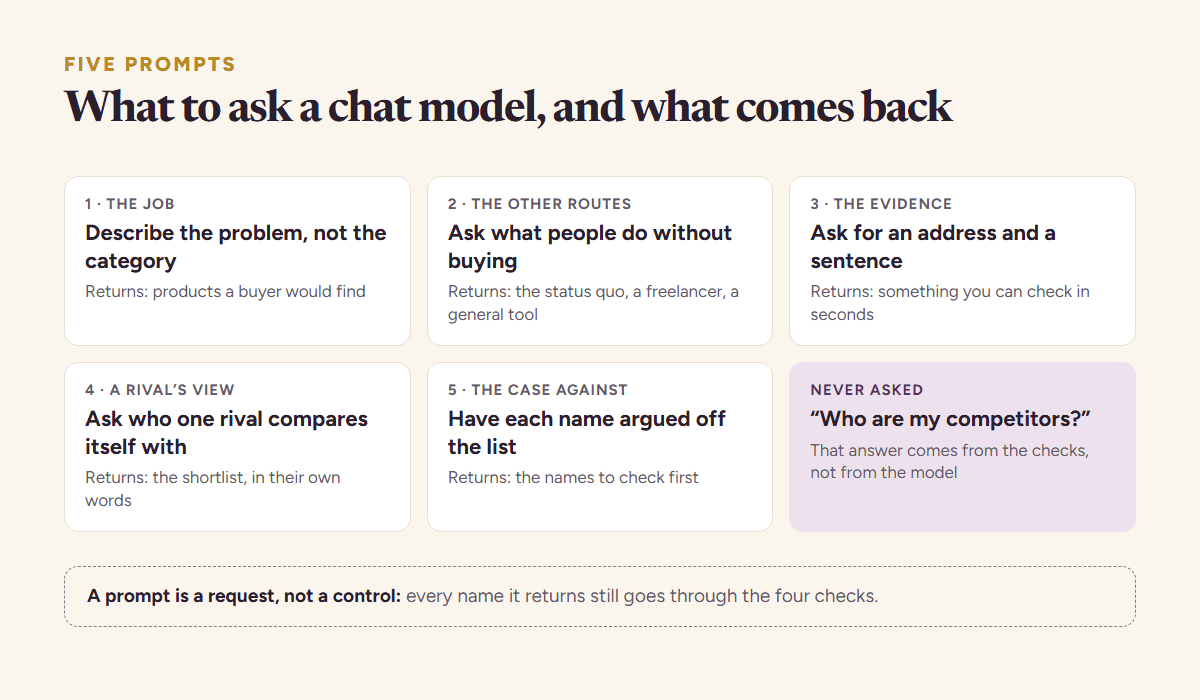
- Describe the job, not the category. “Here is a problem in a customer’s own words: [who has it, what they do today, what they would pay]. Do not name a category. List the products and services this person would find when looking for a fix, and say in one sentence what each does.”
- Ask for the status quo and the other routes. “For the same problem, list what people do today without buying a product, and every other route to the same outcome: a freelancer, an agency, a general-purpose tool, doing nothing. Say what each costs in money and in time.”
- Ask for an address and a sentence. “Search the web. For each company you named, give its own website address and copy the exact sentence from its home or pricing page that shows it does this job for this customer. If you cannot open the page or find such a sentence, write ‘not confirmed’. Do not guess.”
- Follow one rival’s own comparisons. “Open [the address of one confirmed competitor] and any comparison or alternatives pages on that site. Which companies does it compare itself with, and on which page? Quote the sentence for each.”
- Have it argue each name off the list. “Here is my list: [names]. For each one, make the strongest case that it is not my competitor: a different buyer, a different job, a different price band, or no longer trading. Which would you remove, and what evidence would change your mind?”
The paragraph in the first prompt does most of the work. Written as a customer describes the problem, it finds products; written as a pitch, it finds nothing. One that works: “Restaurants that sell on delivery apps need photos of every dish that look professional, and cannot afford a photographer for a hundred items.”
The third prompt changes the answer most: asking for the address and the sentence gives the model a reason to open the page. It is a request, not a guarantee, so the checks come next. AI competitor analysis applies the same rule to rivals you already know.
How do you check the competitors ChatGPT gives you?
With four checks on every name, each answered from the company’s own website: the page opens, the page says what the model said, the company is alive, and it sells to your buyer in your price band. A name that fails one is dropped. The four take about two minutes a name.
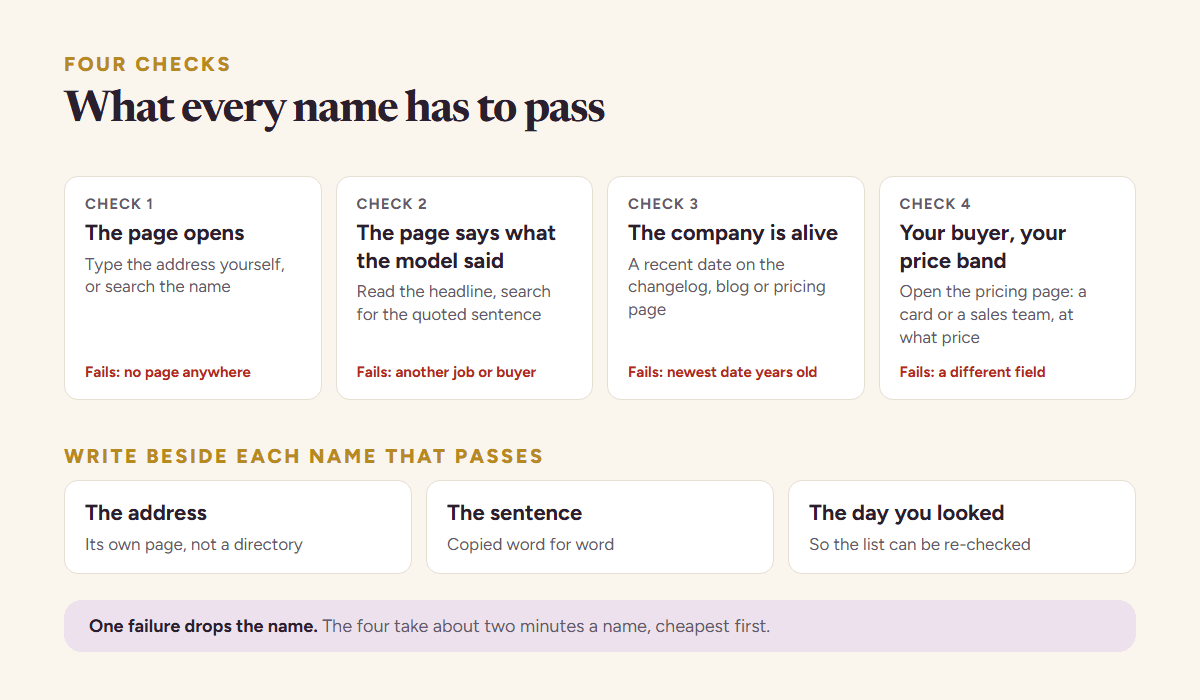
- The page opens. Type the address yourself, or search the name. No website and no mention anywhere means no competitor, whatever the description said.
- The page says what the model said. Read the headline, then search the page for the quoted sentence. If the promise is another job, or made to another customer, the name goes.
- The company is alive. Look for a date from the last few months on the changelog, the blog or the pricing page. A site whose newest date is two years old has most likely closed.
- It sells to your buyer in your price band. Open the pricing page. A product sold by a sales team at many times your price is in a different field from one bought with a card.
Most wrong names fall at the first two checks, in seconds. Beside each surviving name, write the address, the sentence and the day you looked.
A worked example: ten names from ChatGPT, three kept
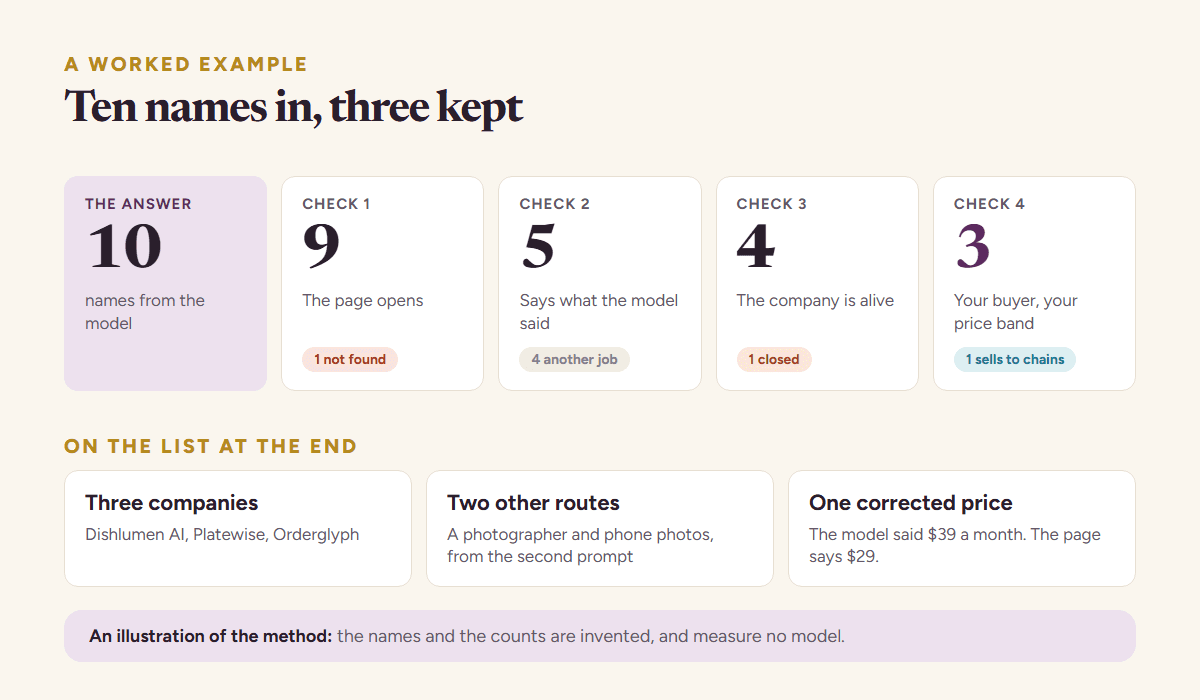
Here is the method run for Forkvane, the fictional startup used across this blog, which turns a phone photo of a dish into a menu photo for independent restaurants. The names and the counts are invented to show the method, and measure no model. Ten names came back. Three were still on the list after the four checks.
| Name the model gave | What the check found | Verdict |
|---|---|---|
| Dishlumen AI | “delivery-ready food photos in minutes”; Starter $29 a month | keep, direct |
| Platewise | the same job for the same restaurants; $49 a month | keep, direct |
| Orderglyph | a neighbouring job for the same restaurants | keep, adjacent |
| A generic image editor, a stock photo library, a menu design tool and a food delivery app | four real products, each doing another job | drop, another job |
| The biggest name in restaurant software | sold to chains by a sales team, no public price | drop, different buyer |
| A startup the model described in detail | newest date two years old, sign-up closed | drop, closed |
| A name with a plausible description | the address does not open; no search finds it | drop, not found |
Two details matter more than the count. The model gave Dishlumen AI’s entry price as $39 a month; the pricing page says $29, and has since 26 September. The name survived and the price did not. And Platewise, which launched recently, was missing until the third prompt made the model search.
The second prompt added the two rows no list of companies contains: a photographer, quoted at $400 a shoot, and phone photos, which are free. Half of Forkvane’s last ten lost deals went to phone photos, the row a chat model is least likely to volunteer. Primary, secondary and tertiary competitors shows how the list was then ranked.
When should you stop asking ChatGPT and ask customers?
After one round. Once the five prompts and the four checks have run, a second round returns the same names in different words. What a chat model cannot know is which of them your buyers actually weigh you against, and that comes from people: the last few who bought, and the last few who did not.
Ask each of them one question: what else did you look at? The answer is often something no search and no model would have named. If everyone comes back empty, that is a finding of its own, covered in no competitors for your product.
Then put the survivors where they can be kept: a competitor list template holds each name with its address, the sentence that confirmed it and the day you looked. Before a product exists, the same prompts fit the week in validating a startup idea with AI.
Is there an AI competitor finder that checks the names for you?
Yes, when the tool opens each candidate’s own page before it shows you the name, and keeps only the ones it could confirm. That is the difference between an AI competitor finder and a chat: the checks are done by the tool, on the day, and what it shows you comes with the evidence.
Competite’s competitor search works that way, from your website or a few sentences about the idea. It searches the web and opens each promising company’s own page, and the code keeps only the companies whose page was actually returned, so a name with no page behind it does not reach the list. Each survivor has an overlap percentage built from four figures (same job, same customers, same features, same pricing model), a sentence behind each and a quote from their page, and you add the ones that matter with a click. A search that confirms nobody costs nothing, and the free plan includes one a month, with no card: start with one competitor search.
Once the list exists, competitor monitoring tools compares what keeps watching it.
Questions people ask
- Can ChatGPT find my competitors?
- It can give you candidates in seconds, and it is good at the words buyers use and at neighbouring categories. It cannot tell you which names are real, still trading and sold to your buyer. Open each company’s own page and keep only the names the page confirms.
- What is the best ChatGPT prompt to find competitors?
- One that starts from the problem and asks for evidence. Describe the problem in a customer’s words without naming a category, then ask for each company’s own address and the exact sentence on its page that shows the same job for the same customer, with “not confirmed” where it finds none.
- Why does ChatGPT name competitors that do not exist?
- Because a model asked for a list produces one. Answering from memory, it writes what such a list would plausibly contain, and a closed or invented name reads exactly like a real one. Asking it to search and to give each address reduces this. Checking that every page opens removes it.
- Is there a free AI competitor finder?
- Yes. The free tier of a general assistant will list candidates with the prompts in this guide, and you check the names yourself. Competite’s free plan includes one competitor search a month, which opens each candidate’s own page and keeps only the companies it could confirm, with no card.
- Can I find competitors with Claude, Gemini or Perplexity instead of ChatGPT?
- Yes, and the same method applies. Which assistant you use matters less than whether the answer was searched or recalled: an answer with links to each company’s own page can be checked, and one without cannot. Whichever you choose, run the same four checks on every name.
See it on your own competitors
Add your product, or just describe the idea. Competite finds the competitors, reads their pages, and writes the comparison with a quote behind every claim. Free, in about three minutes, no card.
Keep reading
AI competitor analysis: what it reads, what it invents, and how to check it
How to run an AI competitor analysis you can check: what a model reads well, where it invents prices, a prompt to copy, and the free tools that work.
6 November 2026 · 12 min read
How to find your competitors, even before you have a product
How to find competitors, even before you have a product: six free ways that start from a job or an idea, how to score the overlap, and how many to keep.
15 September 2026 · 9 min read
Competitor search: the eight searches that find a company’s real rivals
A competitor search that returns companies instead of listicles: eight searches to run in order, what each one returns, and what no search can find.
20 September 2026 · 7 min read
A competitor list template: what to record about each rival, with a filled example
A free competitor list template: the twelve columns to record for each rival, how many names to keep, a filled example, and a CSV for Sheets or Excel.
25 November 2026 · 10 min read
No competitors for your product? What it usually means, and how to check
Found no competitors for your product? Four things that usually explains, five searches that settle it in an hour, and what to say when an investor asks.
15 November 2026 · 8 min read