How to find the competitors of a company, from its own pages
, updated · 7 min read · by the Competite team
How to find competitors of a company is a different question from finding your own, and it has a better answer, because you are allowed to read everything. A company tells you who it competes with on its pricing page, in its comparison pages, in the words it repeats and in the objections it pre-answers. This guide covers where to start, six sources that name rivals by name, what a pricing page gives away, how to decide which of them count, and how to keep the list from going stale the week after you build it.
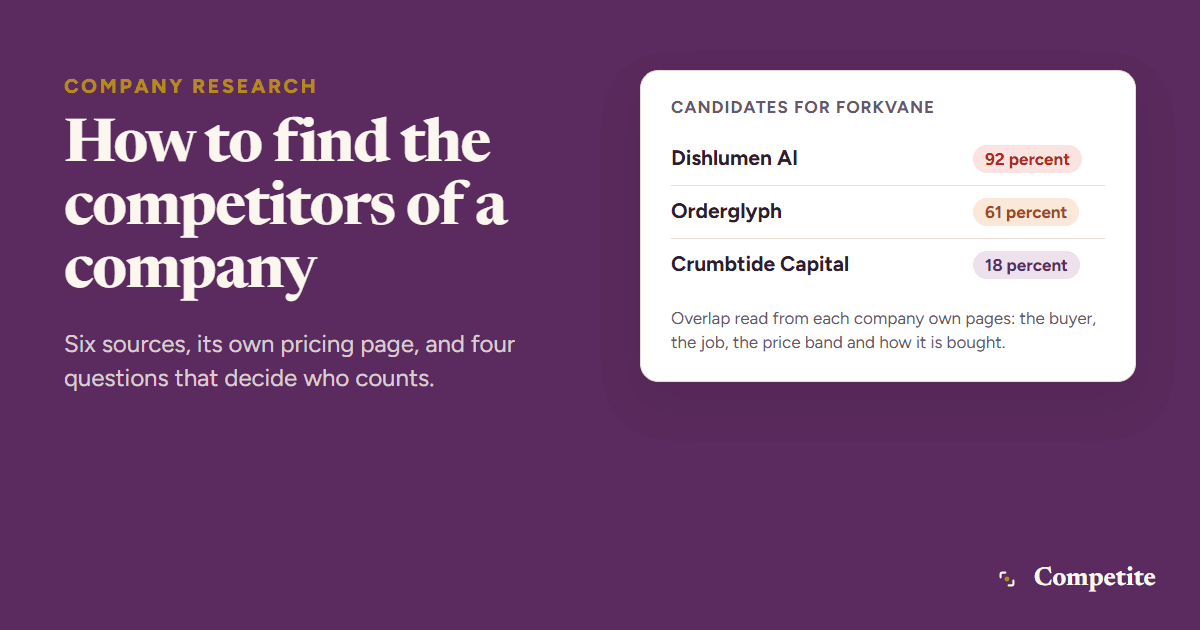
Start with the company, not the category
The usual mistake is to start from the market. You type the category into a search engine, get a list of the twenty biggest companies in it, and write those down. That list is almost never the company you are researching competes with, because it is sorted by size rather than by who its buyers shortlist.
Start from the company itself and work outwards. Three things about it decide the field: who it sells to, what it charges, and how it is bought. A product at nine dollars a month bought with a credit card does not compete with a product at forty thousand a year bought through a procurement process, even when the two do the same thing on paper.
| What to read first | Where it is | What it tells you |
|---|---|---|
| Who it sells to | the home page headline and the customer logos | the buyer, which fixes the field |
| What it charges | the pricing page, or the absence of one | the price band, and whether it is self-serve or sales-led |
| What it says it is not | the comparison pages and the FAQ | the rivals it loses to often enough to answer in public |
| Who it hires | the jobs page | where it is going next, which is where the field will be |
A company with no public price is telling you something too. It means the buyer talks to a person before seeing a number, which puts it in a different field from anything you can sign up for in a browser, whatever the feature list says.
Six sources that name rivals by name
These are ordered by how much signal they carry, not by how easy they are. The first two are worth more than the other four together.
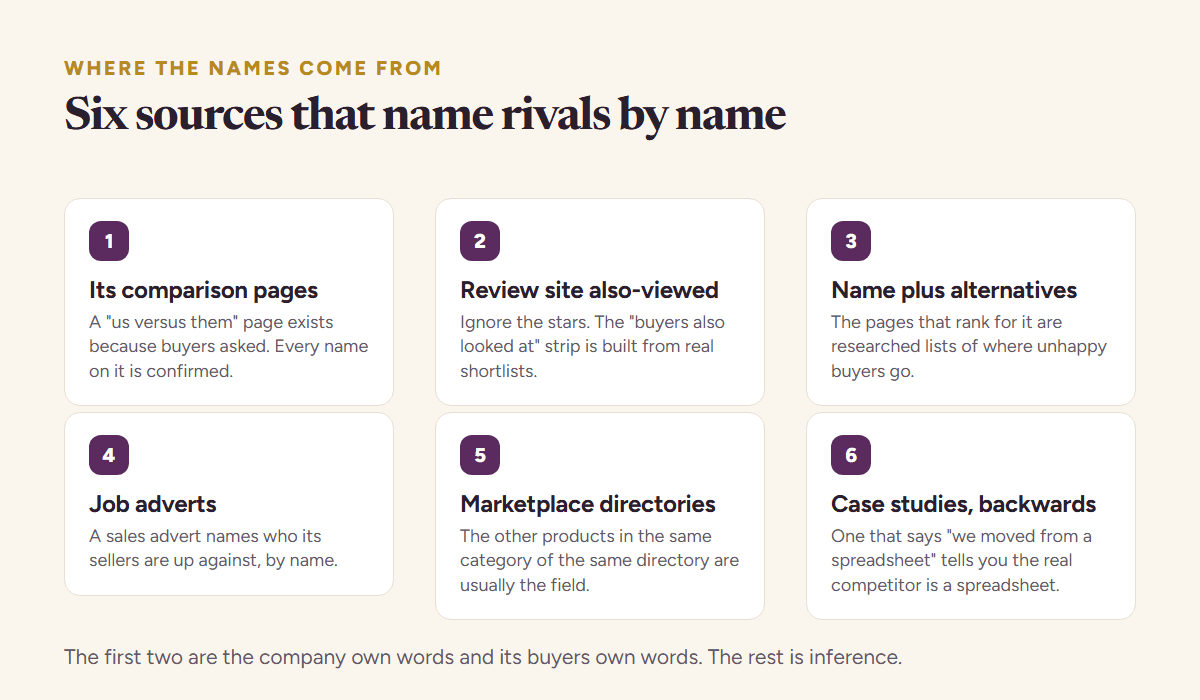
- Its own comparison pages. A page titled "us versus them" exists because enough buyers asked. Every rival named there is a confirmed competitor, named by the company itself. Read the rows it chooses to compare on, and notice the rows it leaves out.
- Review sites, and specifically the also-viewed lists. Ignore the star ratings, which are gamed. The useful part is the "buyers also looked at" strip, because it is built from what real shortlists contained.
- A search for the company name with the word alternatives. The pages that rank for it are written by people trying to capture that company dissatisfied buyers, which means they are researched lists of who those buyers go to instead.
- Job adverts. A sales job description often names the companies its sellers will be up against, and an engineering advert names the problem the company is about to attack next.
- Integration and marketplace directories. The other products in the same category of the same marketplace are usually the field, and the directory has already done the categorising.
- Customer case studies, read backwards. A case study that says "we moved from a spreadsheet" tells you the real competitor is a spreadsheet. A case study that names the tool they left is a gift.
The source that beats all six
Ask a customer what else they looked at. One sentence from somebody who nearly bought something else is worth more than a day of desk research, because it is the only source that knows what the shortlist actually was.
What a pricing page gives away
A pricing page is the most honest document a company publishes, because it has to survive contact with somebody about to pay. Four things on it place a company in its field.
- The shape of the plans. Per seat, per usage, or one flat fee. Companies with the same shape compete; companies with different shapes often do not, because they are sold to different budgets.
- The cheapest paid plan. This is the number a buyer compares first, and it is the single best marker of which field a company is in.
- What the free tier caps. The cap tells you the one thing the company thinks is valuable enough to charge for.
- The plan names. Companies borrow plan names from whoever they think they are up against. Matching names are a strong hint of a matching field.
Read the two pricing pages side by side for the same buyer rather than plan by plan. A "Pro" plan at one company can be the entry plan at another. The comparison that matters is what the same person pays for the same outcome, which is the method in our guide to competitor pricing analysis.
Which of them actually count
Six sources will hand you twenty names. Most of them are not competitors, and a list of twenty is a list nobody reads. Score each candidate on four questions, all answerable from its own website, and keep the ones that clear three.
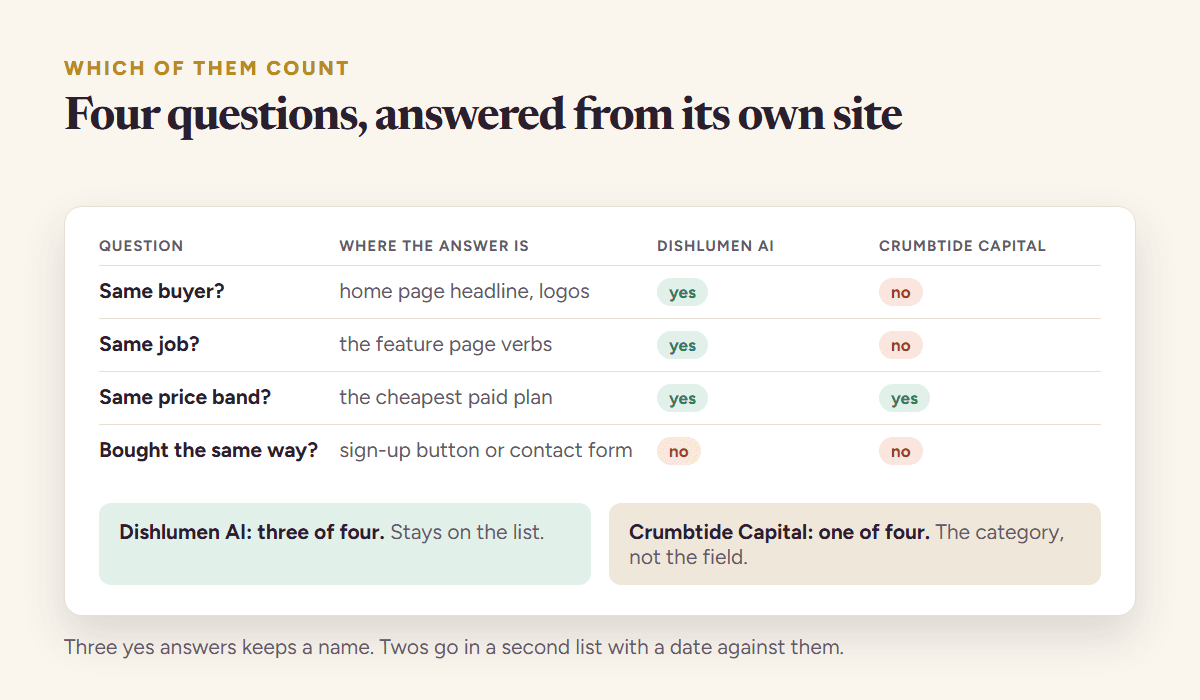
| Question | Where the answer is | Why it decides |
|---|---|---|
| Same buyer? | the home page headline, the logos | a different buyer is a different market, however similar the product |
| Same job? | the feature page verbs | solving a neighbouring problem is not competing yet |
| Same price band? | the cheapest paid plan | a tenfold price gap means the two are never on one shortlist |
| Bought the same way? | is there a sign-up button or a contact form | self-serve and sales-led are separate fields |
Keep the ones that score three or four. Put the twos in a second list with a date against them, because a company one step away today is a competitor the quarter it moves. The ones that score one are the category, not the field, and they belong in a market-size paragraph rather than a comparison.
A competitor list that never loses a name is a list that was written once and never checked.
Keeping the list current
Everything above has a shelf life of about a quarter. Prices move, plans get renamed, free tiers get capped, and a company two steps away ships the one feature that puts it on your buyer shortlist. The research is not the hard part; noticing the change is.
Two habits cover most of it. Re-read the pricing pages of the names that scored four, once a month, and write down the cheapest paid plan each time so you have a series rather than a snapshot. And re-run the six sources once a quarter, because the newcomers show up in the also-viewed strips before they show up anywhere else.
If doing that by hand is the part that never happens, that is the job Competite does: it reads the pages you point it at, keeps the plans and prices as a history, and mails you when one of them changes. The method on this page is the method it follows, which is why the reasoning is on the page rather than hidden in a score.
If the company you are researching is your own, the question turns around and the answer is a little different. That version is in how to find your competitors, and the table to put the findings in is in the competitor analysis template.
Questions people ask
- How do I find the competitors of a private company?
- The same six sources work, because none of them need financial filings. A private company still publishes a pricing page, still writes comparison pages, still posts job adverts and still appears in review site also-viewed lists. What you cannot get is its revenue or its customer count, which is not needed to decide who it competes with.
- Are another company competitors also my competitors?
- Often, but not automatically. Its field is set by its buyer, its price band and how it is bought. If any of those three differ from yours, part of its list belongs to it and not to you. Score its rivals on the same four questions you would score your own, and keep the ones that clear three.
- How many competitors does a company usually have?
- Three to seven that matter, whatever the category size. Below three the list is usually missing the status quo, which is what most deals are actually lost to. Above about ten, nobody re-reads the list and it stops being used.
- Can I find a company competitors from its website alone?
- You can get most of the way. Its comparison pages, pricing page, FAQ and jobs page together name rivals and fix the price band and the buyer. The one thing a website cannot tell you is what a buyer had open in the other tab, which is why asking one customer beats a day of reading.
See it on your own competitors
Add your product, or just describe the idea. Competite finds the competitors, reads their pages, and writes the comparison with a quote behind every claim. Free, in about three minutes, no card.
Keep reading
How to find your competitors, even before you have a product
How to find competitors for a startup: who counts as one, six ways to find them from a job or an idea, how to score the overlap, and how many to keep.
15 September 2026 · 6 min read
How to identify early-stage competitors, before anyone has named the category
How to identify early-stage competitors before the category has a name: seven places a rival shows up first, and the signal that it just became direct.
19 September 2026 · 6 min read
Competitor analysis services: what they cost, and when to buy one
What competitor analysis services cost, from a 300 dollar audit to 30,000 a month, what lands in the deliverable, and the three times it is the wrong purchase.
19 September 2026 · 7 min read