Competitor analysis services: what they cost, and when to buy one
· 7 min read · by the Competite team
Almost every page selling competitor analysis services leaves the price off. That is the first thing worth knowing about the category: the number is negotiable enough that publishing it would cost the seller money. So here are the bands, gathered from the firms that do publish, along with what actually lands in the deliverable, the three situations where paying somebody is the right call, and the more common ones where it buys you a document nobody opens.
What it costs
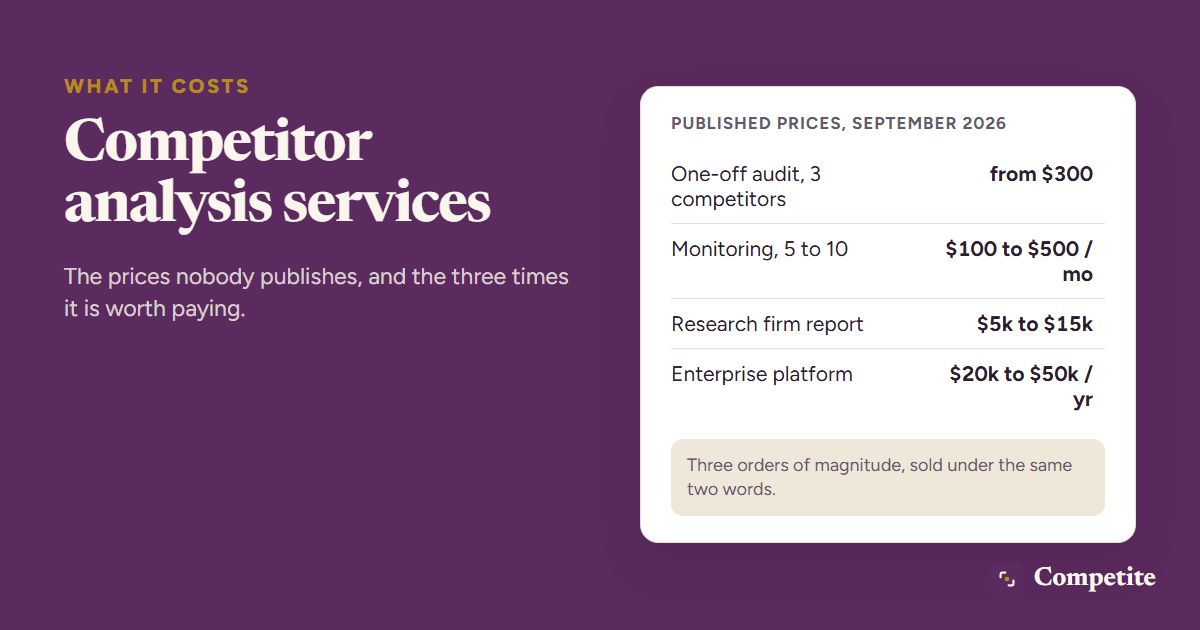
The spread is wider than in almost any other kind of marketing work. A one-off audit and an enterprise retainer differ by three orders of magnitude and are both sold under the same two words.
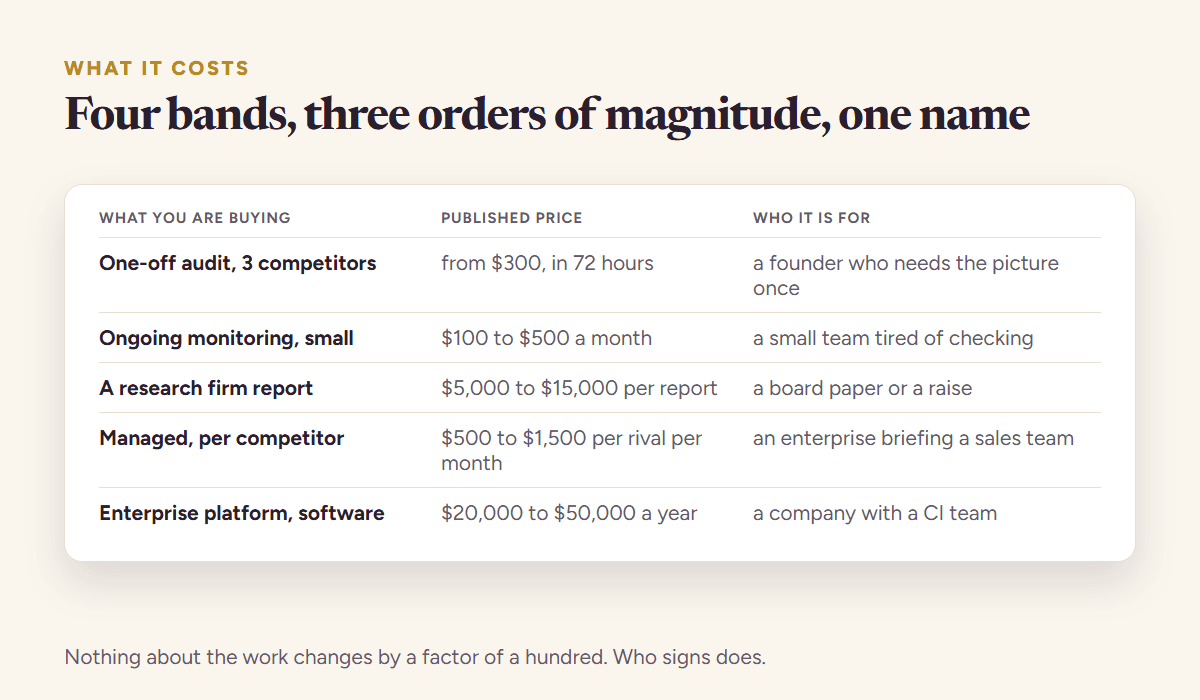
| What you are buying | Published price | Who it is for |
|---|---|---|
| A one-off audit of three competitors | from about 300 dollars, delivered in 72 hours | a founder who needs the picture once, before a decision |
| Ongoing monitoring, small | 100 to 500 dollars a month for five to ten competitors | a small team that wants to stop checking by hand |
| A research firm report | 5,000 to 15,000 dollars per report | a board paper, a fundraise, a market entry |
| Per-competitor monitoring, managed | 500 to 1,500 dollars per competitor per month | enterprises with a named rival and a sales team briefing on it |
| An enterprise platform, software only | 20,000 to 50,000 dollars a year | a company with a competitive intelligence function already |
The jump from the second row to the fourth is the one to notice. Nothing about the work changes by a factor of a hundred. What changes is who signs, how long the sales cycle is, and whether a person sits between you and the data.
What actually arrives
Deliverables across the category are more alike than the prices suggest. Most of the time you get some combination of five things.
- An executive snapshot. One or two pages. In practice the only part that gets read, and the part you could have written yourself if you had the underlying work.
- A long report. Thirty to fifty pages is the usual shape. Its length is a pricing signal, not a quality one.
- A feature matrix. You against them, row by row. Useful exactly as far as the rows were chosen by somebody who has heard a buyer talk.
- A pricing benchmark. Their plans next to yours. The single most perishable page in the document, and usually the most valuable one.
- A dashboard or an export. Whether this is worth anything depends entirely on whether it updates after the invoice is paid.
The tell that you bought the wrong thing
Page count in the sales conversation. A firm that leads with "a comprehensive 40-page report" is selling you weight. Ask instead how many of the pages will still be true in March, and watch what happens to the conversation.
The three times it is worth it
Not a long list, and none of the three is "we should keep an eye on the competition", which is the reason most of these are bought.
- A decision with a date on it. Entering a market, repricing the whole list, deciding whether to build a thing that takes a quarter. The research has a deadline and an owner, and it stops when the decision is made. This is the case a one-off audit was invented for, and the cheapest band usually covers it.
- A room you cannot get into. Win-loss interviews with buyers who chose somebody else, or calls with people who will talk to a neutral researcher and not to you. This is the one thing a service does that neither you nor any tool can, and it is worth more than the report wrapped around it.
- A document somebody else has to sign off. A board pack, a diligence answer, an investment committee. Here you are partly paying for the letterhead, which is a legitimate thing to buy as long as you know that is what you are doing.
When it is the wrong purchase
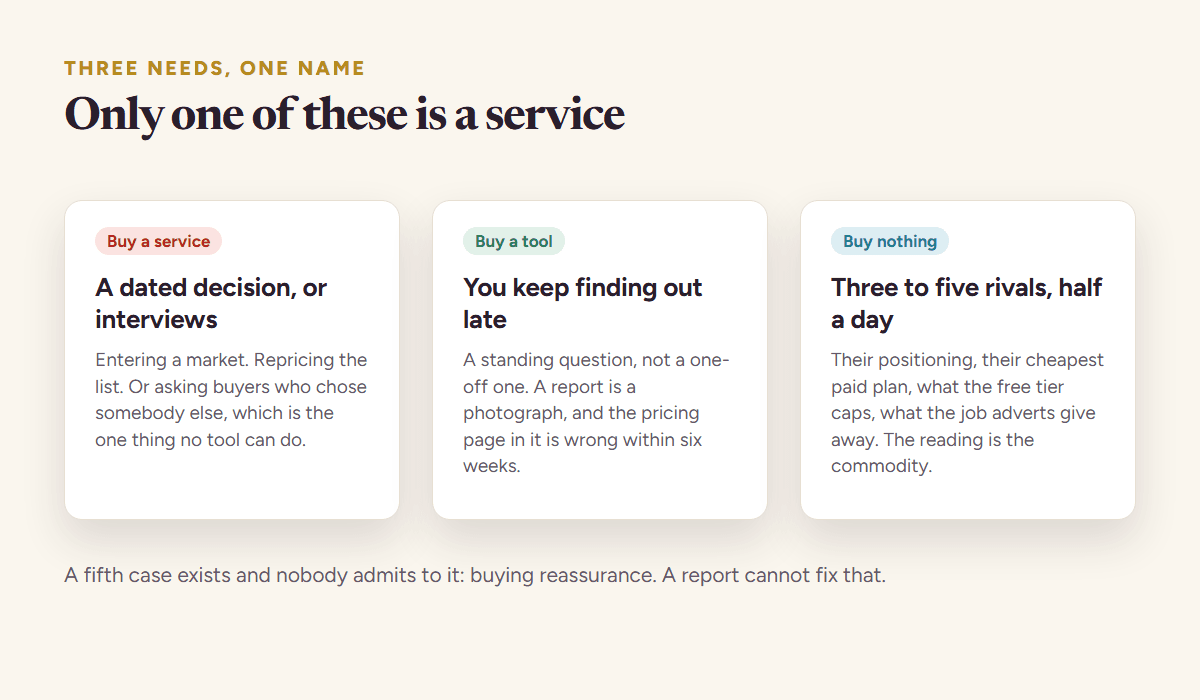
The common mistake is buying a one-off answer to a standing question. Prices, plans and positioning move on their own schedule, and a report is a photograph. Six weeks after delivery, the pricing benchmark, which was the best page in it, is the page you can no longer rely on.
| What you actually need | What it looks like | What to buy |
|---|---|---|
| A picture, once, for a decision | a deadline and a named decision | a one-off audit at the low band |
| To know when something changes | you keep finding out late, from a customer | a tool, or twenty minutes a week |
| To understand why you lose deals | the list is right and you still lose | win-loss interviews, which is a service |
| Something for the board | a date and a room | a firm, and the letterhead with it |
| Reassurance | no decision attached to it | nothing, honestly |
That last row is not a joke. A meaningful share of this category is bought because looking at competitors feels like work and is easier than pricing your own product. A report cannot fix that, and at five thousand dollars it is an expensive way to postpone it.
What an afternoon gets you
Before paying anybody, it is worth knowing the shape of the thing you would be buying. For three to five competitors, the core of a paid audit is roughly half a day of reading their own pages: who they say they are for, what their cheapest paid plan is, what the free tier caps, what their comparison pages admit, and what their job adverts give away about next quarter.
That is not a claim that a service adds nothing. It is a claim about which part it adds. The reading is the commodity; the interviews and the judgement are not. If a quote is mostly for the reading, the quote is mostly for the commodity. The method is in how to find competitors of a company and competitor pricing analysis, and the table to put it in is here.
Pay for the interviews and the judgement. The reading is the part that is already free.
Five questions before you sign
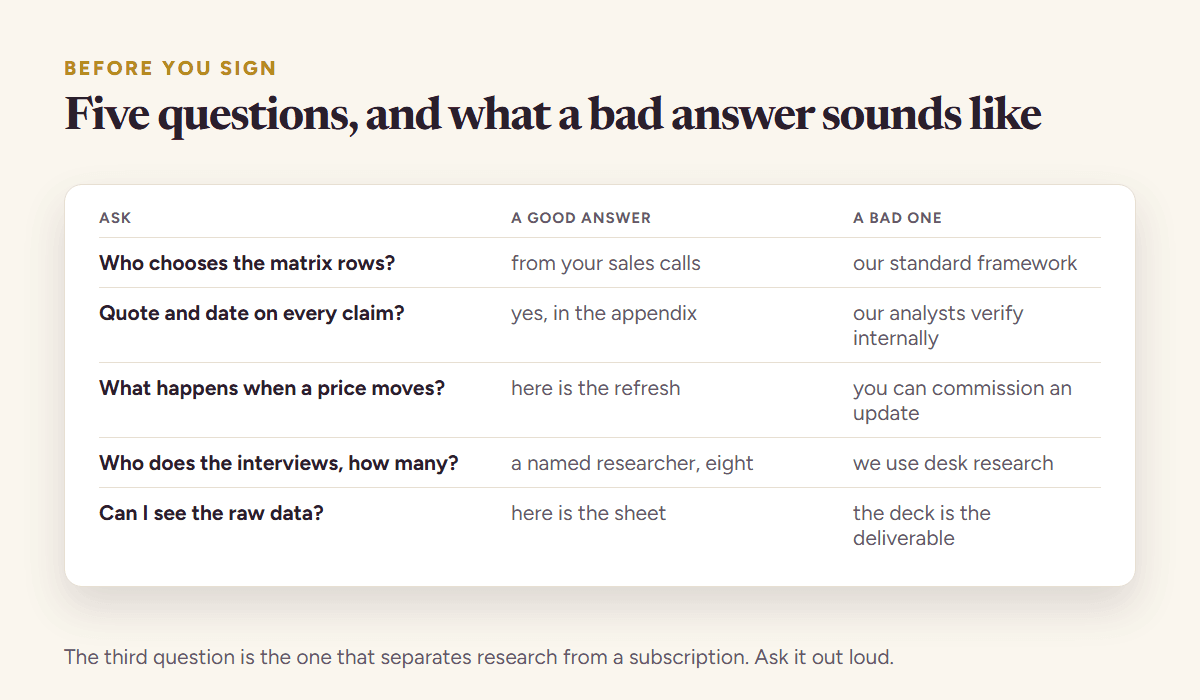
- Who chooses the rows in the feature matrix, and on what evidence? If the answer is "our standard framework", the matrix is about their process rather than your buyers.
- Will every claim carry a quote and a date? A competitor analysis without sources is a set of opinions with a price on it, and you cannot check any of it.
- What happens six weeks after delivery, when a price moves? Ask this one out loud. The answer tells you whether you are buying research or a subscription.
- Who does the buyer interviews, and how many? This is the expensive, valuable part. If nobody is being interviewed, you are paying a premium for desk research.
- Can I see the raw data, not the deck? The willingness to hand over a spreadsheet is a decent proxy for whether one exists.
Where we sit, so you can discount this properly
Competite is a tool, not a service. It reads the competitor pages you point it at, keeps their prices and plans as a history, and emails you when one of them changes. That puts it squarely in the second row of the table above, and it means this page has an interest in you concluding that a standing need is better served by software than by a report.
So take the part that cuts against us seriously: if you need to know why buyers chose somebody else, no tool will tell you, ours included. That is an interview, and interviews are a service. And if you need one picture for one decision next Thursday, an audit at the bottom of the price range is a perfectly sensible purchase that we would be wrong to argue you out of.
If the need turns out to be the standing one, Competite is free to start with one competitor and one report a month.
Questions people ask
- How much does a competitor analysis service cost?
- Published figures in September 2026 run from about 300 dollars for a one-off audit of three competitors, delivered in around 72 hours, through 100 to 500 dollars a month for ongoing monitoring of five to ten competitors, to 5,000 to 15,000 dollars for a research firm report. Managed per-competitor monitoring runs 500 to 1,500 dollars per competitor per month, and enterprise platforms are 20,000 to 50,000 dollars a year for the software alone.
- Is a competitor analysis service worth it for a startup?
- Sometimes, for three reasons: a decision with a deadline, interviews with buyers who will not talk to you, or a document somebody else has to sign off. For the standing question of what changed this week, a service is the wrong shape, because a report is a photograph and prices move after it is delivered.
- What should a competitor analysis service deliver?
- Usually an executive snapshot, a long report of thirty to fifty pages, a feature matrix, a pricing benchmark and some kind of dashboard or export. The pricing benchmark is normally the most valuable page and the fastest to go stale. Page count is a pricing signal rather than a quality one.
- Can I do competitor analysis myself instead?
- The desk research part, yes, in about half a day for three to five competitors: their positioning, their cheapest paid plan, what the free tier caps, what their comparison pages admit and what their job adverts reveal. What you cannot do yourself is interview the buyers who chose somebody else, which is the part of a service genuinely worth paying for.
See it on your own competitors
Add your product, or just describe the idea. Competite finds the competitors, reads their pages, and writes the comparison with a quote behind every claim. Free, in about three minutes, no card.
Keep reading
Competitor analysis tools in 2026: which kind you actually need
The five kinds of competitor analysis tools, what each answers, who it is for and what it costs, from traffic estimators to founder-focused tracking.
9 September 2026 · 6 min read
Competitor analysis for startups: a founder’s guide
How to do a competitor analysis as an early-stage founder: find the real competitors, read their pricing, quote their claims, and keep it alive every week.
9 September 2026 · 7 min read
Competitor pricing analysis: how to read a pricing page like a buyer
Competitor pricing analysis in an afternoon: the eight things to read on a pricing page, how to compare plans that are not alike, and how to set your price.
15 September 2026 · 8 min read