Company competitor search: the eight searches, in order
· 6 min read · by the Competite team
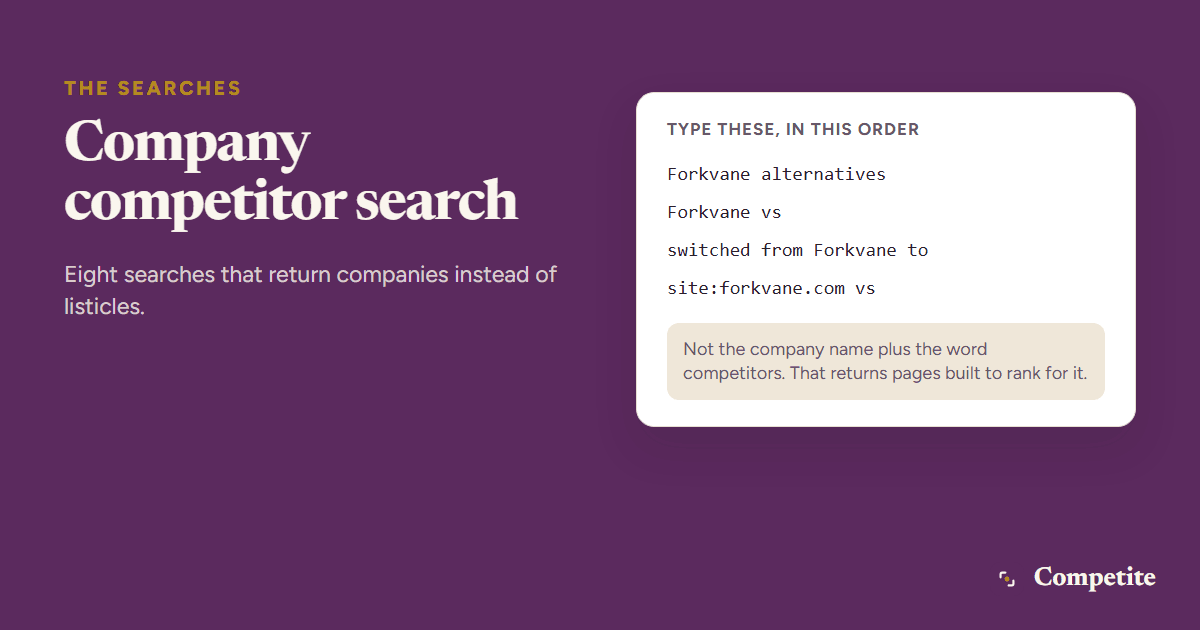
Type a company name plus the word competitors and you get listicles: twenty names, ranked by who paid for the placement or who writes the most content. None of them know which two companies that buyer actually chose between. These are the eight searches that return companies instead, roughly in the order worth running them, with what each one gives you and the three things no search will ever find.
Why the obvious search fails
The query "Forkvane competitors" is answered almost entirely by pages built to rank for it. Their job is to capture the search, not to be right, and the fastest way to look authoritative is to list twenty companies. A list of twenty is a list nobody can act on, and it will contain the market leader whether or not that company has ever appeared on a real shortlist.
The searches below work because of who wrote the pages they return. A forum thread was written by somebody switching. An alternatives page was written by a rival with a commercial reason to be accurate about who the unhappy buyers are. A job advert was written by a hiring manager who has no idea it is being read this way.
The eight searches
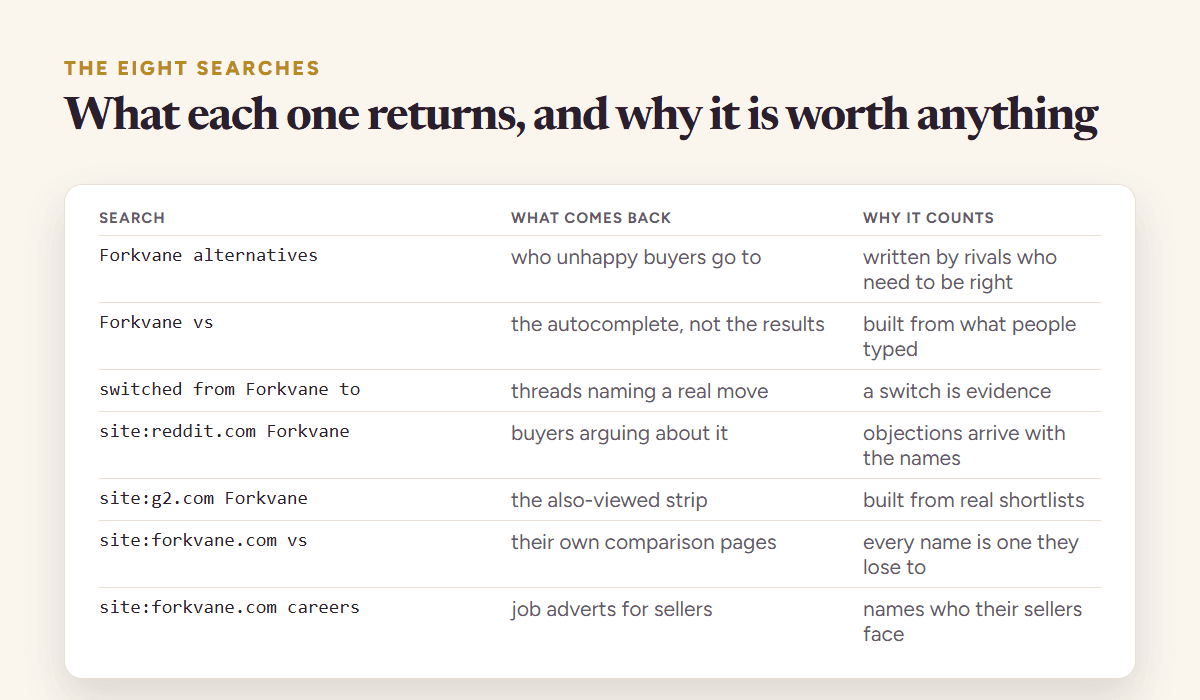
| Search | What comes back | Why it is worth anything |
|---|---|---|
| Forkvane alternatives | pages listing who unhappy buyers go to | written by rivals with a commercial reason to be right |
| Forkvane vs | the autocomplete suggestions, not the results | the suggestions are what people actually typed |
| switched from Forkvane to | forum posts and reviews naming a real move | a switch is evidence; a listicle is not |
| instead of Forkvane we use | the same thing, phrased the way people write | catches threads the first phrasing misses |
| site:reddit.com Forkvane | threads where buyers argue about it | the objections arrive with the names |
| site:g2.com Forkvane | the also-viewed strip on the listing | built from what real shortlists contained |
| site:forkvane.com vs | their own comparison pages | every rival they name is one they lose to |
| site:forkvane.com careers sales | job adverts for sellers | often names who their sellers are up against |
The one most people skip
Search the name with "vs" and read the autocomplete rather than the results. Those suggestions are aggregated from what people typed, which means the list is built from real comparisons rather than from whoever ranked best. It takes four seconds and it is the highest signal-per-second search on this page.
The second pass: search the problem
Everything above starts from a company name. That finds the field as it is already understood, and misses anything that has not been categorised yet. So run a second pass with no product noun in it at all: the sentence a buyer would type when they are annoyed.
For a menu-photo product, "restaurant photos look bad on delivery apps" rather than "AI food photography". The first returns the companies solving it, including a photographer directory and a freelancer marketplace, neither of which would appear in any competitors search. The second returns people writing about the market. That method, for a category with no name yet, is in identify early-stage competitors.
Three things no search will find
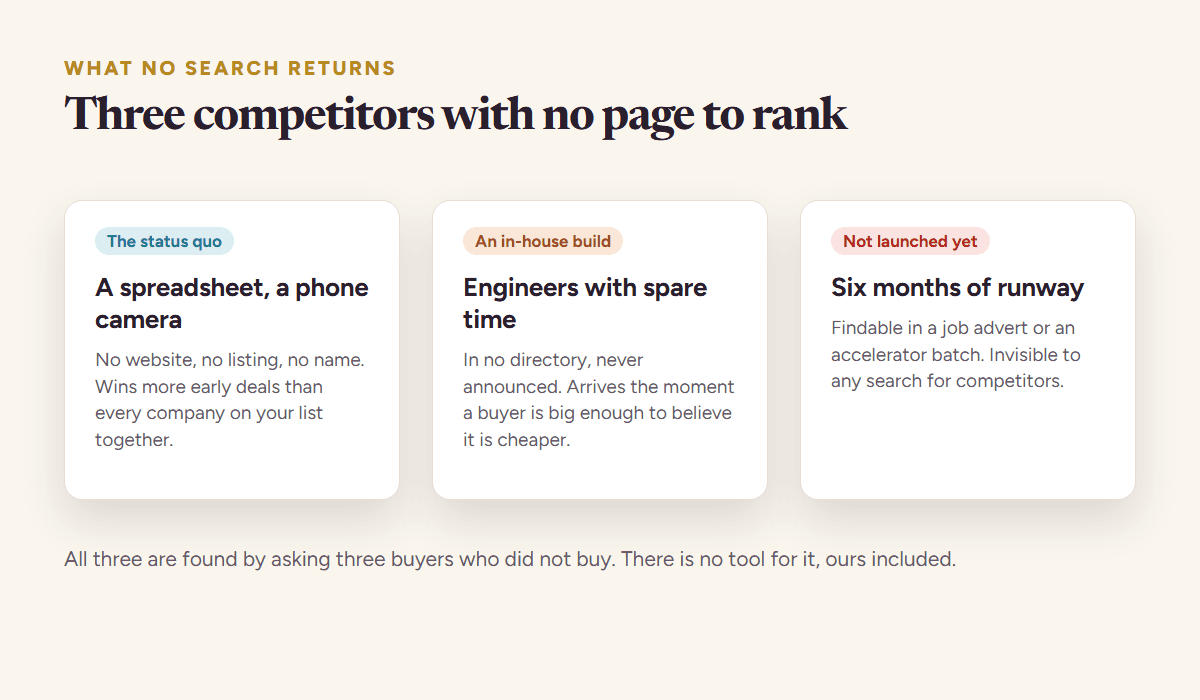
- The status quo. A spreadsheet, a phone camera, carrying on. It has no website, no listing and no name, and for an early product it wins more deals than every company on your list put together.
- An in-house build. Common the moment a buyer is large enough to have engineers with spare time, or believes they are. It appears in no directory and is never announced.
- A company that has not launched. Six months of runway pointed at your buyers, findable only in a job advert or an accelerator batch, and invisible to any search for competitors.
All three are found the same way, which is three messages to the last three buyers who did not buy. That is not a search and there is no tool for it, ours included, and it will tell you more in a morning than the eight searches above.
When the company is too small to have been written about
Below a certain size, nobody has written an alternatives page about a company and it has no review site listing, so six of the eight searches return nothing. This is normal and not a dead end; it means you have to go through its customers instead of its category.
Search their customer names with the problem: if a restaurant is on their logo wall, search that restaurant plus what the product does, and the other vendors chasing the same account surface. Search their integrations, because a company listed in a marketplace sits next to its field in that directory. And search the founder name rather than the company, since founders talk about what they are up against in interviews and threads long before anyone writes a comparison page.
From results to a list you can use
Eight searches produce twenty-odd names. Most are not competitors. Score each against four questions answerable from its own site, keep the ones that clear three, and put the rest in a second list with a date on it.
| Question | Where the answer is |
|---|---|
| Same buyer? | the home page headline and the customer logos |
| Same job? | the verbs on the feature page |
| Same price band? | the cheapest paid plan |
| Bought the same way? | a sign-up button, or a contact form |
Three to seven names is the working size. The scoring, and what each answer means, is in how to find competitors of a company. Once the list exists, the thing that goes stale is their prices, and Competite watches those so the list has a history rather than a memory.
A search finds the companies that wrote pages. A customer tells you the ones they nearly bought.
Questions people ask
- How do I search for a company competitors?
- Not with the name plus the word competitors, which returns listicles written to rank for that phrase. Search the name with "alternatives", read the autocomplete after the name plus "vs", look for "switched from" phrasings in forums, and use site: searches against review sites, the company own comparison pages and its job adverts.
- Is there a competitor search tool?
- Plenty, and they mostly return the same category listings a search does. What none of them can return is the status quo, an in-house build, or a company that has not launched, which between them account for most lost deals at an early stage. Those come from asking buyers, not from a search box.
- Why does searching a company name plus competitors give bad results?
- Because the pages that rank for it were built to rank for it. Listing twenty companies is the cheapest way to look comprehensive, and the list will include the market leader whether or not that company has ever been on a shortlist with the one you are researching.
- How many competitors should the search leave me with?
- Three to seven. Twenty names is a list nobody re-reads, which is the same as no list. Score each candidate on whether it takes the same buyer, does the same job, sits in the same price band and is bought the same way, and keep the ones that clear three of the four.
See it on your own competitors
Add your product, or just describe the idea. Competite finds the competitors, reads their pages, and writes the comparison with a quote behind every claim. Free, in about three minutes, no card.
Keep reading
How to find the competitors of a company, from its own pages
How to find competitors of a company: six sources that name rivals, what its own pricing page gives away, and how to tell a real competitor from a long list.
17 September 2026 · 7 min read
How to identify early-stage competitors, before anyone has named the category
How to identify early-stage competitors before the category has a name: seven places a rival shows up first, and the signal that it just became direct.
19 September 2026 · 6 min read
A competitor analysis example, start to finish, with the decision it produced
A worked competitor analysis example: the list, the scoring, both pricing pages compared, the filled table, the decision it produced and what changed after.
20 September 2026 · 6 min read