AI competitor analysis: what it reads, what it invents, and how to check it
, updated · 12 min read · by the Competite team
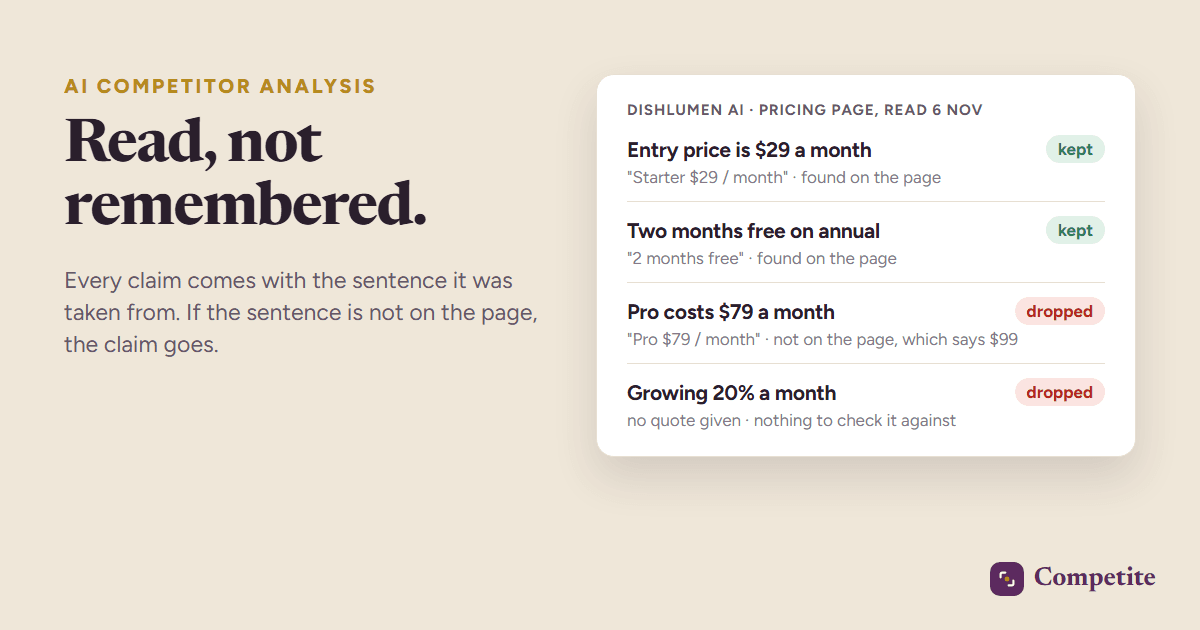
AI competitor analysis means letting a language model read your competitors’ pages and write the comparison: plans and prices, features, claims, and where you are ahead. It reads fast and well. It is also confident about things it never read, and that is where it costs founders money. One rule fixes most of it: every claim comes with the sentence it was taken from, and somebody checks that the sentence is on the page.
What is AI competitor analysis?
AI competitor analysis is a competitor analysis in which a language model does the reading and the first draft. You give it a competitor’s pricing, features and changelog pages, or a tool fetches them; it pulls out the plans, prices, claims and gaps and lays your product next to theirs. Deciding what it means, and checking it, is still your job.
The work it replaces is real. Reading four pages for each of three competitors, carefully enough to fill a table, takes most of an afternoon, and most of that afternoon is copying: plan names, prices, quotas, which feature sits on which tier. A model does the copying in under a minute, and does it well, as long as what it is copying from is in front of it.
That condition is the whole subject of this guide. A model asked about a competitor it has not been shown answers from memory, and its memory is a blend of everything it read about the category before its training stopped, months old at best. The answer looks exactly the same either way, which is the problem.
What AI does well in a competitor analysis
Reading and sorting. A model is very good at turning a long, messy pricing page into a clean table, at putting two products side by side on the same rows, and at noticing what one page says that the other leaves out. It is also quick at the tedious jobs nobody does twice: reading a changelog, summarising forty reviews, sorting a long list of names.
| Job | How well a model does it | On one condition |
|---|---|---|
| Pull plans, prices and quotas off a pricing page | very well | the page text is in front of it |
| Compare two products on the same rows | very well | both sides were read the same way, on the same day |
| Spot what one page says and the other leaves out | well | the rows come from your buyer, not from the model |
| Summarise a changelog or a pile of reviews | well | the dates survive the summary |
| Draft positioning lines from the gaps | well, as a draft | you choose the line |
| Say what a competitor charges today, from memory | badly | none: read the page |
| Estimate traffic, revenue or customer counts | badly | none: nothing it says here can be checked |
The pattern in that table is the useful part. Everything a model does well, it does to text it was given. Everything it does badly is a question about the world, answered from what it remembers.
Where AI competitor analysis goes wrong
In five ways, and all five look exactly like correct answers. The model states a price it remembers instead of the one on the page today, names a competitor that does not exist, gives a traffic or revenue figure nobody outside the company can know, reads a page built in JavaScript as empty, or blends two companies’ plans into one row.
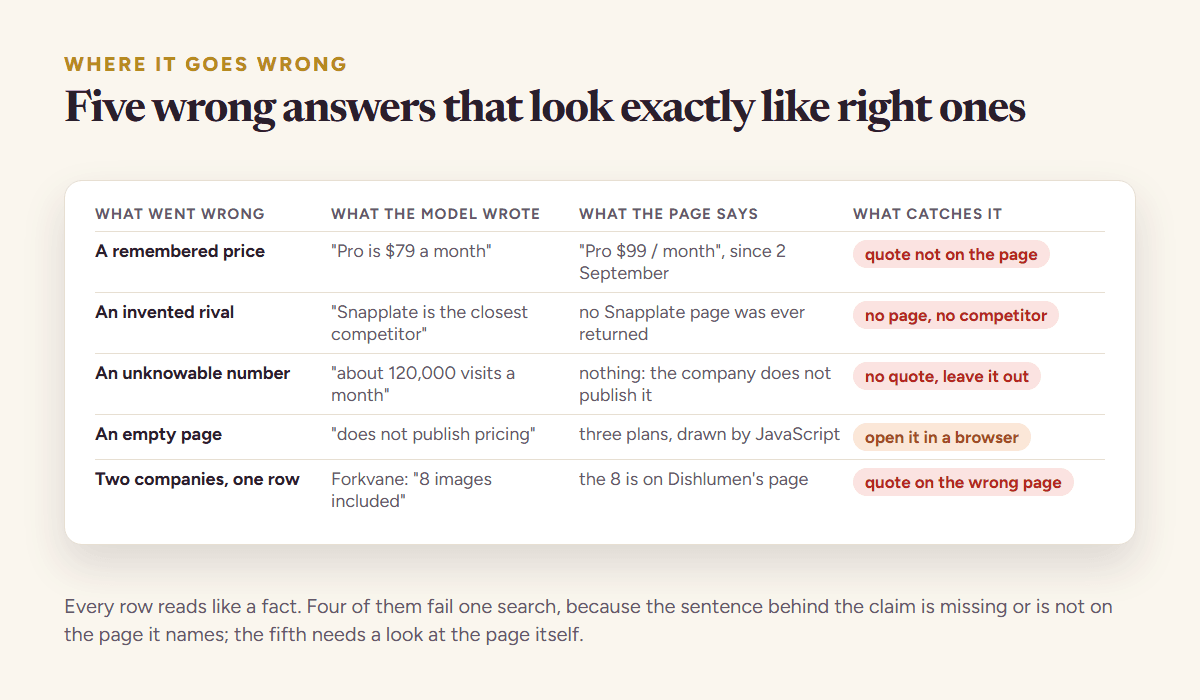
- A remembered price. A model whose training stopped before a competitor raised its Pro plan from $79 to $99 will say $79, fluently, with no sign that it is guessing. Prices are the facts that move fastest, and the ones a founder most needs right.
- An invented rival. Asked to list competitors, a model fills the list. Some names will be real, some closed two years ago, and some are plausible combinations of words that were never a company.
- An unknowable number. Monthly visits, revenue, customer counts. When the company has not published the figure, nobody outside it knows, and a model that answers anyway is producing a number with nothing underneath.
- An empty page. Many of the tools that read pages for a model fetch the HTML without running its scripts. A pricing table drawn by JavaScript comes back blank, and the analysis reports that the competitor “does not publish pricing”.
- Two companies, one row. Given several long pages at once, a model can attach one company’s quota to another company’s plan. Each half is real; the row is wrong.
None of the five is rare, and none announces itself. A table with one invented price in it looks exactly like a table without one, which is why the check has to be mechanical rather than a feeling that the answer seems right.
The one rule that makes an AI competitor analysis checkable
Every claim carries the exact sentence it came from, copied from the competitor’s page, with the address and the date. Then the sentence is checked against the page: if it is not there word for word, the claim goes. That one rule catches the remembered price, the invented rival, the unknowable number and the blended row.
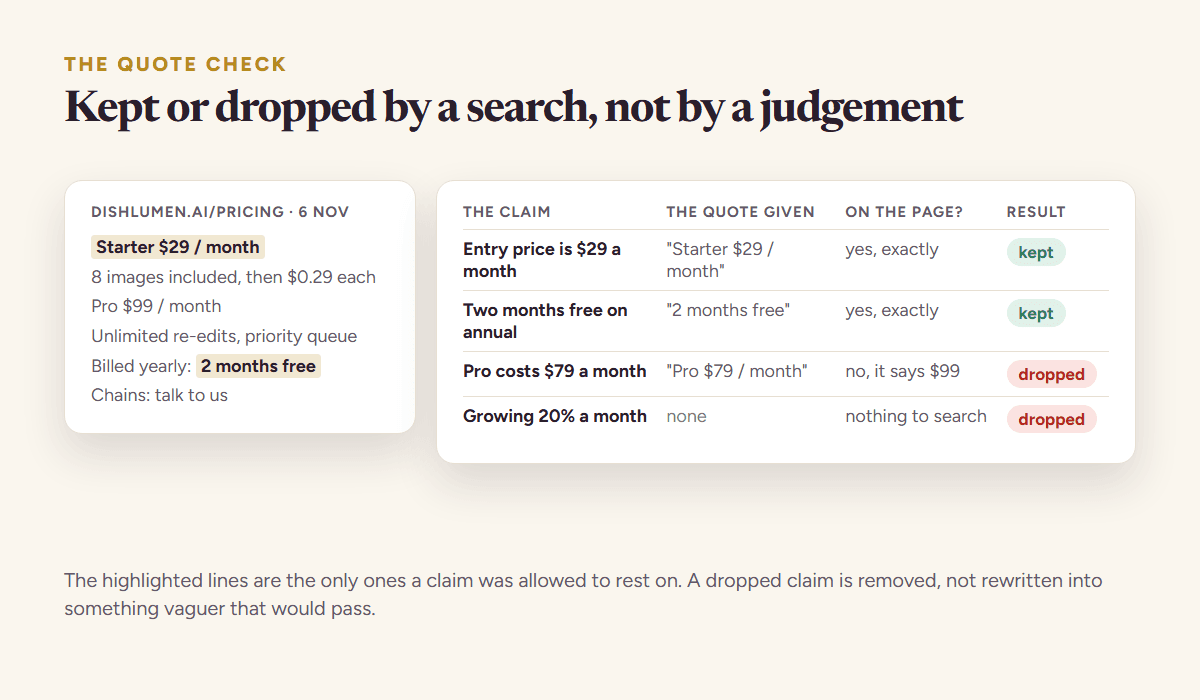
The check is a search rather than a judgement, so anyone can do it in seconds: open the page, press Ctrl+F or Cmd+F, paste the quote. A quote that is found means the claim was read, not remembered. A quote that is not found means the claim goes, however plausible it sounds, and it is not rewritten into a vaguer version that would survive.
The date matters as much as the quote: a price that was right in March is wrong in November more often than founders expect. And an empty page has nothing to quote at all, so when a pricing page comes back without prices, look at it in a browser before believing it.
How to run an AI competitor analysis you can check
In six steps, and the model does two of them: filling the table, and sorting the changes when you read the pages again. You choose the competitors and the buyer, collect the pages, check every quote against its page, and date the table so the next reading has something to be compared with.
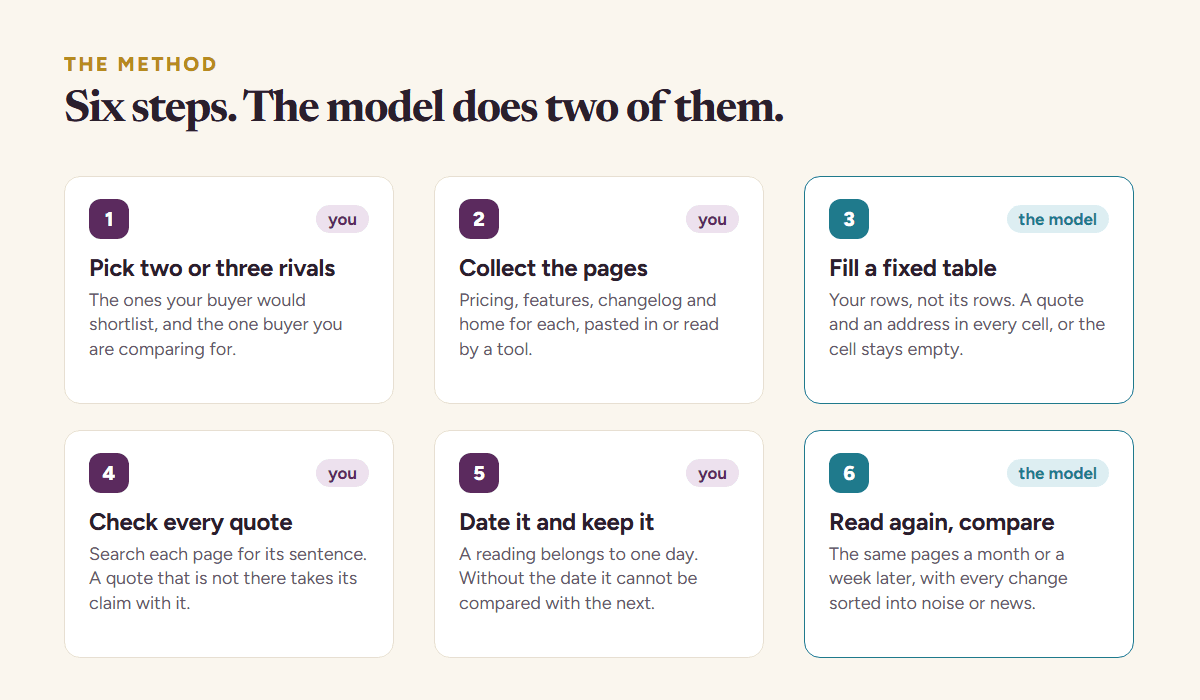
- Pick two or three rivals and one buyer. The products your buyer would shortlist against you, not the biggest names in the category. How to find competitors covers who belongs on the list, and how to find competitors using ChatGPT covers asking a model for the names in the first place.
- Collect the pages. Pricing, features, changelog and the home page for each, as text you paste in or as addresses a tool reads. Four pages per competitor is plenty.
- Have the model fill a fixed table. The rows come from you, not from the model, and a cell without a quote stays empty. The competitor analysis template has the twelve rows that matter.
- Check every quote. Search each page for its sentence, and drop every claim whose quote is not there.
- Date it and keep it. The table is a reading taken on one day. Without the date it cannot be compared with the next one.
- Read again and compare. Monthly at least, weekly for the closest competitor. The difference between two readings is where the decisions come from.
Steps one, four and five are the ones people skip, and they are the ones that make the result usable. A model will happily choose the competitors for you, fill every cell without a quote and leave out the date; the output looks just as complete, and nothing in it can be defended in a pricing discussion.
A prompt for AI competitor analysis
The prompt below works in any general assistant that accepts long text. It fixes the rows, tells the model not to answer from memory, and asks for a quote and an address in every cell. Paste each page’s text under its address, replace the brackets, and still check every quote it returns: a prompt is a request, not a control.
Copy this prompt
Compare my product with the competitors below for one buyer: [describe the buyer in one sentence]. Use only the page text I paste below, where each block starts with its page address. Do not use anything you remember about these companies. Fill a table with one column per product, mine first, and these rows: entry price, billing model, free tier, top plan, top three features, proof, positioning line. In every cell, copy the exact sentence from the page and give its address. If no page says it, write “not stated” and leave the quote empty. Do not estimate traffic, revenue or customer numbers. Then mark each row ahead, level or behind for my product, using the same quotes.
Two lines do most of the work. “Use only the page text” steers the model away from its memory, although it cannot guarantee it; the quote check is what guarantees it. And “not stated” gives the model an honest answer to give when the page is silent, so it has less reason to invent one.
Can you do an AI competitor analysis for free?
Yes, in three ways, and what separates them is who checks the quotes. A general assistant’s free tier with the prompt above costs only your time, and you check every quote yourself. A free page-change watcher tells you when to run it again. A dedicated tool’s free plan reads the pages and checks the quotes for you, for a small number of competitors.
| Route | Who reads the pages | Who checks the quotes | When it runs again |
|---|---|---|---|
| A general assistant’s free tier, with the prompt | you, by pasting the text in | you, with a search on each page | when you remember to |
| A free page-change watcher | the watcher, looking for changes only | nobody: it writes no analysis | on its schedule, as an alert |
| Competite’s free plan | Competite, on the pages you confirm | code: a claim whose quote is not on its page is dropped | monthly, for one competitor |
Competite’s free plan is deliberately small: one product, one competitor read monthly, one report and one competitor search a month, as of November 2026. That is enough to see whether a quoted analysis is worth more to you than an unquoted one, and the paid plans add competitors and weekly reads when it is.
Which AI tool is best for competitive analysis?
The one that reads the competitor’s pages instead of recalling them, and shows you the sentence behind every claim. Which kind of tool that is depends on the job: a general assistant for a one-off draft you will check yourself, an enterprise platform for a sales team’s battlecards, a founder’s tracker for what to charge and what moved this week.
Four questions sort them faster than a feature list, and every vendor can answer them in a demo:
- Does every claim show its quote? A claim without the sentence behind it cannot be checked, so it cannot be argued with in a pricing discussion.
- Does it read the page on the day? Or does it answer from what the model remembers? Ask on what date the price it shows was read.
- Does it say when a page could not be read? A blank page reported as “no public pricing” is the most convincing wrong answer there is.
- Does it read the same pages again? One analysis is a snapshot. The second reading, set against the first, is where the decisions come from.
The competitor analysis tools guide sorts the wider category, AI or not, by the question each kind of tool answers.
AI competitor monitoring: what changes after the first report
The first analysis is a snapshot, and it starts going stale the week it is written. AI competitor monitoring repeats the same reading on a schedule, with the model doing the part a diff cannot: deciding whether a change matters. A copy tweak and a price cut are both changes, and only one of them deserves your Monday morning.
A raw diff of a pricing page fires on everything: a rotated testimonial, a new date in the footer, a reordered list. What the model adds is the judgement a person would make on reading it, sorted into levels such as noise, minor, notable and major, with only the top two reaching you. Without that step, monitoring trains you to ignore the alerts, and the alert you ignore will be the price cut.
The addresses should not change either: if the model chooses where to look each week, week two differs from week one because it looked somewhere else, not because the competitor changed. Funding, launches and press come from search instead, and the same rule holds: a move without the page that reported it, and a quote from it, is a rumour. The competitor tracking guide has the cadence for each signal.
Competite runs the whole loop on the pages you confirm: it reads them, keeps only the claims whose quotes are on the page, says when a page could not be read, reads them again weekly on the paid plans and monthly on the free one, and emails you only when a change is notable or major, with what it means and one action. Start free with one competitor; the first report starts as soon as you confirm its pages.
Questions people ask
- Can AI do a competitor analysis?
- Yes, the reading and the first draft: pulling plans, prices and claims off competitors’ pages and laying them next to yours. It cannot be trusted on anything it was not shown, such as today’s price from memory or a competitor’s traffic, so every claim needs the sentence it came from, checked against the page.
- What is the best free AI competitor analysis tool?
- For a one-off, a general assistant’s free tier with the competitors’ page text pasted in and a prompt that asks for a quote in every cell, followed by a search for each quote on its page. For an analysis that repeats and checks the quotes itself, Competite’s free plan reads one competitor monthly and writes one report a month.
- Is ChatGPT good for competitor analysis?
- For reading pages you paste in, yes: it extracts plans and compares two products well, and so do Claude and Gemini. Asked about a competitor from memory, any of them can state an old price or name a rival that does not exist, with the same confidence as a correct answer. Paste the pages, ask for quotes, and check them.
- Can AI monitor competitors automatically?
- Yes, if something reads the same pages on a schedule and the model only judges the changes. The addresses have to stay fixed, or week two differs from week one because the model looked somewhere else. The model’s job is deciding which change matters, so that only the notable ones reach you.
- How accurate is AI competitor analysis?
- As accurate as what it read. On page text in front of it, extraction is reliable enough to check rather than redo; from memory, it is wrong often enough that every price should be treated as unverified. The accuracy comes from the quote check, not from the model: a claim whose quote is on the page is right about what that page said on that day.
See it on your own competitors
Add your product, or just describe the idea. Competite finds the competitors, reads their pages, and writes the comparison with a quote behind every claim. Free, in about three minutes, no card.
Keep reading
Competitor analysis tools in 2026: which kind you actually need
The five kinds of competitor analysis tools, what each answers, who it is for and what it costs, from traffic estimators to founder-focused tracking.
9 September 2026 · 7 min read
Competitor tracking: how to monitor competitors’ prices, features and funding every week
Competitor tracking for founders: the six signals to monitor, how often each one moves, where they live, and what a good alert looks like.
9 September 2026 · 7 min read
How to track competitor website changes without drowning in alerts
How to track competitor website changes: the six pages worth watching, four ways to do it, free or automatic, how to filter noise, and what to do next.
6 November 2026 · 11 min read
A competitor analysis template that fits on one page, with the table
A free competitor analysis template on one page: the twelve-row table, the rules for filling it with quotes and dates, a scoring key, and a worked example.
15 September 2026 · 8 min read
How to validate a startup idea with AI before you build it
Validate a startup idea with AI using a seven-day research plan for buyer pain, competitors, demand, pricing, interviews, and a paid test.
7 October 2026 · 7 min read
Competitor analysis services: what they cost, and when to buy one
What competitor analysis services cost, from a 300 dollar audit to 30,000 a month, what lands in the deliverable, and the three times it is the wrong purchase.
19 September 2026 · 8 min read
How to find competitors using ChatGPT, and how to check every name it gives you
How to find competitors using ChatGPT or another AI assistant: five prompts to copy, four checks every name must pass, and a worked example of ten names.
25 November 2026 · 10 min read