A direct competitor comparison that survives contact with a buyer
· 5 min read · by the Competite team
A comparison across eight competitors is a survey. A direct competitor comparison is one rival, read properly, and it is the one that changes what you charge and what you say on a landing page. It is also the one most often done dishonestly, usually by accident: rows chosen because you win them, plans lined up because they share a name, and no dates anywhere. This covers picking the rival, making the plans comparable, and the four habits that quietly ruin it.
Which rival, and only one
Not the biggest name in the category. The one your buyers actually mention, which is usually smaller and closer, and which you can identify in about three messages by asking the last three people who did not buy what else they looked at.
One at a time matters more than it sounds. The point of a direct comparison is depth: reading their onboarding, counting the steps, finding the footnote under the price. Across six competitors that becomes a table of shallow cells, which is a different artefact with a different job. That one is the template, and it is worth having too, for different reasons.
| Pick this rival | Not this one |
|---|---|
| The name buyers say out loud in a sales call | The market leader, who sells to a different buyer |
| Same price band, same way of buying | A company ten times your price with a sales team |
| You have lost at least one deal to them | A company you find impressive |
| Their pricing page is public | A company whose pricing is "contact us", which is a different field |
Making two price lists comparable
This is where most comparisons break, and it breaks quietly, because plan names look like they line up. A Pro at one company is an entry plan at another. Comparing them because they share a word produces a number that is wrong in a direction nobody notices.
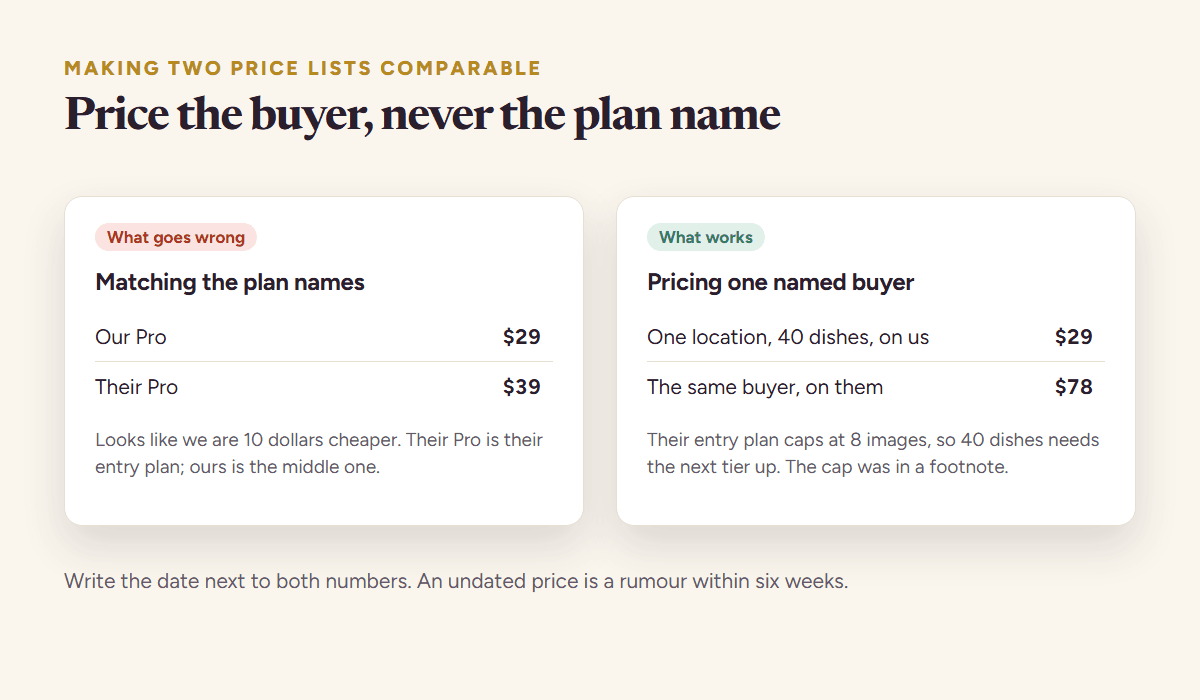
- Write down one specific buyer: what they need, how much of it, how many people. A restaurant with one location and forty dishes, not "a small business".
- Price that buyer on your list. Note which plan they land on and what it costs a month.
- Price the same buyer on theirs, ignoring plan names entirely. Read the footnotes: the cap is usually in one.
- Write both numbers with the date you read them. Prices move, and an undated number becomes a rumour within about six weeks.
- Repeat for a second buyer who is meaningfully different. Two buyers is usually enough to show whether one of you is cheaper everywhere or only somewhere.
The eight things worth reading on a pricing page, and the tricks that make a number look smaller than it is, are in competitor pricing analysis.
Choosing the rows, which is the whole game
A comparison is only as honest as its rows, and rows are where the thumb goes on the scale. The test is simple and uncomfortable: has a buyer ever asked about this, unprompted, in a sales call or a support message? If not, it is not a row. It is something you are proud of.
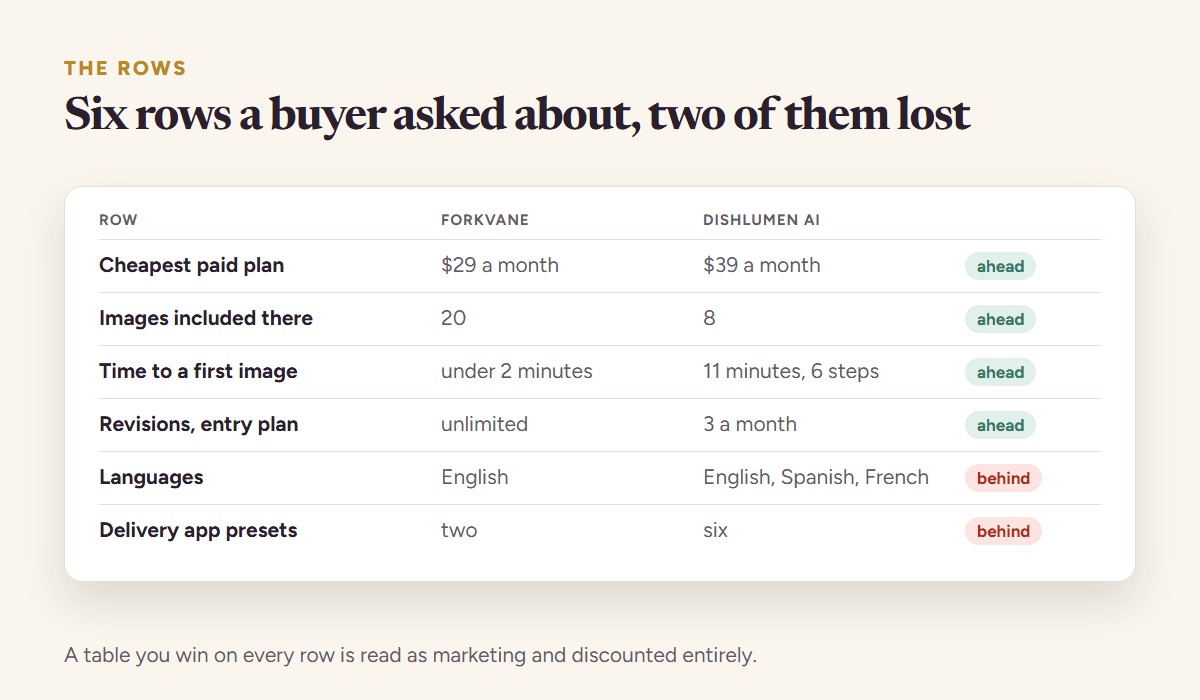
| Row | Forkvane | Dishlumen AI | Verdict |
|---|---|---|---|
| Cheapest paid plan | 29 dollars a month | 39 dollars a month | ahead |
| Images included at that price | 20 | 8 | ahead |
| Time to a first usable image | under 2 minutes | 11 minutes, 6 steps | ahead |
| Revisions on the entry plan | unlimited | 3 a month | ahead |
| Languages | English | English, Spanish, French | behind |
| Delivery app presets | two | six | behind |
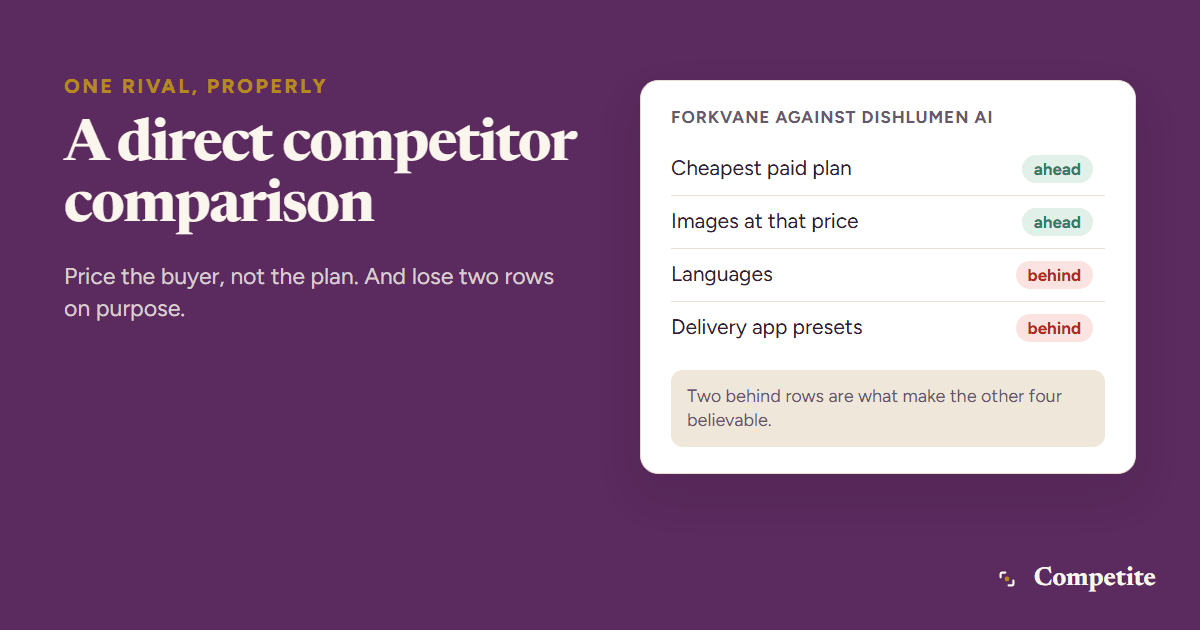
Two behind rows out of six is not a weakness in that table, it is the reason anybody believes the other four. A comparison where you win every row is read as marketing and discounted entirely, which is the opposite of what it cost you to make.
Four habits that ruin it
- Comparing your best plan with their worst. Usually accidental: you know your own list well and theirs shallowly, so you reach for the plan you know. Fix it by pricing a buyer rather than a plan.
- Rows with no buyer behind them. Every feature you shipped and they did not, listed because it exists. It makes the table longer and less convincing at the same time.
- Claims with no quote. "They are slow" is not a row. "Eleven minutes to a first image, six steps, read on 14 September" is. Anything you cannot quote either gets checked or gets dropped, and dropping is better than softening.
- Writing it once. The pricing line goes stale first, usually within a quarter. A comparison with one date on it, from March, is worse than no comparison, because it is confidently wrong.
A comparison you win on every row is not a comparison. It is a brochure with a table in it.
What to do with it afterwards
Three things, in descending order of value, and none of them is "put the table on the website".
- Decide whether your price is right. Two buyers priced on both sides is usually enough to tell whether you are cheaper everywhere, cheaper somewhere, or quietly more expensive than you thought.
- Write one sentence for sales, about the difference, in the buyer words. Not the table. One sentence, so nobody on your side improvises in a call.
- Only then consider a public comparison page, and only if buyers already mention them unprompted. Writing one against a rival nobody is shortlisting gives them free attention and ranks your own site for their name.
And put a date on the pricing row, then check it monthly. That single row is where a good comparison rots first. Watching it is what Competite does, so the number in your table has a history behind it rather than a memory.
Questions people ask
- What is a direct competitor comparison?
- A head-to-head against one rival that sells to the same buyer, at a comparable price, bought the same way. It goes deeper than a table across many competitors: their onboarding counted in steps, the footnote under their price, their claims quoted with dates. It is the comparison that changes what you charge.
- How do I compare two pricing pages fairly?
- Never by plan name. Write down one specific buyer, price them on your list, then price the same buyer on theirs while ignoring what the plans are called, reading the footnotes for caps. Do it for a second, different buyer as well, and write the date next to both numbers.
- Should I win every row in a competitor comparison?
- No, and a table where you do is read as marketing and discounted. Two rows out of six where you are behind is what makes the other four believable. It also tells you something true, which is the point of doing it at all.
- How often does a direct competitor comparison need updating?
- The pricing row goes stale fastest, usually within a quarter, so check it monthly. The rest holds for six months or so unless they repackage. A comparison carrying one date from six months ago is worse than none, because it is confidently wrong.
See it on your own competitors
Add your product, or just describe the idea. Competite finds the competitors, reads their pages, and writes the comparison with a quote behind every claim. Free, in about three minutes, no card.
Keep reading
A competitor analysis template that fits on one page, with the table
A free competitor analysis template on one page: the twelve-row table, the rules for filling it with quotes and dates, a scoring key, and a worked example.
15 September 2026 · 7 min read
Competitor pricing analysis: how to read a pricing page like a buyer
Competitor pricing analysis in an afternoon: the eight things to read on a pricing page, how to compare plans that are not alike, and how to set your price.
15 September 2026 · 8 min read
Direct and indirect competitors, and the one that beats both
Direct vs indirect competitors, with examples: what separates them, why the status quo beats both, and how to sort your own list in about ten minutes.
17 September 2026 · 6 min read