Competitive intelligence for startups: a 20-minute weekly routine, without a team
· 10 min read · by the Competite team
Competitive intelligence for startups is not a department. It is a short list of competitors, a fixed set of pages, twenty minutes a week to read what moved, and a decision written down each time something did. This guide covers the four decisions it serves, the minimum system, the weekly review minute by minute, the decision log, the one-page monthly brief, and what to leave to companies with a sales team.
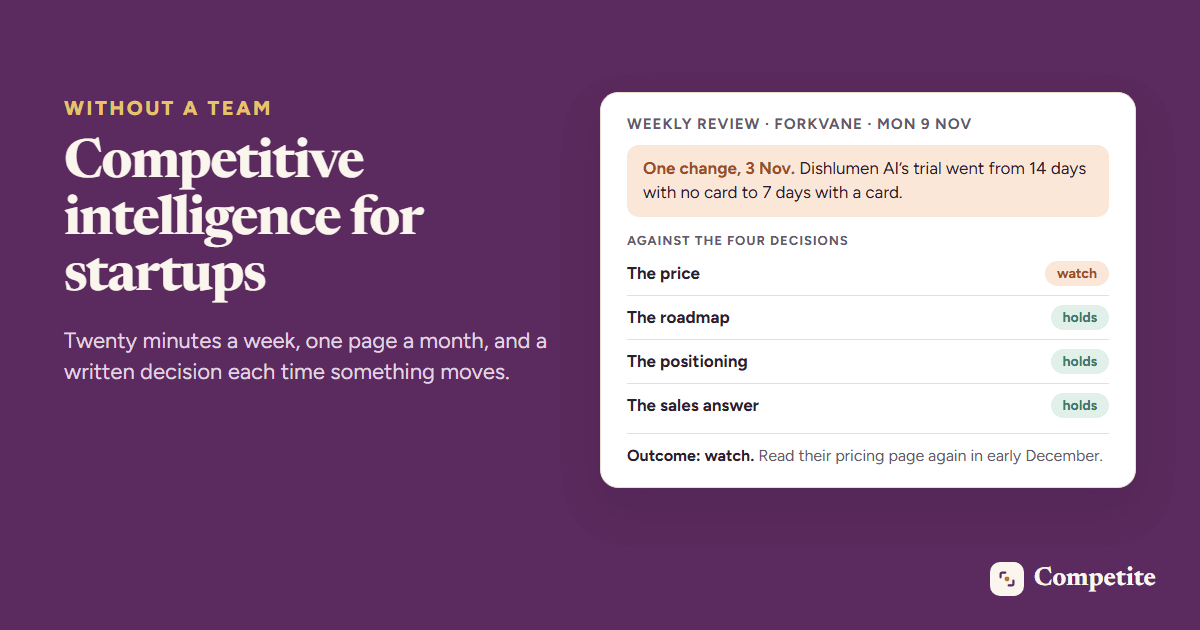
What is competitive intelligence for startups?
Competitive intelligence is the habit of collecting what competitors do in public and turning it into decisions. At a large company it is a team that briefs the sales floor. At a startup it is one person, a short list and a weekly review, and what it produces is a decision about price, product or message, not a report.
| What it is | How often | What comes out of it | |
|---|---|---|---|
| Competitor analysis | you against a rival, at one moment | each quarter | where you are ahead, what to charge |
| Competitor tracking | re-reading their pages for what moved | every week | a dated note of each change |
| Market research | asking buyers what they need and pay for | before a large decision | what buyers want, in their words |
| Competitive intelligence | the routine that joins the three to a decision | weekly and monthly | a decision, with its reason |
The first two have their own guides: competitor analysis for startups covers the comparison, and the competitor tracking guide covers the six signals. This guide is the part that joins them: who looks, when, and what gets decided afterwards.
Which decisions does competitive intelligence serve at a startup?
Four: what to charge, what to build next, what to say on the home page, and what to answer when a buyer names a rival. Intelligence that feeds none of the four is reading for its own sake. Before collecting anything, write each one as a question, with today’s answer beside it.
| Decision | The question to keep answered | What can change the answer | Where it is read |
|---|---|---|---|
| The price | Is our entry price where we want it against theirs? | a price cut or rise, a new plan, a changed trial or free tier | their pricing page |
| The roadmap | Do buyers now expect something we lack? | a feature shipped, moved to a cheaper plan or removed | their features page and changelog |
| The positioning | Do we still say something they do not? | a new headline, a new audience, a comparison page naming us | their home page |
| The sales conversation | What do we answer when a buyer names them? | a new proof point, a new limit, a lost deal | lost deals, reviews, case studies |
Today’s answer has to be specific enough for a change to contradict it. “Our entry price is $29 a month, level with their Starter plan” can be proved wrong by one reading of a pricing page. “We are competitively priced” cannot.
What is the minimum competitive intelligence process for a small company?
Six parts: a ranked list of three to seven competitors, the signals worth reading, the pages those signals live on, a twenty-minute review every week, a one-page brief every month, and one person who owns all of it. None of the six needs a budget. Each of them needs a place in a calendar.
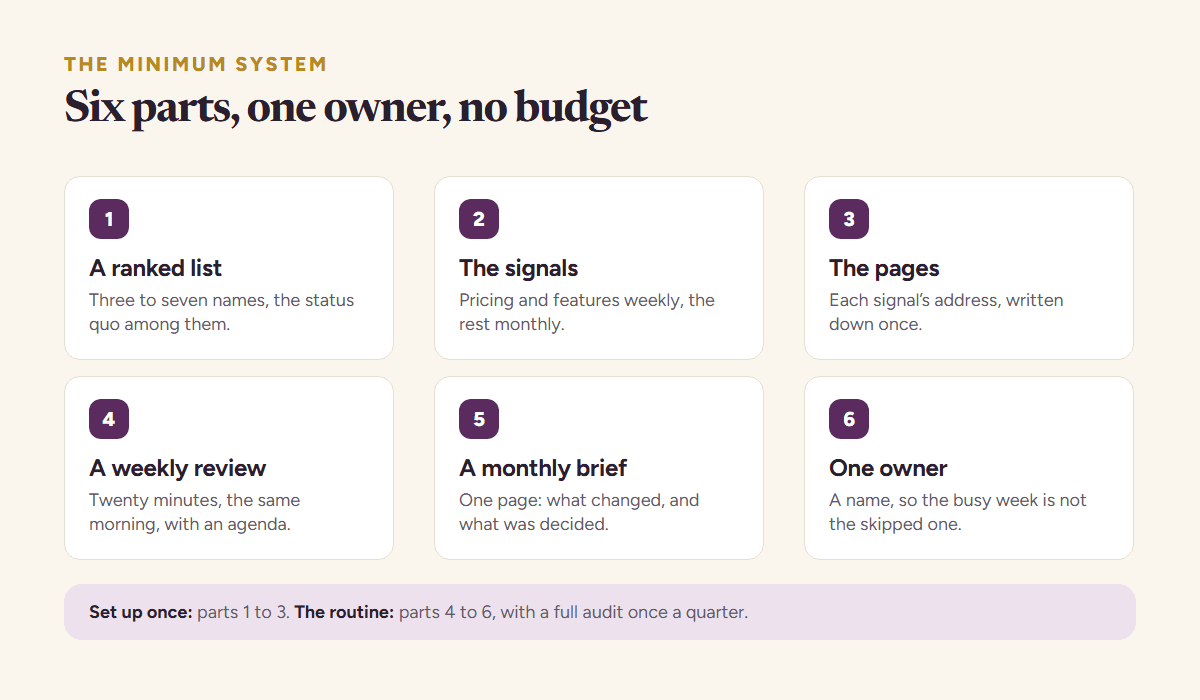
- A ranked list. Three to seven names, the status quo among them. How to find competitors builds it, a competitor list template has the columns, and primary, secondary and tertiary competitors covers the ranking.
- The signals. Pricing and features every week; positioning, hiring and reviews every month; funding and press the day they happen.
- The pages. The address of each primary competitor’s pricing page and changelog, written down once.
- A weekly review. Twenty minutes on the same morning, with the agenda below.
- A monthly brief. One page, readable in two minutes.
- One owner. A name, not “the team”: whoever notices when the review did not happen.
How do you run a weekly competitor review in 20 minutes?
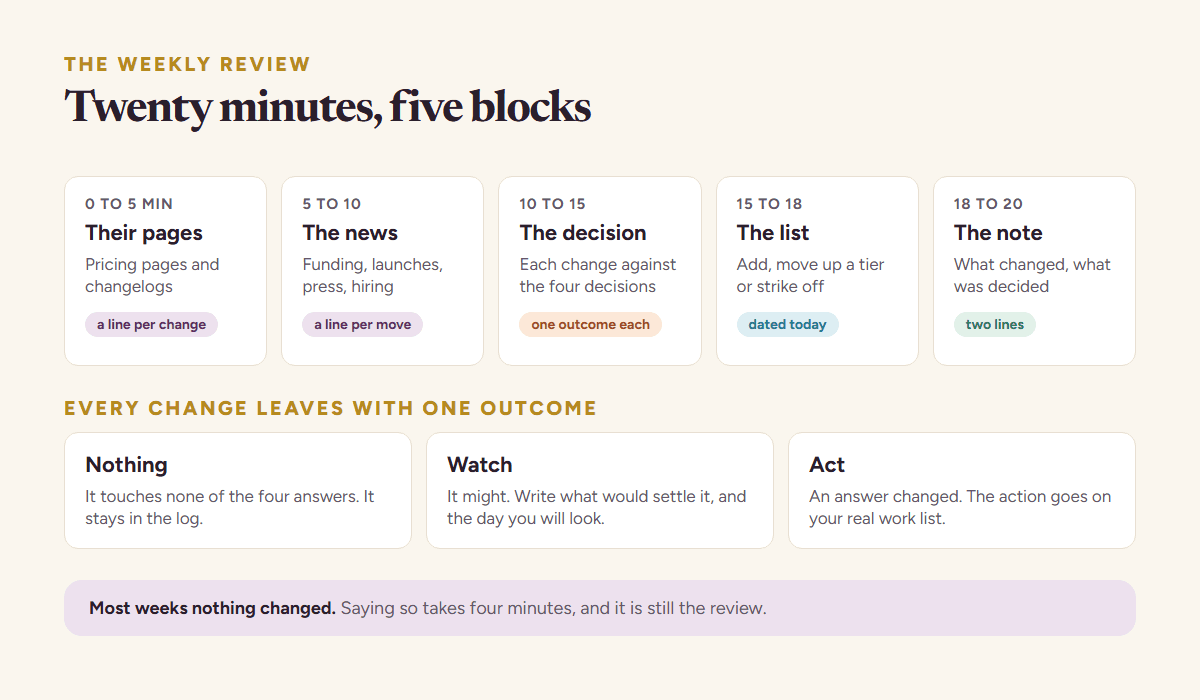
Give it a fixed slot and an agenda: five minutes on what moved on their pages, five on news beyond their sites, five to decide what each change means, three to update the list and two to tell whoever needs to know. Most weeks nothing changed, and saying so takes four minutes.
| Minutes | What you do | What comes out of it |
|---|---|---|
| 0 to 5 | read what moved on each primary competitor’s pricing page and changelog | one line per change, with the before and the after |
| 5 to 10 | read the news beyond their sites: funding, launches, press, hiring | one line per move, with its source |
| 10 to 15 | set each change against the four decisions | nothing, watch or act |
| 15 to 18 | check the list: anyone to add, move up or strike off | the list, dated today |
| 18 to 20 | write two lines to the team, or to yourself | what changed, what was decided |
Every change leaves with one of three outcomes. Nothing: it touches none of the four answers, and stays in the log. Watch: it might, so you write what would settle it and the day you will look. Act: an answer has changed, and the action goes on the same list as the rest of your work.
The twenty minutes are the review, not the collecting: they assume the week’s changes were gathered by alerts, a page watcher or a tool. How to track competitor website changes covers the log, one dated line per change.
What is a decision log, and why keep one?
A decision log is three columns beside each change: what you decided, why, and when you will look again. It is the part of competitive intelligence that shows whether the reading changed anything. Without it, a year of weekly reviews leaves a record of what competitors did and none of what you did.
| Date | What changed | What was decided, and why | Look again |
|---|---|---|---|
| 2 Sep | Dishlumen AI raised Pro from $79 to $99 a month | nothing: buyers compare entry plans, and that price did not move | no |
| 26 Sep | Dishlumen AI cut Starter from $39 to $29 a month | act: hold at $29, and add a line under the price saying revisions are unlimited | in a month |
| 3 Nov | Dishlumen AI’s trial went from 14 days, no card, to 7 days with a card | watch: a price move may follow | early December |
The log above belongs to Forkvane, the fictional startup used across this blog, which turns a phone photo of a dish into a menu photo for independent restaurants; Dishlumen AI is its closest direct competitor. Three changes, three outcomes, a reason beside each. The third came from the review on Monday 9 November: a shorter trial with a card usually means too many trials never paid, and a price move sometimes follows. How to detect competitor trial changes covers what each kind of change tends to mean.
It needs no document of its own: three more columns in the weekly log are enough.
What goes on a one-page competitive intelligence brief?
Five things, once a month: the list as it stands, what changed, what was decided, whether the four answers still hold, and what to look at next month. It is written for whoever was not in the weekly reviews, which at a startup includes you in six months.
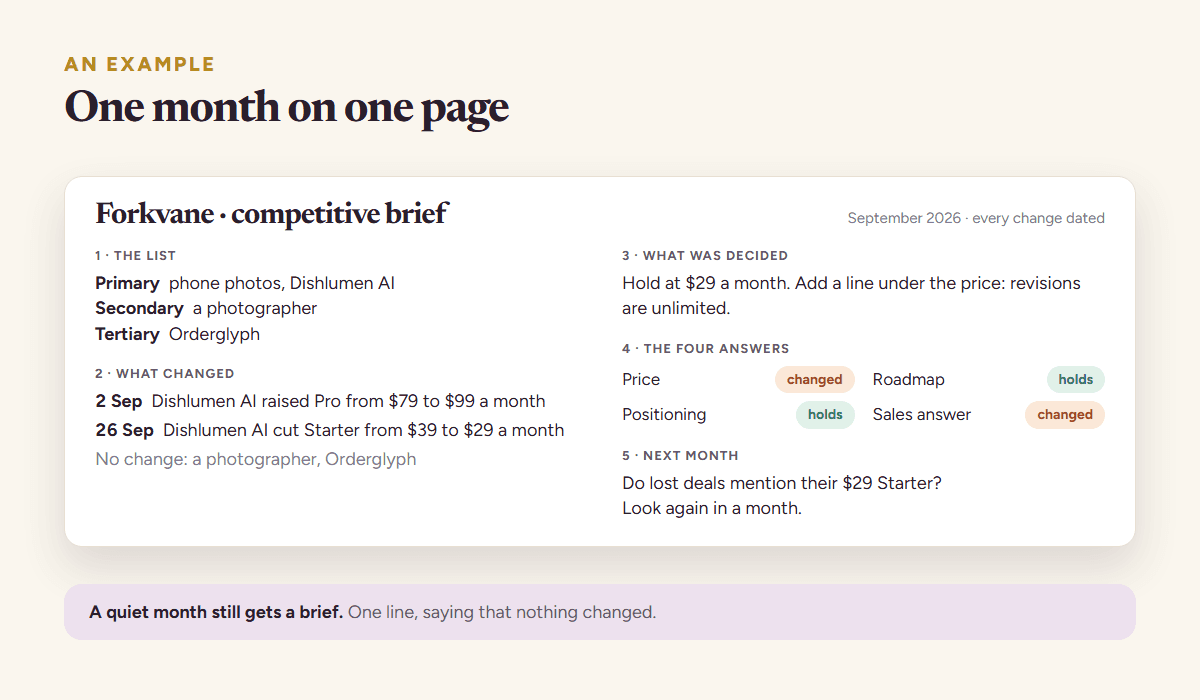
- The list. Every name, by tier.
- What changed. Two to five dated lines, each with the before and the after.
- What was decided. One line per decision, with its reason.
- The four answers. Each marked as holding or changed.
- Next month. What you are watching, and when you will look.
Two rules keep it to a page. Every change has a date and a page behind it. And a month in which nothing changed still gets a brief, one line long, because an unwritten brief looks like a skipped one.
The brief sits between two other records: the weekly log holds every change, the brief holds the few that mattered, and once a quarter a competitor audit in one day re-reads everything from the start.
What can a startup skip until it has a sales team?
Three things that enterprise competitive intelligence is built around: a battlecard programme, a formal win and loss programme, and a platform bought to feed both. Each exists to brief salespeople at scale. With no sales floor there is nobody to brief, and the founder was on the call anyway.
| What | The startup version | Add the full one when |
|---|---|---|
| Battlecards | three lines in the monthly brief: what they claim, what their page says, what you answer | a second person starts selling |
| A win and loss programme | one question to every lost deal: what did you choose instead? | one person no longer hears every deal |
| An enterprise platform | a list, a log and the weekly review | a team exists whose job is to use it |
A lost deal is the only source that knows what was on the buyer’s shortlist, and a name two buyers mention in a quarter belongs at the top of the list. Interviews done properly, by somebody buyers will talk to, are a service: competitor analysis services covers what one costs.
What does competitive intelligence cost a startup?
Time at first, then tens of dollars a month. A spreadsheet, alerts on each competitor’s name and a page watcher with a free tier cost nothing but the hours. A founder-focused tracker starts at tens of dollars a month. Enterprise platforms such as Crayon and Klue are quoted per company, typically in the tens of thousands of dollars a year.
Those bands were read from the vendors’ pages in September 2026; check the page before you decide. Competitor monitoring tools compares named tools with the price on each vendor’s page, and competitor analysis tools sorts the wider category. Run the routine by hand for a month first: the part you keep skipping is the part worth paying to have done.
Which mistakes make startup competitive intelligence useless?
Six, and most share a cause: collecting without deciding. A folder of screenshots, a channel of links and a spreadsheet nobody opens are all intelligence with no decision attached. Each mistake below does the reading and skips the part where it changes something.
- A list of twelve. Past seven names, none of them is read properly.
- No dates. “They are cheaper than us” is true until the day it is not.
- Answering the same day. Give a new name a day, then judge it with the four questions in a new competitor in your market.
- Watching only companies. The buyer who carries on with a spreadsheet or a phone belongs on the list too.
- Skipping the quiet weeks. A review that runs only when something happened misses the week it did.
- Crossing the line. Read what is public. Do not sign up under a false name, pose as a buyer or question a rival’s former employee.
Competite does the collecting. It reads the pages you confirm for each competitor, typically the home page, pricing, features and changelog, weekly on Build and Launch and monthly on the free Idea plan, and alerts you only to notable and major changes. The paid plans also scan for moves beyond the site, such as funding, launches, press coverage and hiring: monthly on Build, weekly on Launch. Reports carry a quote behind every claim and a pricing recommendation, and an action queue collects what to do. It is not built for battlecards or a sales team.
Idea is free, with one competitor, one report and one competitor search a month, and no card. Build is $49 a month and Launch is $99. Start free with one competitor.
Questions people ask
- What is competitive intelligence in a startup?
- The habit of collecting what competitors do in public and turning it into decisions about price, product, positioning and sales answers. At a startup that means one owner, a list of three to seven competitors, a twenty-minute weekly review and a one-page monthly brief.
- How do you do competitive intelligence without a team?
- Give it one owner and a fixed slot. Keep a ranked list of three to seven competitors, read the pricing pages and changelogs of the two or three that matter most every week, and write one line per change with the decision beside it.
- How long should a weekly competitor review take?
- About twenty minutes for three competitors, once the week’s changes have been collected by alerts or a tool: five on their pages, five on news beyond them, five on decisions, three on the list and two on a note to the team.
- Does a startup need a competitive intelligence tool?
- Not to begin with. A spreadsheet, alerts on each competitor’s name and a page watcher with a free tier cover the first months. A tool earns its place when the weekly reading keeps being skipped, an enterprise platform when there is a sales team to brief.
- Is competitive intelligence ethical?
- Yes, when it stays with public sources: what a company publishes and what others publish about it. It stops being ethical with deception, such as signing up under a false name or posing as a buyer, and with confidential information taken from a rival’s former employee.
See it on your own competitors
Add your product, or just describe the idea. Competite finds the competitors, reads their pages, and writes the comparison with a quote behind every claim. Free, in about three minutes, no card.
Keep reading
Competitor tracking: how to monitor competitors’ prices, features and funding every week
Competitor tracking for founders: the six signals to monitor, how often each one moves, where they live, and what a good alert looks like.
9 September 2026 · 7 min read
Competitor monitoring tools: ten compared by what each one watches and what it costs
Ten competitor monitoring tools compared: what each one watches, who it is for, and its entry price as read on the vendor’s own page on 25 November 2026.
25 November 2026 · 11 min read
A competitor list template: what to record about each rival, with a filled example
A free competitor list template: the twelve columns to record for each rival, how many names to keep, a filled example, and a CSV for Sheets or Excel.
25 November 2026 · 10 min read
A competitor audit in one day: the checklist, and what it costs to have one done
How to run a competitor audit in a day: what to read on each competitor, a six-part checklist, what the audit should produce, and what a paid audit costs.
15 November 2026 · 7 min read
Competitor analysis for startups: a founder’s guide
How to do a competitor analysis as an early-stage founder: find the real competitors, read their pricing, quote their claims, and keep it alive every week.
9 September 2026 · 8 min read