A new competitor just launched in your market. What to do first
· 5 min read · by the Competite team
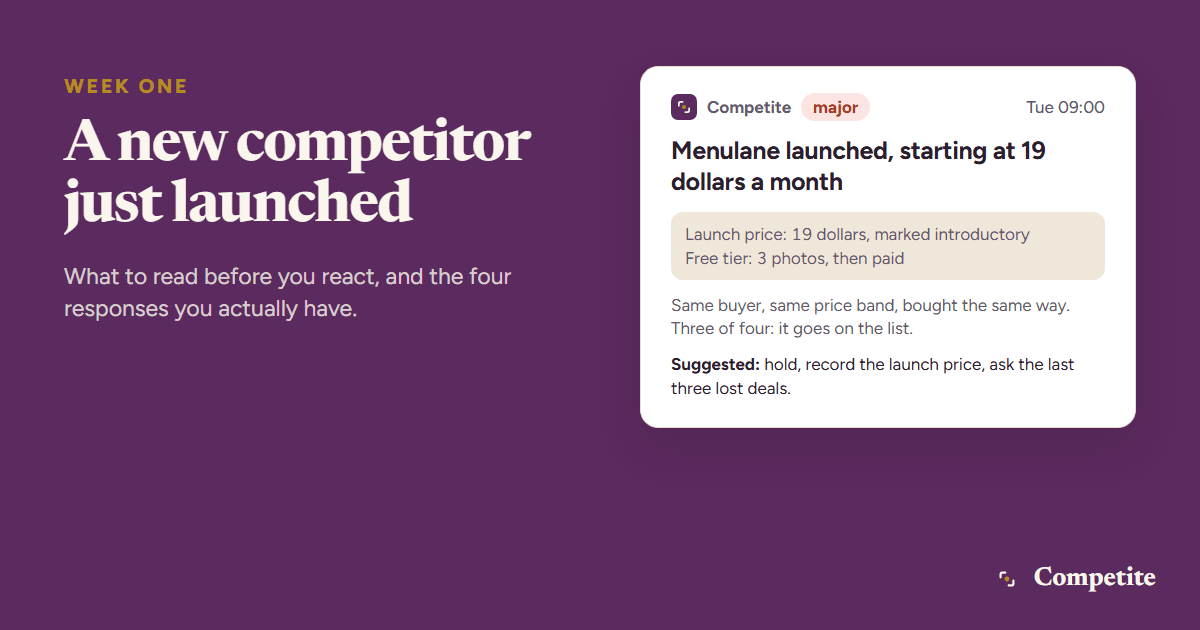
A new competitor in your market is the news founders handle worst, because it arrives as a feeling rather than as information. The launch post is designed to look inevitable, the pricing looks aggressive, and the instinct is to answer within the day. Almost none of that instinct is right. This guide covers what to read before you react, the four questions that decide whether this one matters, the four responses that are actually available, and the small number of things worth doing in the first week.
The twenty-four hours before you do anything
A launch is a marketing event, not a product event. What you are looking at is the most flattering possible description of something that may be two weeks old. Separate what shipped from what was announced, and the panic usually goes with it.
- Sign up, if you can. Twenty minutes in the product tells you more than the whole launch post. Count the steps to a first useful result.
- Read the pricing page, not the announcement. Launch pricing is often introductory, and a page usually says so in small type.
- Check what is behind the screenshots. Features shown in a video and features you can reach in the product are different lists.
- Find out how old it is. A company two years old that launched publicly today is a different problem from one that started in March.
The thing not to do on day one
Do not change your price. A price moved in a week under pressure is very hard to move back, and launch pricing from a company with no customers is not information about what the market pays.
Four questions that decide whether it matters
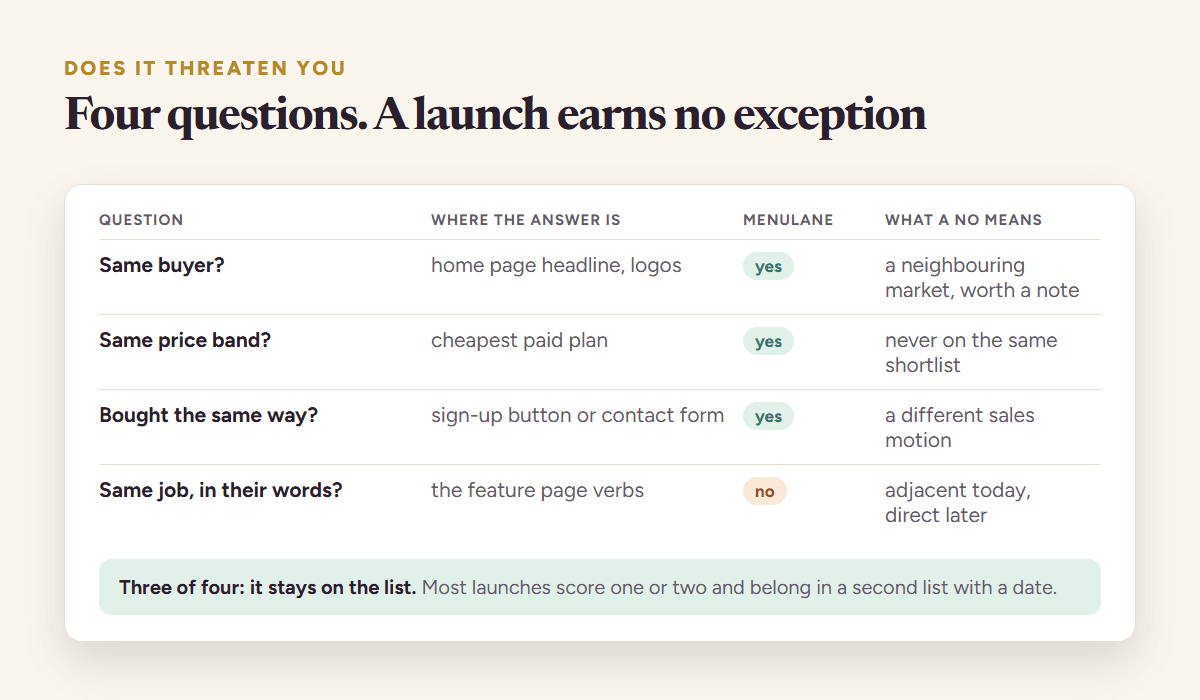
A new product is not automatically a competitor, and a loud launch is not evidence that it is. Run it through the same test as any other candidate, and keep it only if it clears three.
| Question | Where the answer is | What a no means |
|---|---|---|
| Same buyer? | their home page headline and logos | a neighbouring market, worth a note and nothing else |
| Same price band? | their cheapest paid plan | never on the same shortlist as you |
| Bought the same way? | sign-up button or contact form | a different sales motion, so different deals |
| Same job, in the words a customer uses? | their feature page verbs | adjacent today, possibly direct next quarter |
Most launches score one or two and belong in a second list with a date against them. The scoring and where each answer lives are covered in how to find competitors of a company, and the labels in direct and indirect competitors.
The four responses you actually have
There are only four, and three of them are cheap. The expensive one is the one people reach for first.
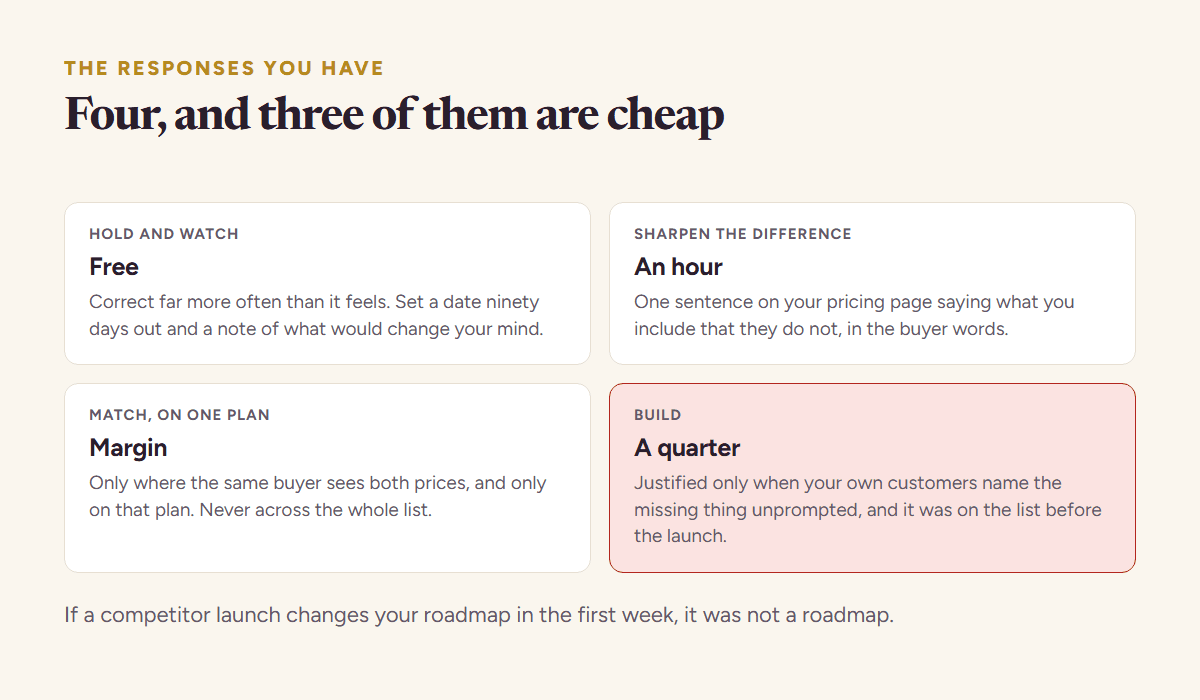
- Hold and watch. Correct far more often than it feels. Set a date three months out and a note of what would change your mind. A launch with no customers behind it frequently goes quiet on its own.
- Sharpen the difference. Cheapest real response. One sentence on your pricing page and your home page saying what you include that they do not, in the buyer words rather than yours.
- Match, on the one plan that overlaps. Only where the same buyer genuinely sees both prices, and only on that plan. Matching across a whole price list because of one competitor is how a business loses a margin it never gets back.
- Build. The expensive one. Justified when the missing thing is named by your own customers, unprompted, more than once, and it was already on your list before the launch.
If a competitor launch changes your roadmap in the first week, it was not a roadmap.
What to actually do in week one
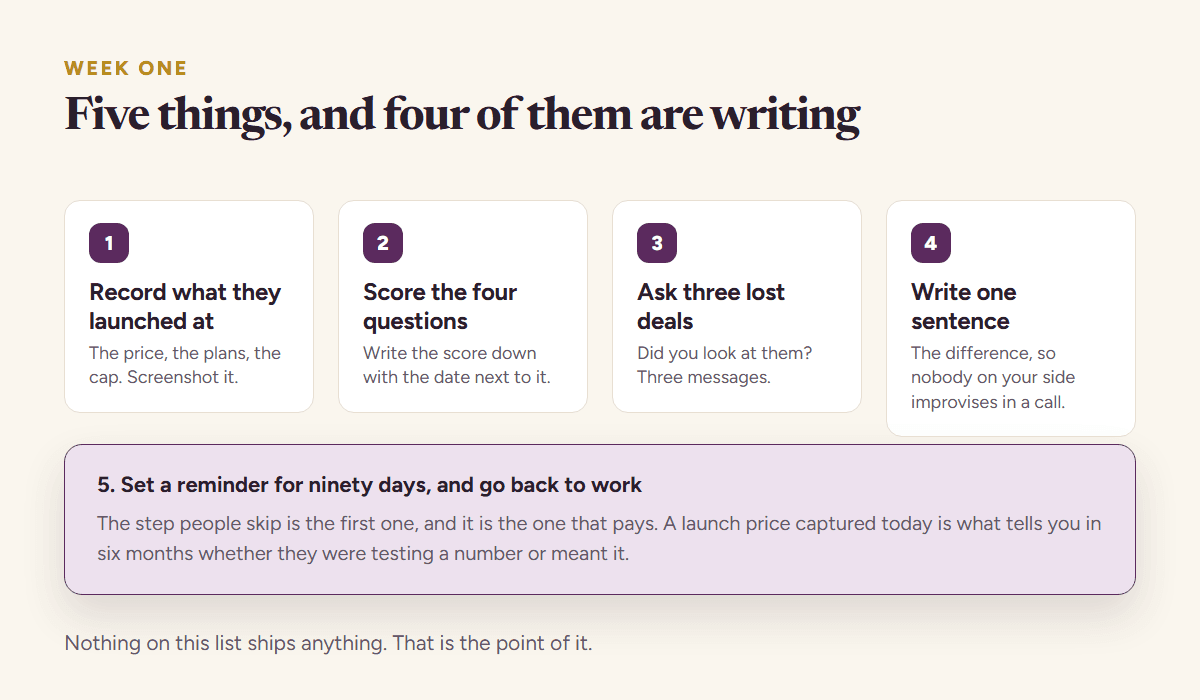
Short list, in order. Most of it is writing things down rather than shipping anything.
- Record what they launched at: the price, the plan names, what the free tier caps. Screenshot it. Launch pricing changes and you will want the original.
- Answer the four questions and write the score down with the date.
- Ask your last three lost deals whether they looked at it. This is the only real evidence, and it takes three messages.
- Write one sentence for your sales conversations about the difference, so nobody on your side is caught improvising.
- Set a reminder for ninety days and go back to work.
The step people skip is the first one, and it is the one that pays. A launch price captured today is what tells you, six months from now, whether they were testing a number or meant it. Keeping that history is the part worth automating rather than diarising: Competite reads the pages you point it at and mails you when one of them moves, so the record exists without anyone remembering to look.
When the price does move, the week that follows has its own playbook, which is in competitor price tracking.
Questions people ask
- A competitor launched a product like mine. Should I lower my price?
- Almost never in the first week. Launch pricing from a company with no customers is not evidence about what the market pays, and a price cut made under pressure is very hard to reverse. If you match at all, match on the single plan where the same buyer sees both prices, and leave the rest of the list alone.
- How do I know whether a new competitor is a real threat?
- Ask whether it takes the same buyer, sits in the same price band, is bought the same way, and does the job in the words your customers use. Keep it on the list only if it clears three of the four. Then check the only real evidence, which is whether your last few lost deals looked at it.
- Should I write a comparison page against a new competitor?
- Not immediately. A comparison page aimed at a product nobody is shortlisting yet gives it free attention and ranks your site for their name. Wait until buyers mention them unprompted; until then, one sentence about what you include does the same job without the advertising.
- How do I find out about new competitors sooner?
- The early signals are not launch posts. New names appear in review site also-viewed strips, in search results for your own name with the word alternatives, and in the job adverts of companies one step away from your category. Checking those once a quarter finds most newcomers before they announce anything.
See it on your own competitors
Add your product, or just describe the idea. Competite finds the competitors, reads their pages, and writes the comparison with a quote behind every claim. Free, in about three minutes, no card.
Keep reading
Competitor price tracking: what to do the week a competitor cuts a price
Competitor price tracking for founders: what to watch on a pricing page, how to track it by hand or automatically, and the four moves when they cut a price.
15 September 2026 · 7 min read
Direct and indirect competitors, and the one that beats both
Direct vs indirect competitors, with examples: what separates them, why the status quo beats both, and how to sort your own list in about ten minutes.
17 September 2026 · 6 min read
Competitor tracking: how to monitor competitors’ prices, features and funding every week
Competitor tracking for founders: the six signals to monitor, how often each one moves, where they live, and what a good alert looks like.
9 September 2026 · 6 min read