Primary, secondary and tertiary competitors: how to rank the ones you found
· 8 min read · by the Competite team
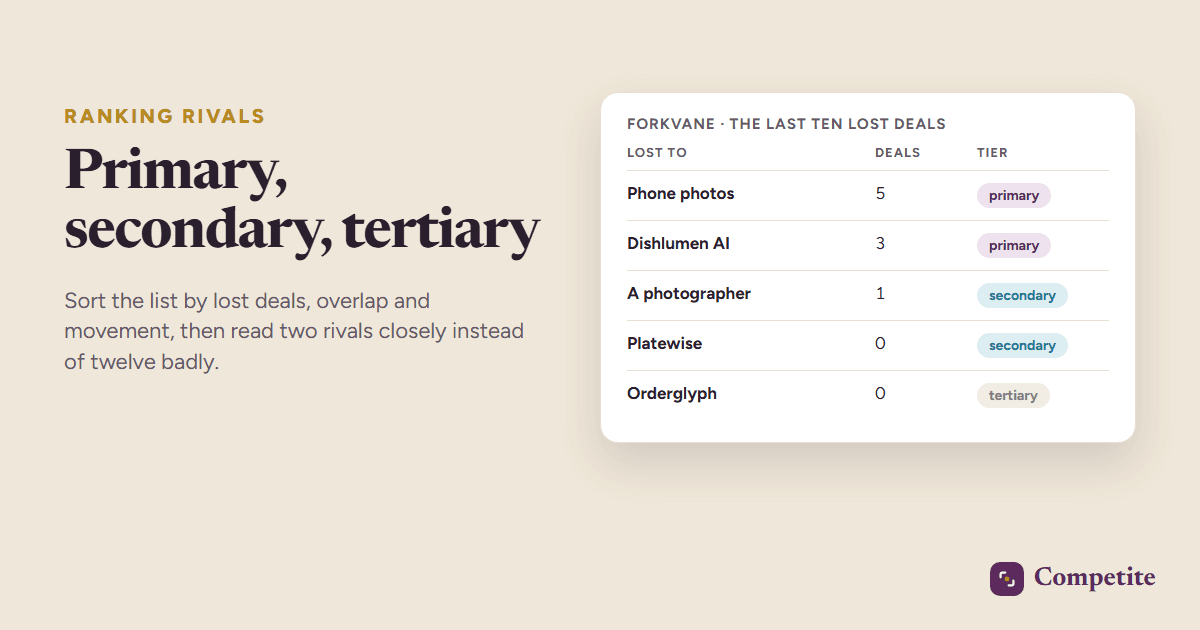
Primary, secondary and tertiary competitors are the same list of rivals, sorted by how much of your attention each one deserves. Finding competitors produces a list; ranking them decides which two you read every week and which ten you can leave alone until something changes. This guide covers what the three tiers mean, the three questions that place a competitor in one, a worked example, and the signals that move a rival up.
What are primary, secondary and tertiary competitors?
Primary competitors are the ones you meet in most deals and lose customers to. Secondary competitors do the same job for a slightly different buyer or price, or solve the same problem another way, and come up now and then. Tertiary competitors are adjacent products and newcomers that could matter later. The tiers rank attention, not size: a small rival you lose to every week is primary.
| Tier | Who is in it | How often you meet them | What they get |
|---|---|---|---|
| Primary | the alternatives buyers actually choose instead of you | in most deals | a weekly read of their pricing and features, and a full comparison |
| Secondary | a near neighbour: another buyer, another price, another route | now and then | a monthly look, and one row in the analysis |
| Tertiary | adjacent products and new entrants | rarely or never, so far | a dated note, read again each quarter |
The names vary. Some teams say tier one, two and three; others say top competitors and the rest. What matters is the idea underneath: a list on which every name gets the same attention is a list nobody keeps up.
How is this different from direct and indirect competitors?
Direct and indirect describe what a competitor is; primary and secondary describe how much it matters to you this quarter. The two usually line up, since a direct competitor is often a primary one, but not always. A photographer is an indirect competitor to a menu-photo tool, and if half of the lost deals go to photographers, the photographer is primary.
Kind is stable and rank is not. A competitor stays direct or indirect for years, because that depends on what it sells. Its tier can change in a month, because that depends on what your buyers did last. The direct vs indirect competitors guide covers the first label; this one is about the second.
The status quo deserves a tier as well. For an early product, “they carried on with what they had” is the most common reason a deal is lost, which makes doing nothing a primary competitor with no website.
How do you rank a competitor? Three questions
Ask how often buyers choose it instead of you, how closely it overlaps with what you sell, and whether it is moving. Frequency comes from your own lost deals, overlap from the competitor’s pages, and movement from what changed on those pages lately. A rival that scores high on the first question is primary whatever the other two say.
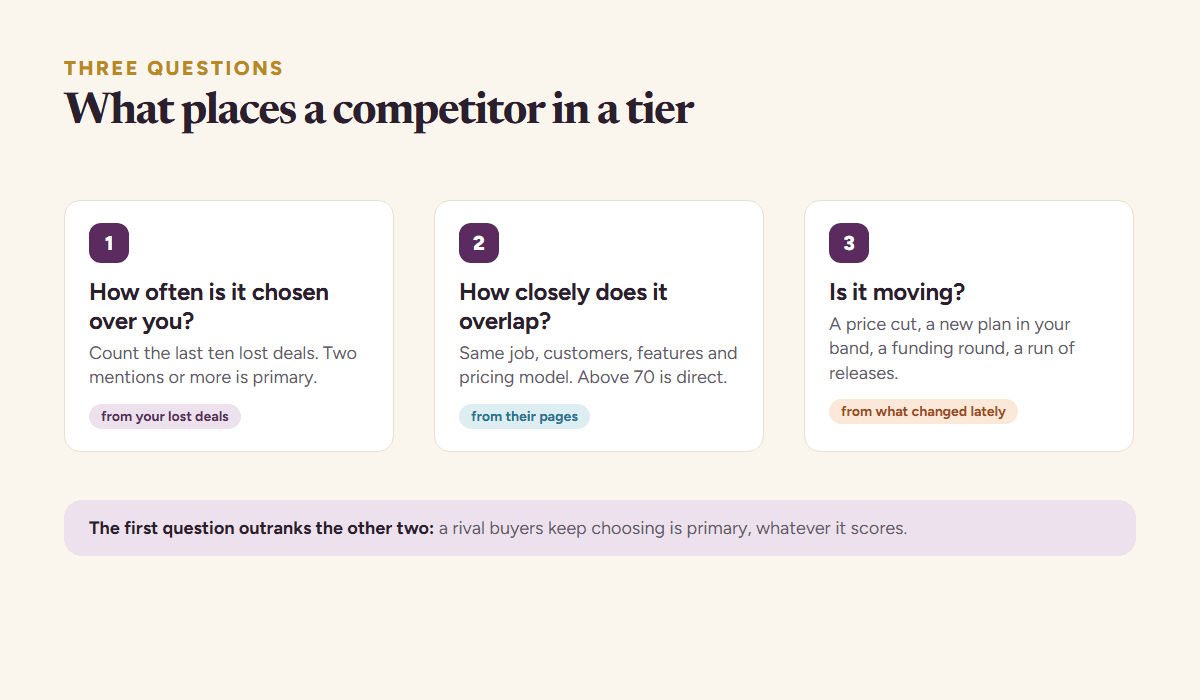
- How often do buyers pick it over you? Go through the last ten deals you lost, the ones lost to doing nothing included, and write a name beside each. Two or more mentions makes a primary competitor.
- How closely does it overlap? Score the same job, the same customers, the same features and the same pricing model from its own pages. How to find competitors has the weights: above about 70 is direct, 40 to 70 is adjacent.
- Is it moving? A price cut, a new plan in your band, a funding round, a run of releases. A quiet rival can wait; one that changed its pricing page twice this quarter cannot.
Before you have ten lost deals to count, use the second question alone and treat the result as provisional. The first real deal you lose will correct it faster than any amount of scoring.
A worked example: ranking six names
Here is the list for Forkvane, the fictional startup used across this blog, which turns a phone photo of a dish into a menu photo for independent restaurants. It found six alternatives. Two are primary, two are secondary, one is tertiary and one comes off the list, and only one of the two primary ones is a company.
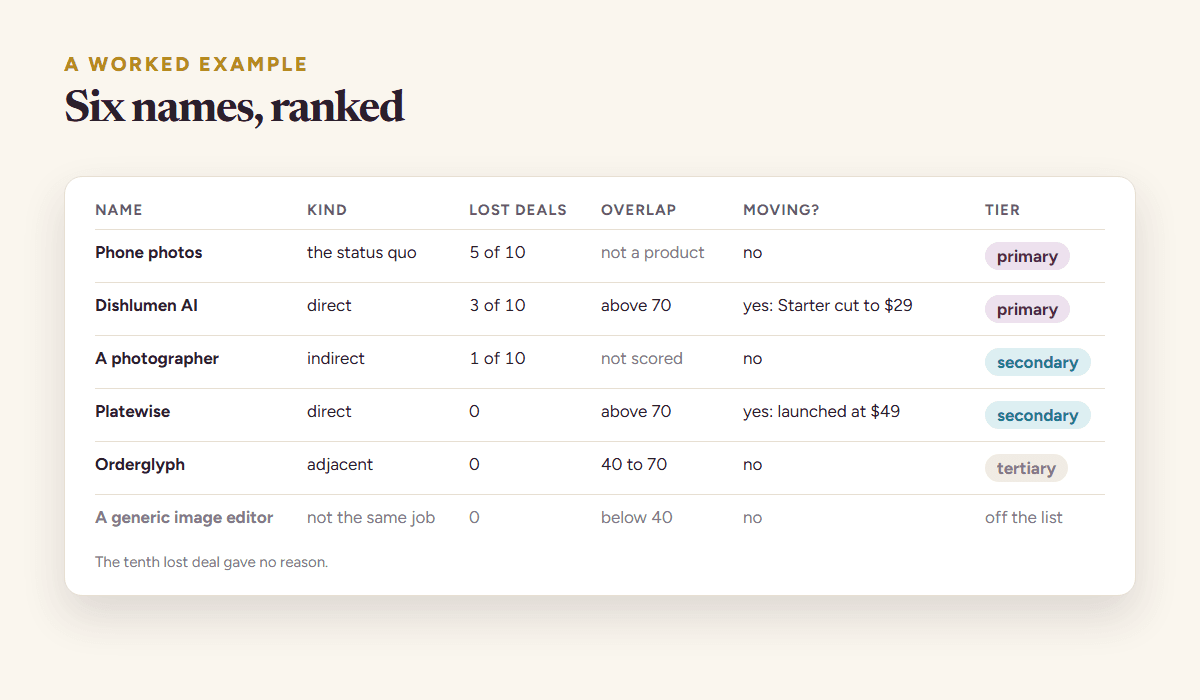
| Name | Kind | Lost deals, of the last ten | Overlap | Moving? | Tier |
|---|---|---|---|---|---|
| Phone photos | the status quo | 5 | not a product | no | primary |
| Dishlumen AI | direct | 3 | above 70 | yes: Starter cut to $29 | primary |
| A photographer | indirect | 1 | not scored | no | secondary |
| Platewise | direct | 0 | above 70 | yes: launched at $49 a month | secondary |
| Orderglyph | adjacent | 0 | 40 to 70 | no | tertiary |
| A generic image editor | not the same job | 0 | below 40 | no | off the list |
Three things in it are worth noticing. The top competitor is not a company: half the lost deals went to restaurants that kept using their phones. Platewise scores as high on overlap as Dishlumen AI and is still secondary, because no buyer has mentioned it yet. And the image editor, which looked like a competitor on a list, does a different job and gets no attention at all.
The tenth lost deal gave no reason, which is normal. Nine named alternatives out of ten is enough to rank a list, and far more than a search of the market would have told Forkvane about who it actually loses to.
How much attention does each tier get?
Primary competitors get a weekly read of the two pages that move most, pricing and the changelog, and a full side-by-side comparison. Secondary ones get a monthly look and one row in the analysis. Tertiary ones get a dated note and a quarterly check. The point of ranking is to spend an hour a week on two rivals instead of ten minutes on twelve.
- Primary: every week. Pricing and features change most often, and change your own decisions most. The competitor tracking guide has the six signals and how often each one moves.
- Secondary: every month. The home page headline, the cheapest plan, anything new. Enough to notice a move towards your buyer.
- Tertiary: every quarter. One line each, with the date you last looked. Most stay where they are; the list exists for the one that does not.
For the status quo, the weekly read is of your own lost deals instead of somebody’s pricing page: what the buyer said they would do instead, in their words. That is the only page it has.
When does a competitor move up a tier?
When a buyer names it. One lost deal moves a secondary competitor up for a closer look, and two in a quarter make it primary. Short of that, three changes on its own pages are worth acting on: a new plan in your price band, a headline rewritten in your buyer’s words, and a comparison page that names you.
| Signal | What it means | What to do |
|---|---|---|
| A buyer names it in a lost deal | it is on the same shortlist | read its pricing page this week; a second mention in the quarter makes it primary |
| A new plan in your price band | it now sells to your buyer | treat it as primary until the next ten deals say otherwise |
| Its home page uses your buyer’s words | the positioning has moved before the product | look again in a month |
| Its comparison page names you | it is already losing deals to you | it is primary: write your side of the comparison |
Moves down matter as much. A primary competitor that no buyer has mentioned for two quarters is holding a place a newer rival needs, and a new competitor in your market covers how to judge a newcomer before it earns one.
How many competitors belong in each tier?
Two or three primary, three or four secondary, and as many tertiary as fit on one page. More than three primary competitors means the weekly read will not happen, and a tier nobody reads is the same as no tier. If five rivals all seem primary, rank them by lost deals and let the bottom two drop to monthly.
Competite follows the same shape. Each plan watches a fixed number of competitors, one on Idea, three on Build and seven on Launch, reads the pages you confirm for each on a schedule, and emails you only when something notable changes. Put your primary competitors in those places first. Start free with one competitor.
Questions people ask
- What is a primary competitor?
- A competitor that buyers actually choose instead of you: it appears in most of your deals and you lose customers to it. It is usually a direct competitor, but the test is frequency, not similarity. For many early products the primary competitor is the buyer carrying on with what they already do.
- What is a secondary competitor?
- A near neighbour that comes up now and then: the same job for a different buyer or price band, or a different kind of product that solves the same problem for your buyer. It deserves a monthly look, and it moves up the moment a buyer names it in a deal you lost.
- What is a tertiary competitor?
- An adjacent product or a newcomer that does not compete with you today but could: a tool your buyers already use that might add your feature, or a company that has just launched. Keep one dated line on each, and read the list again every quarter.
- Are primary competitors the same as direct competitors?
- Often, but they are different labels. Direct and indirect say what a competitor sells; primary and secondary say how much it matters to you now. An indirect competitor, such as a service buyers hire instead of buying a tool, is primary if most of your lost deals go to it.
- How do I find out who my top competitors are?
- Count them in your own lost deals. Go through the last ten and write down what each buyer chose instead, doing nothing included. The names that appear twice or more are your top competitors, whatever a search or a list of the market says.
See it on your own competitors
Add your product, or just describe the idea. Competite finds the competitors, reads their pages, and writes the comparison with a quote behind every claim. Free, in about three minutes, no card.
Keep reading
Direct vs indirect competitors: what each one is, and the one that beats both
What a direct competitor is and what an indirect one is, with examples: the test that separates them, why the status quo beats both, and how to sort a list.
17 September 2026 · 8 min read
How to find your competitors, even before you have a product
How to find competitors, even before you have a product: six free ways that start from a job or an idea, how to score the overlap, and how many to keep.
15 September 2026 · 9 min read
Competitor tracking: how to monitor competitors’ prices, features and funding every week
Competitor tracking for founders: the six signals to monitor, how often each one moves, where they live, and what a good alert looks like.
9 September 2026 · 7 min read
A new competitor just launched in your market. What to do first
A new competitor launched in your market: how to read what they actually shipped, decide whether it threatens you, and the four responses worth making.
17 September 2026 · 7 min read
Competitive landscape analysis: putting the whole field on one page
How to run a competitive landscape analysis: pick two axes that decide deals, place every competitor from its own pages, and read the gap that is left.
17 September 2026 · 6 min read
A competitor list template: what to record about each rival, with a filled example
A free competitor list template: the twelve columns to record for each rival, how many names to keep, a filled example, and a CSV for Sheets or Excel.
25 November 2026 · 10 min read