A competitor list template: what to record about each rival, with a filled example
· 10 min read · by the Competite team
A competitor list template is a table with one row for each rival and the same columns for all of them, so the list says more than who: what kind of competitor each one is, how much it matters, what it charges and when you last looked. Most competitor lists are a column of names in a note, which is why they are wrong a month later. This one has twelve columns. The filled example is below, and you can download the template as a CSV file that opens in Google Sheets or Excel.
What is a competitor list?
A competitor list is the short record of who you compete with: one row for each rival, with what kind of competitor it is, how much it matters, what it charges and when you last checked. It sits between finding competitors and analysing them. The search produces names; the list decides which of them you keep reading.
| Finding competitors | The competitor list | The competitor analysis | |
|---|---|---|---|
| What it produces | candidates, often twenty or more | the names you keep, each with a reason and a date | what those names mean for your price and your product |
| How long it is | as long as the search was wide | three to seven names, plus a watch list | two or three competitors beside your own product |
| When it changes | each time the search is run again | when a buyer names somebody, or a price moves | after each read of their pages |
How to find competitors covers six ways to get the names, and competitor search sets out eight searches to run in order. The competitor analysis template is where two or three names are compared with your product, row by row. The list is the roster; the template is the comparison.
What should a competitor list include? The twelve columns
Twelve columns, in four groups: who the competitor is, how much it matters, what to read, and whether it still belongs. Each cell holds one fact you read on a page or heard from a buyer. A cell you cannot fill stays empty: an empty cell is a task, and a guessed one is an error nobody will find.
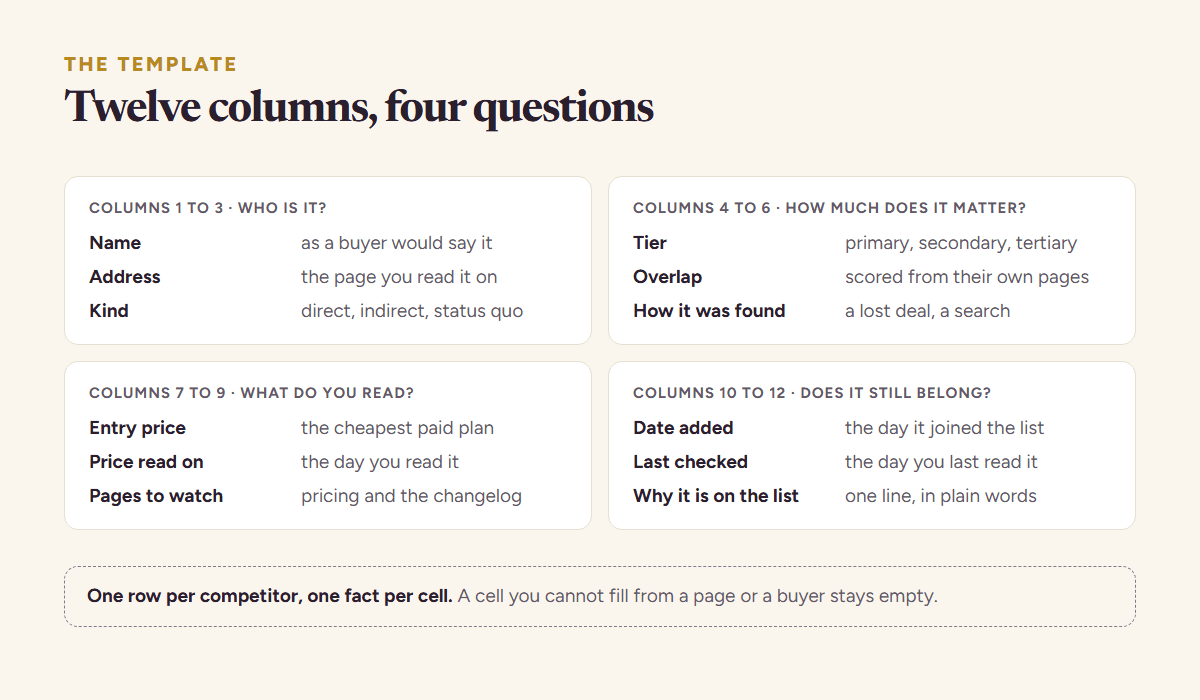
| Column | What to write | Why it is there |
|---|---|---|
| 1. Name | the name a buyer would say, not the legal entity | so a mention in a deal matches a row |
| 2. Address | the home page, or “none” for the status quo | where the other cells were read |
| 3. Kind | direct, indirect or the status quo; “adjacent” for a neighbour that does part of the job | how you compete: on features, on price, or against doing nothing |
| 4. Tier | primary, secondary or tertiary | how often the row is read |
| 5. Overlap | a score from 0 to 100, or a band, from their own pages | separates a competitor from a name that sounded like one |
| 6. How it was found | a lost deal, a search, a review site, a launch site | a name from a buyer outranks a name from a search |
| 7. Entry price | the cheapest paid plan, with its billing period | the first number a buyer compares |
| 8. Price read on | the day you read that price | an undated price cannot be trusted next month |
| 9. Pages to watch | usually pricing and the changelog; three at most | turns the row into a routine |
| 10. Date added | the day the name went on the list | shows which rivals are new this quarter |
| 11. Last checked | the day you last read the pages to watch | shows whether the list is alive |
| 12. Why it is on the list | one line, in plain words | no line, no row |
1–10 of 12 rows | ||
Three columns are labels with a guide behind each. Kind is the difference between direct and indirect competitors. Tier is the ranking into primary, secondary and tertiary competitors. Overlap is scored from the rival’s own pages: the same job, the same customers, the same features and the same pricing model.
The entry price is the column most often filled from memory. Read it on the pricing page and write the day beside it. Where the page says “contact us”, write that; how to find competitor pricing covers the other places a price can be read.
Two columns are missing from most competitor lists: how the name was found, and why it is on the list. The first says how much weight the row deserves. The second is a test: a competitor you cannot justify in one line is a name you copied from somewhere.
Download the competitor list template for Google Sheets or Excel
Download the competitor list template as a CSV file. It has the twelve columns across the top, the six example rows from this page to show what a filled row looks like, and blank rows underneath. It opens in Google Sheets, Excel and Numbers, and nothing in it is a formula.
In Google Sheets, use File, then Import, then Upload; in Excel or Numbers, open the file directly. Delete the example rows once your own are in.
How many competitors should be on the list?
Three to seven active names, and a watch list beside them. Under three, the status quo is usually missing; over seven, the rows will not be re-read. A complete list has three parts: the active names you read on a schedule, a watch list of one-line notes, and the names you took off, kept with the reason.
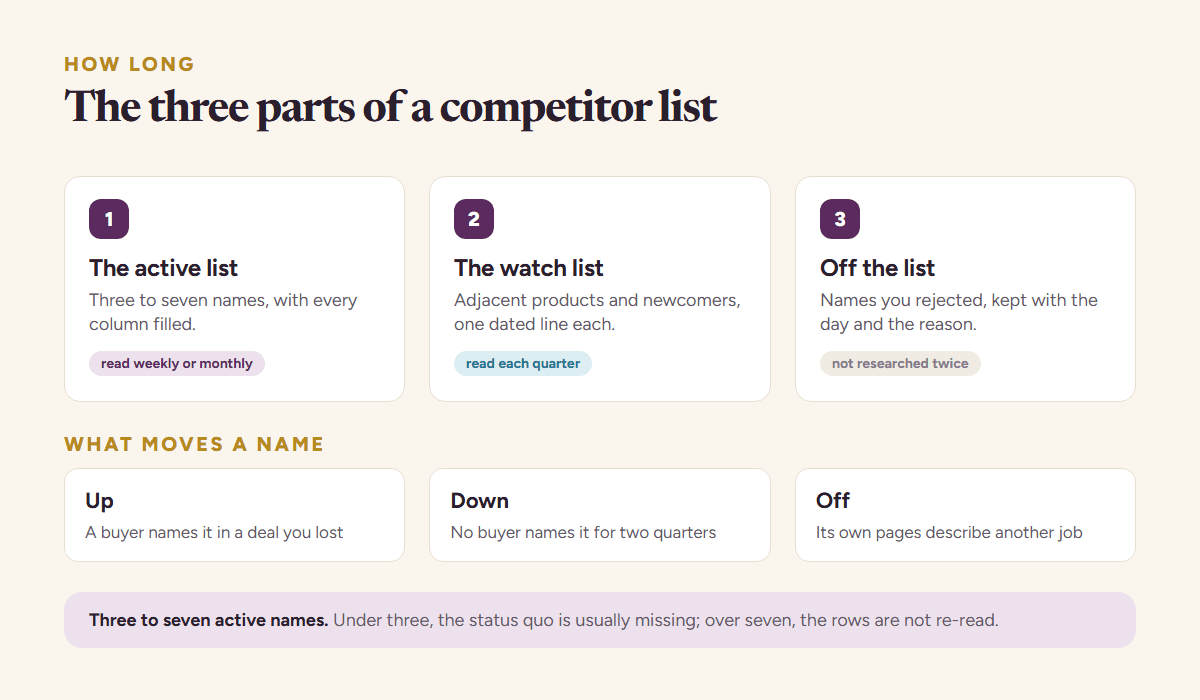
- The active list: three to seven names. Your primary and secondary competitors, with every column filled.
- The watch list: as many as fit on a page. Adjacent products and newcomers. A name, an address, a date and one line; the price can wait until the name moves up.
- Off the list: kept, not deleted. The names you looked at and rejected, with the day and the reason, so that nobody researches them again next quarter.
The numbers follow from attention, not from the size of the market: two or three rivals is all a weekly read can cover. If the list comes out empty, no competitors for your product covers what an empty search usually means.
A competitor list example: five names, and one struck off
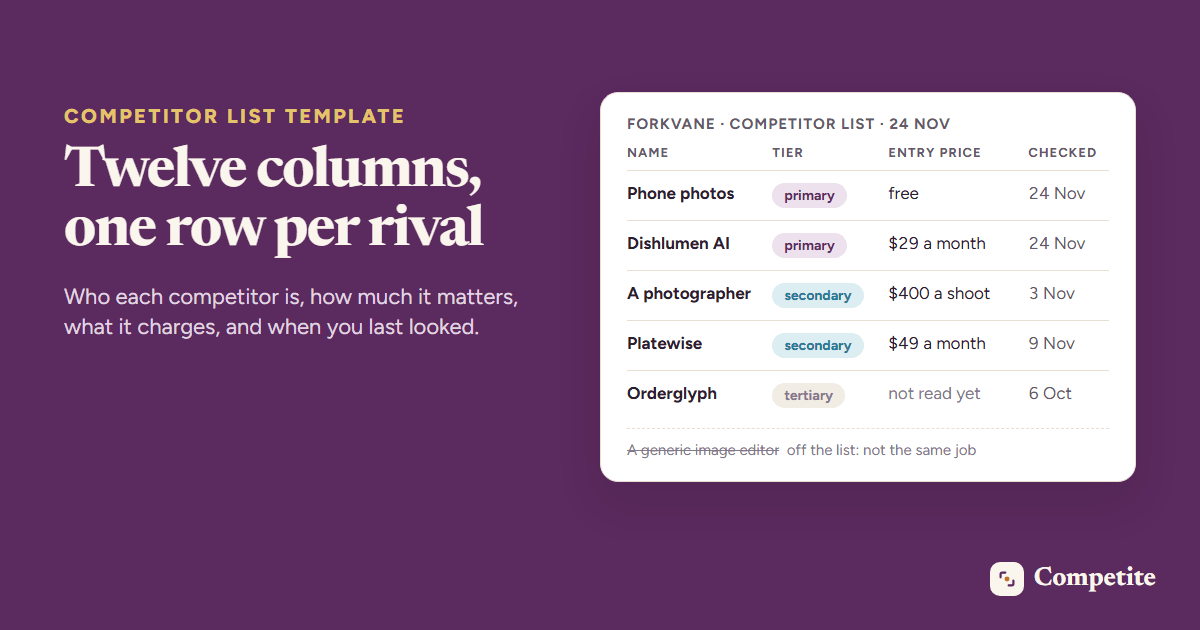
Here is the competitor list for Forkvane, the fictional startup used across this blog, which turns a phone photo of a dish into a menu photo for independent restaurants, as it stood on 24 November 2026. Five names are on it and one has been struck off. Two of the five have no address, because they are not companies.
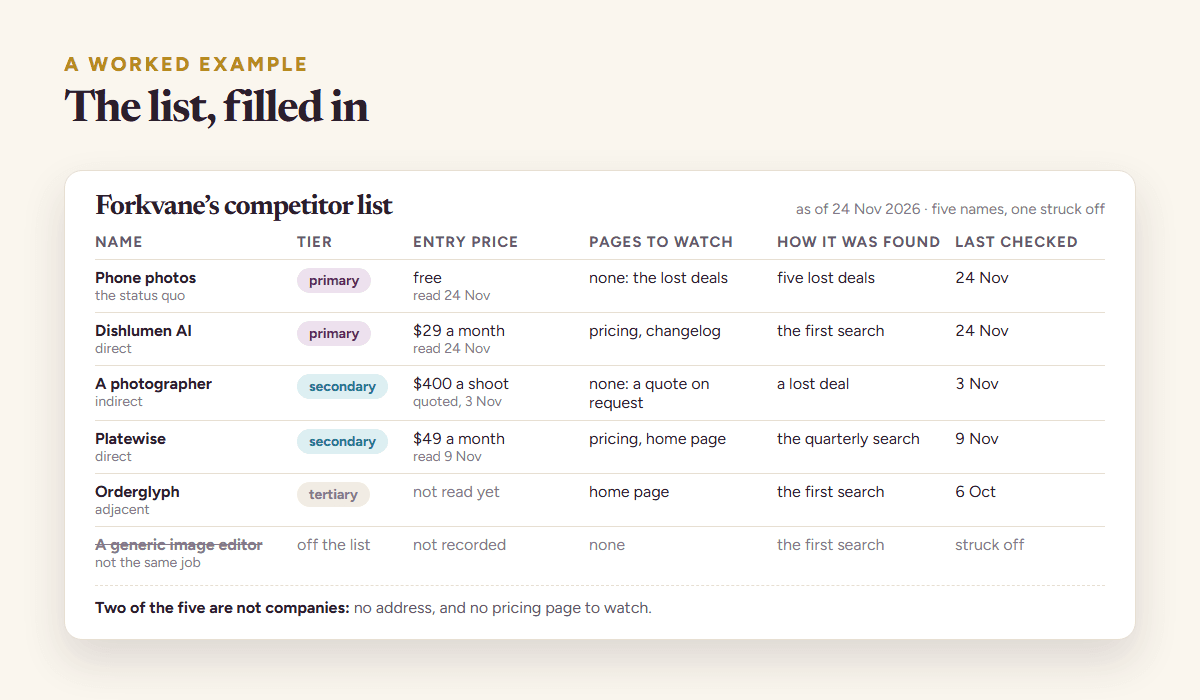
| Name | Kind | Tier | Entry price, and the day it was read | Pages to watch | Why it is on the list |
|---|---|---|---|---|---|
| Phone photos | the status quo | primary | free, 24 November | none: the lost deals | where half of the last ten lost deals went |
| Dishlumen AI | direct | primary | $29 a month, 24 November | pricing, changelog | same job, same price; named in three lost deals |
| A photographer | indirect | secondary | a quoted $400 a shoot, 3 November | none: a quote on request | the choice when the photos must look real |
| Platewise | direct | secondary | $49 a month, 9 November | pricing, home page | a new entrant, same job; no buyer has named it yet |
| Orderglyph | adjacent | tertiary | not read yet | home page | sells to the same restaurants and does part of the job |
| A generic image editor | not the same job | off the list | not recorded | none | struck off: a tool for editing photos by hand |
Phone photos has no address and no pricing page, and it is still the first row. Orderglyph’s price cell says “not read yet” instead of a guess, which is what a watch-list row is allowed to look like. And the image editor is still written down, so that nobody spends an afternoon rediscovering it.
The list does not say what Forkvane should charge or build. That is the job of the comparison, and a competitor analysis example runs one for this same company.
What are the rules for keeping a competitor list honest?
Four rules: every cell has a date and a source, the status quo gets a row, names leave the list as well as join it, and the search is run again each quarter. Without them a list turns back into a column of names within a month or two.
- Every cell has a date and a source. The price has the day it was read, the tier has the lost deals behind it, the overlap has the page it was scored from. A cell with neither is an opinion.
- The status quo is a row. What buyers do today without buying anything, a spreadsheet, a freelancer, a phone photo, goes on the list with its price, usually free plus somebody’s time.
- Names leave the list. A primary competitor no buyer has mentioned for two quarters moves down, and a name whose pages describe another job comes off. Write the day and the reason.
- The search is run again each quarter. Use the same words as last time, so the results can be compared. The newcomer that matters shows up there before any buyer names it.
What makes a competitor list useless?
Four habits, and each one is easy to spot in the file: the biggest names in the market at the top, twenty rows, no dates, and no row for doing nothing. Each makes a list that looks thorough and says nothing about what a buyer would choose instead of you.
- Listing the market instead of your competitors. The biggest company in the category usually sells to another buyer at another price. It belongs in a paragraph about market size.
- Keeping every name that came back. Twenty rows get the same attention, which means none. That holds for names from a chat model too: finding competitors with ChatGPT covers the checks a name needs before it earns a row.
- Leaving out the dates. A price with no day beside it cannot be told apart from an old one.
- Leaving out the status quo. The row with no website is the one most early products lose to.
How do you keep a competitor list up to date?
Give each tier a schedule and let the last-checked column show whether you are keeping to it: primary rows every week, secondary rows every month, the watch list every quarter. Two cells change most, the entry price and the tier, and each changes for a reason you can write down: a page you read, or a name a buyer said.
The weekly read is the part that slips first. The competitor tracking guide covers the six signals worth reading and how often each one moves, and competitive intelligence for startups turns the list into a short weekly routine.
Competite keeps this list in working form. Its competitors page is the list: run a competitor search from your website or a description of the idea, and each candidate comes back confirmed from its own page, with an overlap percentage built from four figures and a sentence behind each. Add one with a click, confirm which of its pages are read, and they are read every week on the paid plans and every month on the free one. Plans watch one competitor on Idea, which is free, three on Build at $49 a month and seven on Launch at $99 a month. Start free with one competitor search.
Questions people ask
- What should a competitor list include?
- Twelve columns for each competitor: name, address, kind (direct, indirect or the status quo), tier, overlap, how it was found, entry price, the day that price was read, pages to watch, date added, last checked, and one line on why it is on the list.
- How do I make a list of competitors?
- Search the problem your buyer has, not your category, and ask recent buyers what else they considered. Keep the names whose own pages show the same job for the same buyer, add what buyers do today without buying anything, and give each a row with its kind, tier, entry price and date.
- How many competitors should be on a competitor list?
- Three to seven active names: two or three primary competitors you read every week and a few secondary ones you read every month. Adjacent products and newcomers go on a watch list with one dated line each. Past seven active rows, the list stops being re-read.
- Is there a competitor list template for Excel or Google Sheets?
- Yes. The CSV file on this page opens in Excel, Google Sheets and Numbers with the twelve columns across the top, six filled example rows and blank rows underneath. It contains no formulas and no macros, so it opens the same way in all three.
- What is the difference between a competitor list and a competitor analysis?
- The list is the roster: who you compete with, what kind of competitor each one is, how much it matters and when you last checked. The analysis takes two or three names from the list and compares them with your product row by row.
See it on your own competitors
Add your product, or just describe the idea. Competite finds the competitors, reads their pages, and writes the comparison with a quote behind every claim. Free, in about three minutes, no card.
Keep reading
How to find your competitors, even before you have a product
How to find competitors, even before you have a product: six free ways that start from a job or an idea, how to score the overlap, and how many to keep.
15 September 2026 · 9 min read
Primary, secondary and tertiary competitors: how to rank the ones you found
Primary, secondary and tertiary competitors explained: three questions that rank a list, what each tier deserves of your week, and when a rival moves up.
15 November 2026 · 8 min read
A competitor analysis template that fits on one page, with the table
A free competitor analysis template on one page: the twelve-row table, the rules for filling it with quotes and dates, a scoring key, and a worked example.
15 September 2026 · 8 min read
How to find competitors using ChatGPT, and how to check every name it gives you
How to find competitors using ChatGPT or another AI assistant: five prompts to copy, four checks every name must pass, and a worked example of ten names.
25 November 2026 · 10 min read
Competitive intelligence for startups: a 20-minute weekly routine, without a team
Competitive intelligence for startups without a team: the four decisions it serves, a 20-minute weekly review, a one-page monthly brief, and what to skip.
25 November 2026 · 10 min read