Competitor monitoring tools: ten compared by what each one watches and what it costs
· 11 min read · by the Competite team
Competitor monitoring tools all promise to tell you when a rival changes something, and they mean four different things by it: a search alert, a page that changed, a company’s week summarised, or a sales team briefed for a deal. This guide compares ten by what each one watches and what it costs, as read on each vendor’s own page on 25 November 2026. One of them, Competite, is ours, and is held to the same table.
What are competitor monitoring tools?
Competitor monitoring tools watch what a competitor publishes and tell you when it changes. They fall into four groups by what they watch: search alerts follow a name, page-change watchers follow an address, competitor trackers follow a company’s pricing, product and news, and enterprise platforms turn all of it into material for a sales team.
Traffic estimators and SEO suites are often sold under the same name. They answer other questions, and competitor analysis tools covers them with the rest of the map. This page stays with the tools that notice a change.
How to read this page
Every price and limit below was read from the vendor’s own pricing page on 25 November 2026 and is given as the page stated it. Prices move, and one vendor was running a limited offer that day, so check the page. What each tool watches is the vendor’s own description. We have not tested the other nine.
Which competitor monitoring tools are there, and what does each cost?
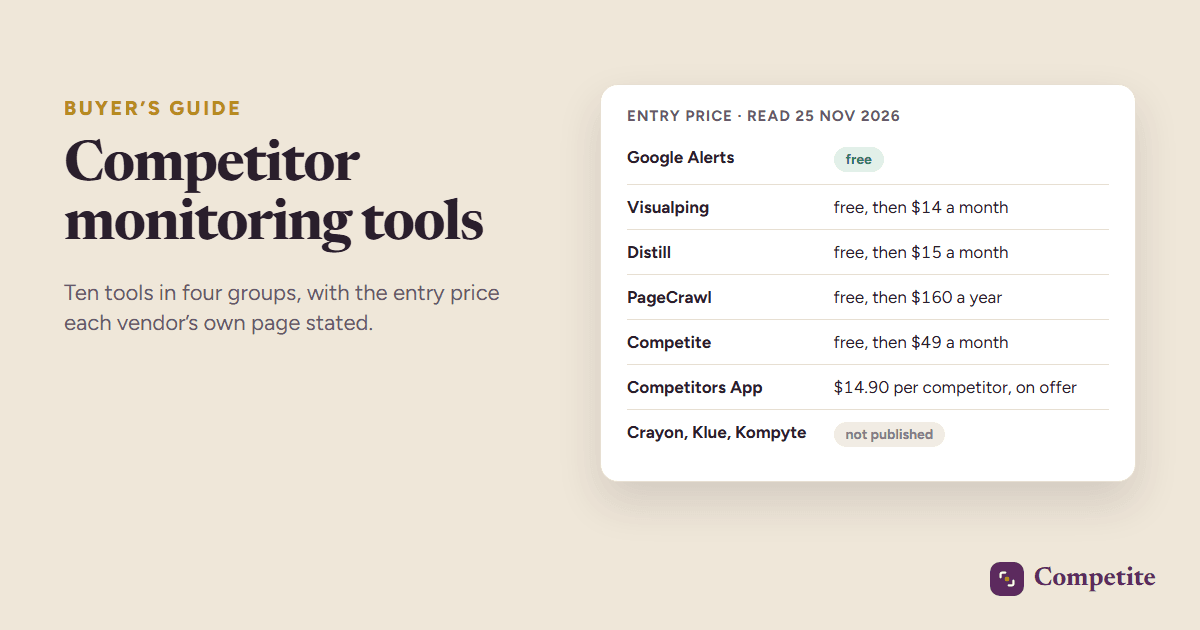
Ten tools cover the four groups. Five can be used for nothing, three publish no price at all, and paid self-serve plans begin at about $10 a month for a page watcher. The table gives each entry price as the vendor’s page stated it on 25 November 2026.
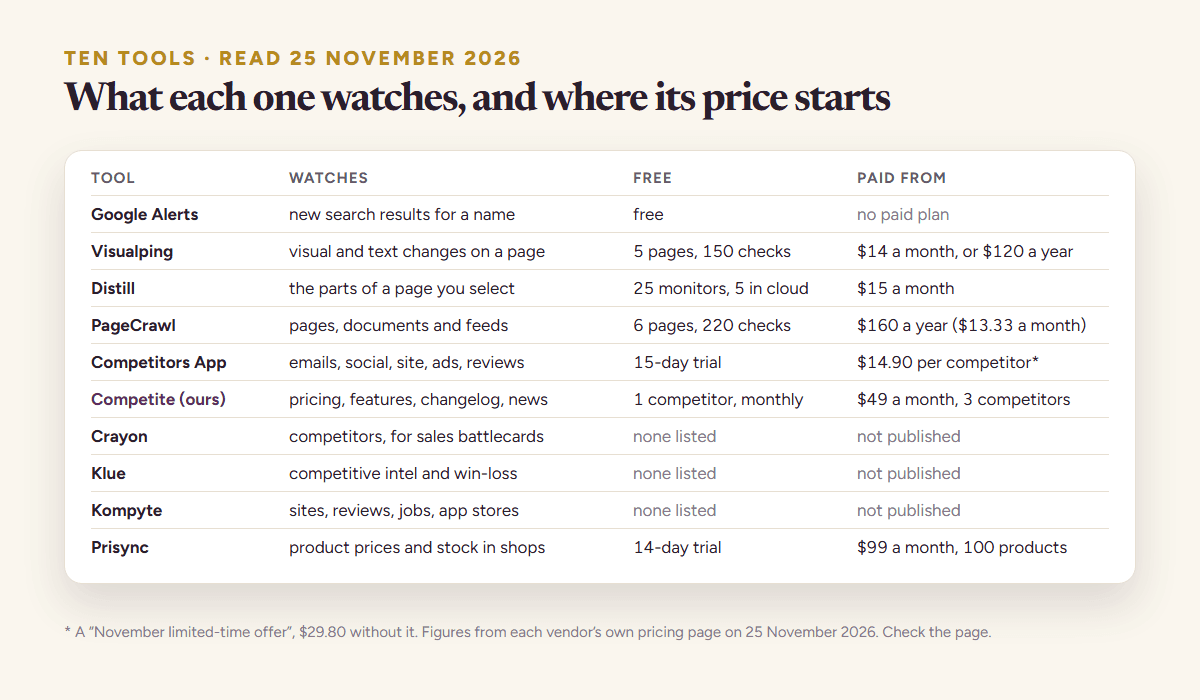
| Tool | What it watches | Free tier | Entry price on the page | Page read |
|---|---|---|---|---|
| Google Alerts | new search results for a term | free | no paid plan | google.com/alerts |
| Visualping | visual and text changes on a page | 5 pages, 150 checks a month | Personal 1K: $14 a month, or $120 a year | visualping.io/pricing |
| Distill | the parts of a page you select | 25 monitors, 5 in the cloud | Starter: $15 a month | distill.io/pricing |
| PageCrawl | pages, documents and feeds | 6 pages, 220 checks a month | Standard: $160 a year, shown as $13.33 a month | pagecrawl.io/pricing |
| Competitors App | emails, social posts, website, ads and reviews | a 15-day trial | Business AI: $14.90 per competitor a month on offer, $29.80 without it | competitors.app/pricing |
| Competite (ours) | the pricing, features and changelog pages you confirm | 1 competitor, read monthly | Build: $49 a month for 3 competitors | our pricing page |
| Crayon | competitors, for sales battlecards | none listed | not published: “Request an Estimate” | crayon.co/pricing |
| Klue | competitive intelligence and win-loss | none listed | not published: no pricing page | klue.com |
| Kompyte | websites, reviews, job posts and app stores | none listed | not published: three plans, no prices | kompyte.com/plans |
| Prisync | product prices and stock in online shops | a 14-day trial | Professional: $99 a month for up to 100 products | prisync.com/pricing |
One row is easy to misread: a yearly price shown per month is still paid at once, so PageCrawl’s $13.33 is $160 a year. And a price per competitor multiplies by the number you follow.
What do free alerts and page-change watchers catch?
They catch that something changed, and leave the meaning to you. A search alert says a competitor’s name appeared in new results. A page-change watcher says an address looks different from the last check. A watcher on two or three pricing pages is the right first tool for most small teams.
Google Alerts describes itself in one line: “Monitor the web for interesting new content.” You enter a term, such as a competitor’s name, and Google emails you new search results. Its pages list no plan and no price. It reports a price change only if somebody wrote about it.
Visualping compares a page with its last capture: “Get an alert: what changed, and whether it matters.” The free plan covers 5 pages and 150 checks a month, with no card. Personal 1K is $14 a month, or $120 a year, for 10 pages. Business plans begin at $140 a month.
Distill lets you select the parts of a page to track, and runs the check in your own browser or on its servers. The free plan lists 25 monitors, 5 of them in the cloud. Starter is $15 a month for 50 monitors, with 20 percent off for paying yearly.
PageCrawl tracks pages and also published PDF, Word, Excel and CSV files. Its free plan covers 6 pages and 220 checks a month. Standard is $160 a year, shown as $13.33 a month, for up to 200 pages. The company states that it is based and hosted in the European Union.
All three watchers now add conditions or an AI summary to cut the noise, and AI competitor analysis covers how to check one. Which pages deserve a watcher is in how to track competitor website changes.
What does a competitor tracker add to a page watcher?
A tracker starts from the company instead of the address. It decides which of a competitor’s pages and channels to read, keeps what it found as a record, and reports in terms of the competitor: a plan was added, a price was cut. You pay more for each competitor and do less of the reading.
Competitors App is built for marketers. Its site lists what it follows: trial emails and newsletters, blog and social posts, website changes, keywords and ads, reviews, traffic and press mentions. The price is per competitor. On 25 November the page showed Business AI at $14.90 a month under a “November limited-time offer” of 50 percent, against $29.80 without it.
Competite is ours, so read this with that in mind. It is built for an early-stage founder with one to seven competitors. It finds competitors from your website or a description of the idea, then reads the pages you confirm, typically the home page, pricing, features and changelog, and compares each read with the last. Only notable and major changes become alerts, by email. Reports carry the quote behind every claim.
The free Idea plan covers one competitor, read monthly, with no card. Build is $49 a month for three competitors read weekly, and Launch is $99 a month for seven. A scan for funding, launches, press and hiring beyond the site runs monthly on Build and weekly on Launch. The plans are on the pricing page.
Competite shows no screenshots or visual comparison of an arbitrary page, so a watcher is the better tool for a layout change. It builds no battlecards, holds no SEO or traffic data, and is not made for a shop tracking thousands of product prices.
When is an enterprise competitive intelligence platform worth it?
When there is a sales team losing deals to named rivals, and somebody whose job is to arm it. Crayon, Klue and Kompyte collect competitive intelligence from many sources and deliver it to sellers inside the tools they already use. None of the three published a price on 25 November 2026. Each quotes per company.
Crayon says it “monitors your competitors and alerts you to relevant intel”. Its pricing address leads to a form, with the line that pricing “is tailored to the needs of your competitive intelligence program” and a button to request an estimate.
Klue describes an agent that “continuously collects competitive intel and delivers it to sellers the moment they need it”, beside a win-loss product built on interviews with buyers. Its pricing address returns to the home page.
Kompyte, whose pages carry the copyright line of Semrush Inc, lists three plans without prices. The smallest, Essentials, tracks 10 companies with 25 user licences. The page says the price depends on the competitors tracked, the licences and single sign-on, and that plans are annual.
A price that is not published can still be bracketed before the sales call: how to find competitor pricing lists the public sources. If the need is one answer and not a subscription, competitor analysis services covers what hiring a person costs.
What does it cost to monitor three competitors?
Between nothing and about $90 a month, for three competitors with four pages each. The sums are our arithmetic on each vendor’s figures as read on 25 November 2026, so check them against the page. The spread comes from what is bought: a check on an address, or a reading of a company.
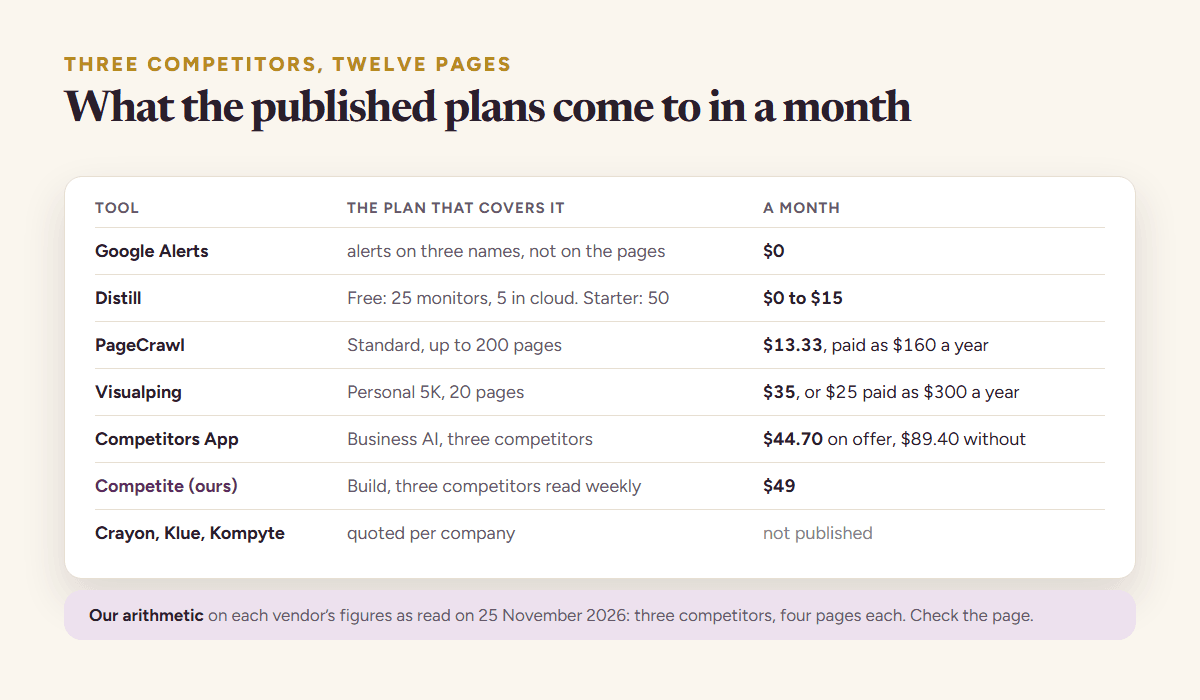
| Tool | The plan that covers twelve pages, or three competitors | A month |
|---|---|---|
| Google Alerts | alerts on three names, not on the twelve pages | $0 |
| Distill | Free lists 25 monitors with 5 in the cloud; Starter lists 50 | $0 to $15 |
| PageCrawl | Standard, up to 200 pages (Free stops at 6) | $13.33, paid as $160 a year |
| Visualping | Personal 5K, 20 pages (Free stops at 5) | $35, or $25 paid as $300 a year |
| Competitors App | Business AI, three competitors | $44.70 on the offer, $89.40 without it |
| Competite (ours) | Build, three competitors read weekly | $49 |
| Crayon, Klue, Kompyte | quoted per company | not published |
The cheapest rows and the dearest are not selling the same thing. Twelve pages on a watcher are twelve streams of changes that somebody has to read. The fair comparison is the price plus the hour a week the cheaper tool leaves with you.
Which competitor monitoring tool should a startup choose?
Choose by what you need to hear, then by who will do the reading. A founder watching two pricing pages needs a free page watcher. A founder who needs to know what a change means for their own price needs a tracker. A company with a sales team needs a platform.
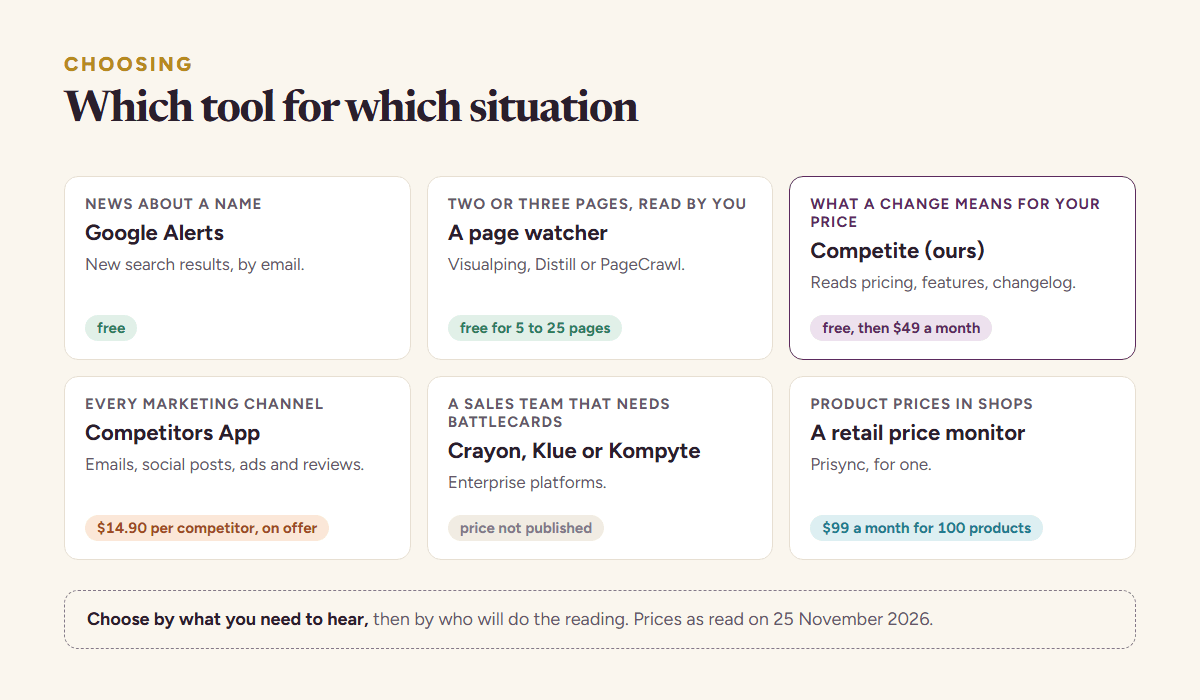
| What you need | Start with | Why |
|---|---|---|
| News about a competitor’s name | Google Alerts | free; new search results by email |
| Two or three pricing pages, read by you | a page watcher: Visualping, Distill or PageCrawl | free plans cover 5 to 25 pages |
| What a change means for your own price | Competite | reads pricing, features and changelog; alerts on notable changes only |
| A competitor’s emails, social posts, ads and reviews | Competitors App | follows marketing channels, priced per competitor |
| Battlecards for a sales team | Crayon, Klue or Kompyte | built for sellers; quoted per company |
| Rivals’ product prices in shops | a retail price monitor such as Prisync | priced by the number of products |
The last row is a category of its own. Prisync calls itself competitor price tracking and monitoring software. Its lowest plan, Professional on the URL-based model, was $99 a month for up to 100 products, with a 14-day trial that needs no card. If you sell software, competitor price tracking covers the pricing-page version of the same job.
Two tools often beat one: a free alert on each competitor’s name, and one tool that reads the pages. Competitive intelligence for startups sets out the weekly routine the tool is there to serve.
What do competitor monitoring tools not do?
None of them sees what a competitor has not published, and none of them decides anything. A tool reports a change on a page, a post or a search result. An unlisted price, a roadmap and the reason a buyer chose somebody else are all outside what monitoring can reach.
A change is not a decision, either. Somebody still has to say whether a competitor’s new plan alters your price, and competitor tracking covers which signals deserve that attention.
How do you try two competitor monitoring tools in a week?
Run two tools side by side on the same three competitors for seven days, then count. Every self-serve tool here can be tried without paying: the three watchers and Competite have free plans, Competitors App has a 15-day trial and Prisync a 14-day one.
- Choose three competitors and four pages each. Pricing, the home page, features and the changelog. If a rival sells on a free trial, add the page that states its terms: how to detect competitor trial changes covers what to record.
- Add one page you control. Change a number on it midweek. A tool that misses a change you made yourself will miss a competitor’s.
- Count what arrives. Beside each alert write one word, mattered or noise.
- Read one pricing page by hand on day seven. Anything neither tool reported is the gap you would be paying to keep.
If the question is what a competitor’s change means for your own price, start with the tracker and keep a free watcher as a backstop. Competite’s free plan reads one competitor and writes one report a month, and needs no card.
Questions people ask
- What is the best competitor monitoring tool for a startup?
- It depends on what you need to hear. For two or three pricing pages, the free plan of a page-change watcher such as Visualping, Distill or PageCrawl is enough. To know what a change means for your own price, a tracker such as Competite reads pricing, features and changelog pages.
- Is there a free competitor monitoring tool?
- Yes, several. As read on 25 November 2026, Google Alerts is free, Visualping’s free plan covers 5 pages, Distill’s lists 25 monitors with 5 in the cloud, PageCrawl’s covers 6 pages, and Competite’s free Idea plan reads one competitor monthly. Limits change, so check each vendor’s page.
- How much do competitor monitoring tools cost?
- As read on 25 November 2026, self-serve plans start at $120 a year for Visualping, $160 a year for PageCrawl and $15 a month for Distill. Competitors App is priced per competitor, and Competite is $49 a month for three competitors. Crayon, Klue and Kompyte publish no price and quote per company.
- How do I monitor a competitor’s website for changes?
- Choose the pages where decisions show: pricing, the home page, features and the changelog. Then re-read them on a fixed day each week, put a page-change watcher on each one, or use a tracker that reads them and reports what changed.
- What is the difference between a page-change watcher and a competitor tracker?
- A page-change watcher checks an address you give it and tells you the page changed, usually with the before and the after. A competitor tracker starts from the company: it reads its pricing, features and changelog, keeps a history, and says what changed. The first is cheaper, and the second saves the reading.
See it on your own competitors
Add your product, or just describe the idea. Competite finds the competitors, reads their pages, and writes the comparison with a quote behind every claim. Free, in about three minutes, no card.
Keep reading
Competitor analysis tools in 2026: which kind you actually need
The five kinds of competitor analysis tools, what each answers, who it is for and what it costs, from traffic estimators to founder-focused tracking.
9 September 2026 · 7 min read
How to track competitor website changes without drowning in alerts
How to track competitor website changes: the six pages worth watching, four ways to do it, free or automatic, how to filter noise, and what to do next.
6 November 2026 · 11 min read
Competitor tracking: how to monitor competitors’ prices, features and funding every week
Competitor tracking for founders: the six signals to monitor, how often each one moves, where they live, and what a good alert looks like.
9 September 2026 · 7 min read
Competitive intelligence for startups: a 20-minute weekly routine, without a team
Competitive intelligence for startups without a team: the four decisions it serves, a 20-minute weekly review, a one-page monthly brief, and what to skip.
25 November 2026 · 10 min read
Competitor price tracking: what to do the week a competitor cuts a price
Competitor price tracking for founders: what to watch on a pricing page, how to track it by hand or automatically, and the four moves when they cut a price.
15 September 2026 · 8 min read