Competitive benchmarking: the metrics worth tracking, and the ones that lie
· 7 min read · by the Competite team
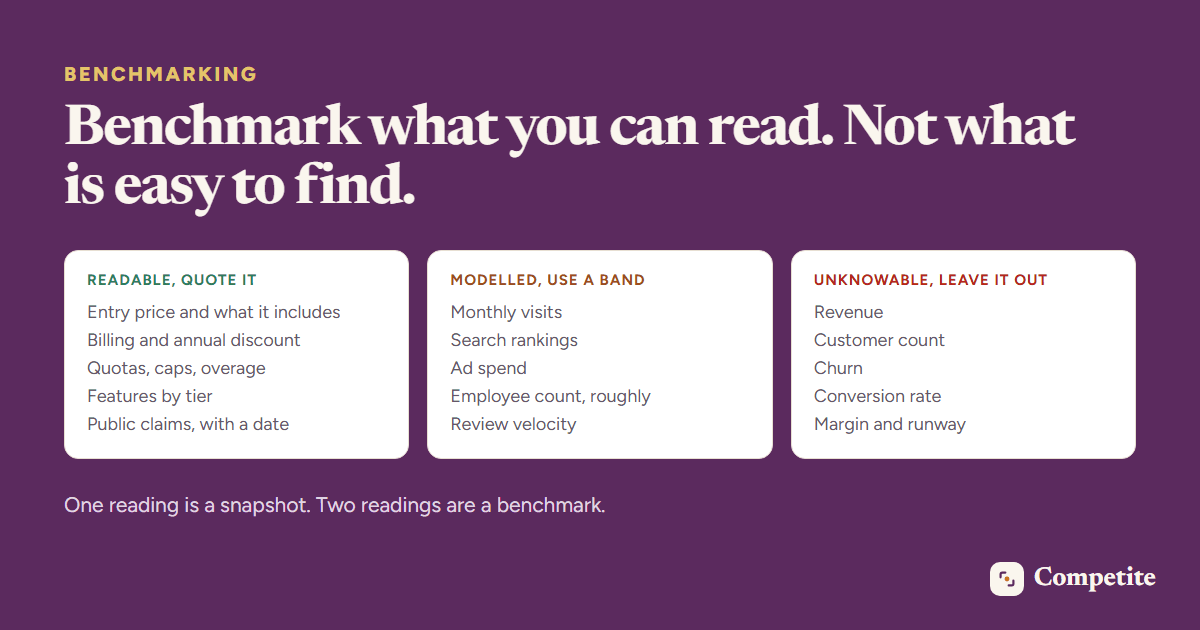
Competitive benchmarking is comparing yourself with rivals on the same measures, over time. It goes wrong in one specific way: people benchmark the metrics that are easy to find rather than the ones that are true. Traffic estimates and follower counts are easy; entry price and what it includes are true. This sorts the metrics into readable, estimated and unknowable, gives the cadence each one deserves, and shows what a benchmark looks like when it is built from quotes instead of guesses.
What is competitive benchmarking?
It is picking a small set of measures, recording where you and your competitors sit on each one, and repeating that on a schedule so you can see direction rather than a single position.
The word doing the work is "repeating". A one-off comparison is an analysis; a benchmark is the same comparison taken again later, and the difference between the two readings is the entire value. One reading tells you a competitor charges $39. Two readings ninety days apart tell you they cut it from $49, which is a different fact and a more useful one.
That is also the test for whether you are benchmarking at all. A sheet with one column of numbers and no dates on them is a competitor analysis wearing the word. A benchmark carries at least two dated columns, and the content worth reading is the difference between them rather than either one on its own.
Which competitor metrics can you actually know?
Three kinds, and the difference matters more than any individual metric. Some are published and readable. Some are modelled by a third party and carry real error. Some are inside the company and nobody outside it knows them.
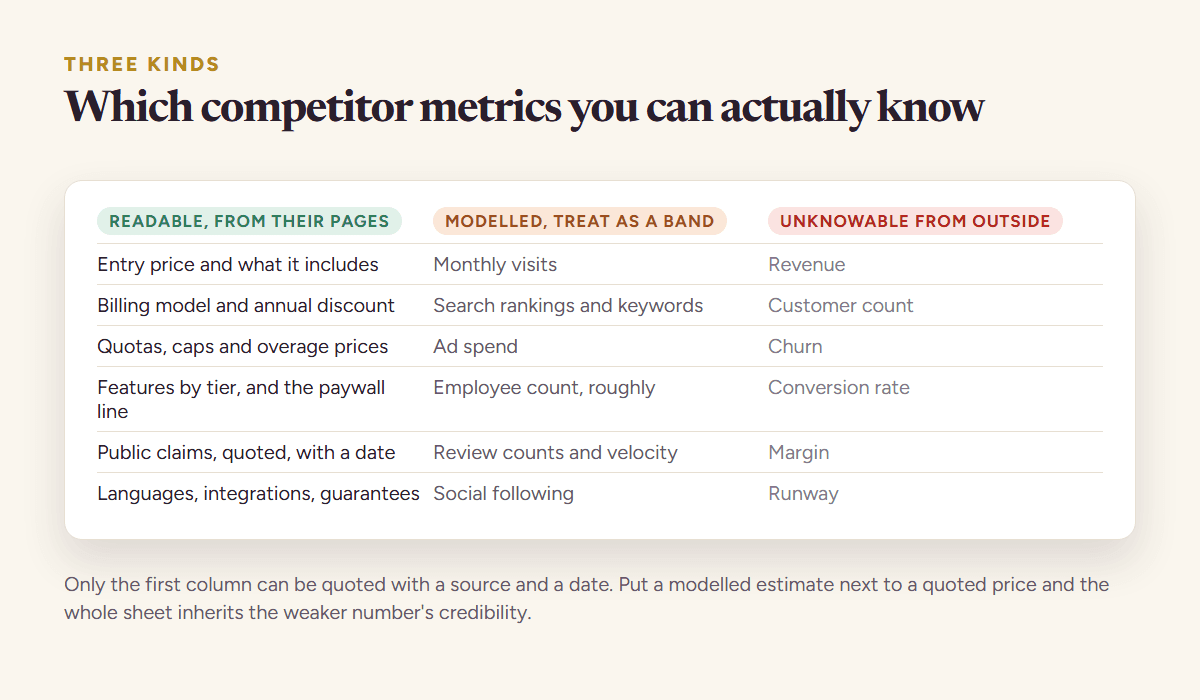
| Readable, from their pages | Modelled, treat as a band | Unknowable from outside |
|---|---|---|
| Entry price and what it includes | Monthly visits | Revenue |
| Billing model and annual discount | Search rankings and keywords | Customer count |
| Quotas, caps and overage prices | Ad spend | Churn |
| Features by tier, and the paywall line | Employee count, roughly | Conversion rate |
| Public claims, quoted, with a date | Review counts and velocity | Margin |
| Languages, integrations, guarantees | Social following | Runway |
The rule that keeps a benchmark honest
Every number in the sheet carries where it came from and the date it was read. A cell that cannot carry a source is either an estimate, and should say so with a range, or a guess, and should not be in the sheet. This is the difference between a benchmark somebody can argue with and one nobody believes twice.
Why do traffic estimates mislead small companies?
Because the models behind them need volume to work, and small competitors do not produce it. Below a few thousand visits a month the number is either missing or invented, and it is presented with the same confidence either way.
That is the exact size band where an early-stage founder’s real competitors live. Benchmarking a rival with two thousand visits against a modelled estimate produces a chart that looks rigorous and is decorative. If you want the size question answered anyway, treat every such figure as a band rather than a point, and never put it next to a quoted price as though the two were the same kind of fact. The tool landscape, and what each kind is honestly good at, is in competitor analysis tools.
How often should each metric be re-read?
By how fast it moves, not by when your meeting is. Prices move a few times a year and without warning. Positioning moves about once a year. Nothing useful is learned by re-reading either one daily.
| Metric | How often it really moves | Read it |
|---|---|---|
| Entry price and quotas | A few times a year, unannounced | Weekly |
| Plans and the paywall line | A few times a year | Weekly |
| Features and changelog | Continuously, in small pieces | Weekly |
| Funding and launches | Rarely, then suddenly | The day it is reported |
| Positioning and who they sell to | About once a year | Quarterly |
| Review count and velocity | Slowly and steadily | Monthly |
The cadence is the part people skip, and skipping it is what turns a benchmark back into a one-off analysis with an old date on it. The full signal-by-signal version is in the competitor tracking guide.
What does a benchmark look like when it is done properly?
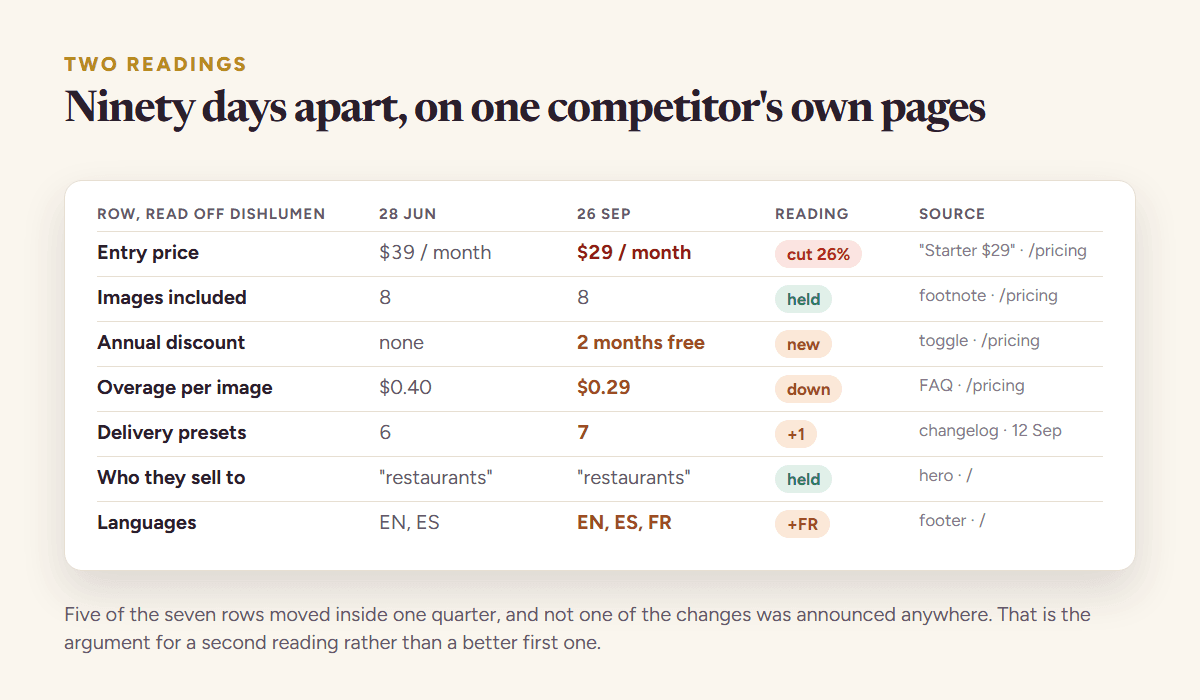
Six to eight rows, three to five companies, two readings. Not a dashboard with forty metrics: a sheet small enough that somebody re-reads it, with a date beside every figure.
Read the second column against the first and the pattern is almost always the same. The rows describing who a company is for hold for a year. The rows with a number in them, the price, the quota, the cap, move within a quarter and nobody sends an email about it. That pattern is the argument for benchmarking a few things often rather than many things once.
Note what is not in it. No traffic estimate, no follower count, no guess at revenue. Every row survived one question asked of every cell: can you point at the page this came from and the day you read it? Six rows that pass that test are worth more than forty that do not.
What makes a benchmarking exercise worthless?
Four things, and three of them are about the metrics you chose rather than the work you did.
- Benchmarking what is easy to count. Followers, page count, blog frequency. They are countable and no decision rests on any of them.
- Mixing quoted facts with modelled estimates. A price read off a page and a traffic estimate belong in different columns, marked differently, or the whole sheet inherits the weaker one’s credibility.
- Benchmarking against the market leader. If no buyer has ever chosen between you and them, every row comes back "they have more" and teaches nothing. Benchmark against whoever your lost deals actually went to.
- Doing it once. Without a second reading there is no benchmark, only a snapshot. The comparison is the point.
Can competitive benchmarking be automated?
The readable column can, which is most of what matters. Pages are public, they can be read on a schedule, and two readings can be compared without anybody remembering to do it.
The estimated column cannot be made more accurate by automating it; it only becomes wrong faster. And the unknowable column stays unknowable however much software is pointed at it.
Competite does the readable part: it reads the pricing, features and changelog pages you confirm every week, keeps every plan with its price and quota as history, and emails you when one of them moves, with the before, the after and the quote it came from. It is free to start with one competitor. Add your product, confirm a competitor, and the first reading is about three minutes away.
One reading is a snapshot. Two readings are a benchmark. Everything else is decoration.
Questions people ask
- What is competitive benchmarking?
- Comparing yourself with competitors on the same measures, repeated on a schedule so you can see direction rather than a single position. The repetition is what separates it from a one-off competitor analysis: two readings ninety days apart tell you a price was cut, where one reading only tells you what it is today.
- Which competitor metrics can you actually measure?
- Three groups. Readable ones come off their own pages: entry price, billing model, quotas, features by tier, public claims. Modelled ones, such as traffic and ad spend, are third-party estimates with real error and belong in a sheet as bands. Revenue, customer count, churn, conversion and margin are inside the company and cannot be known from outside.
- How often should you benchmark competitors?
- By how fast each metric moves. Prices, plans and quotas weekly, because they change a few times a year without announcement. Funding and launches the day they are reported. Positioning and who a company sells to quarterly, since it holds for about a year.
- Are competitor traffic estimates accurate enough to benchmark on?
- Not for small competitors. The models need volume, and below a few thousand visits a month the figure is either missing or invented while still being shown with full confidence. That is the exact size band an early-stage founder competes in, so treat those numbers as bands and never place them beside a quoted price as if they were the same kind of fact.
- How many competitors should you benchmark against?
- Three to five, chosen from where your lost deals actually went rather than from who is biggest. Benchmarking against the market leader produces a sheet where every row says they have more, which is true and useless.
See it on your own competitors
Add your product, or just describe the idea. Competite finds the competitors, reads their pages, and writes the comparison with a quote behind every claim. Free, in about three minutes, no card.
Keep reading
Competitor tracking: how to monitor competitors’ prices, features and funding every week
Competitor tracking for founders: the six signals to monitor, how often each one moves, where they live, and what a good alert looks like.
9 September 2026 · 6 min read
Competitor price tracking: what to do the week a competitor cuts a price
Competitor price tracking for founders: what to watch on a pricing page, how to track it by hand or automatically, and the four moves when they cut a price.
15 September 2026 · 8 min read
Competitor analysis tools in 2026: which kind you actually need
The five kinds of competitor analysis tools, what each answers, who it is for and what it costs, from traffic estimators to founder-focused tracking.
9 September 2026 · 6 min read