Direct and indirect competitors, and the one that beats both
· 6 min read · by the Competite team
Direct and indirect competitors are the two labels every competitor analysis starts with, and the distinction is not academic: it decides whether you compete on features, on price, or on whether the buyer does anything at all. A direct competitor does the same job for the same buyer. An indirect competitor gets the buyer to the same outcome another way. The third kind, the one that wins more deals than either, is the buyer doing nothing. This guide defines the three with examples, shows why mislabelling them wastes a quarter, and sorts a list in about ten minutes.
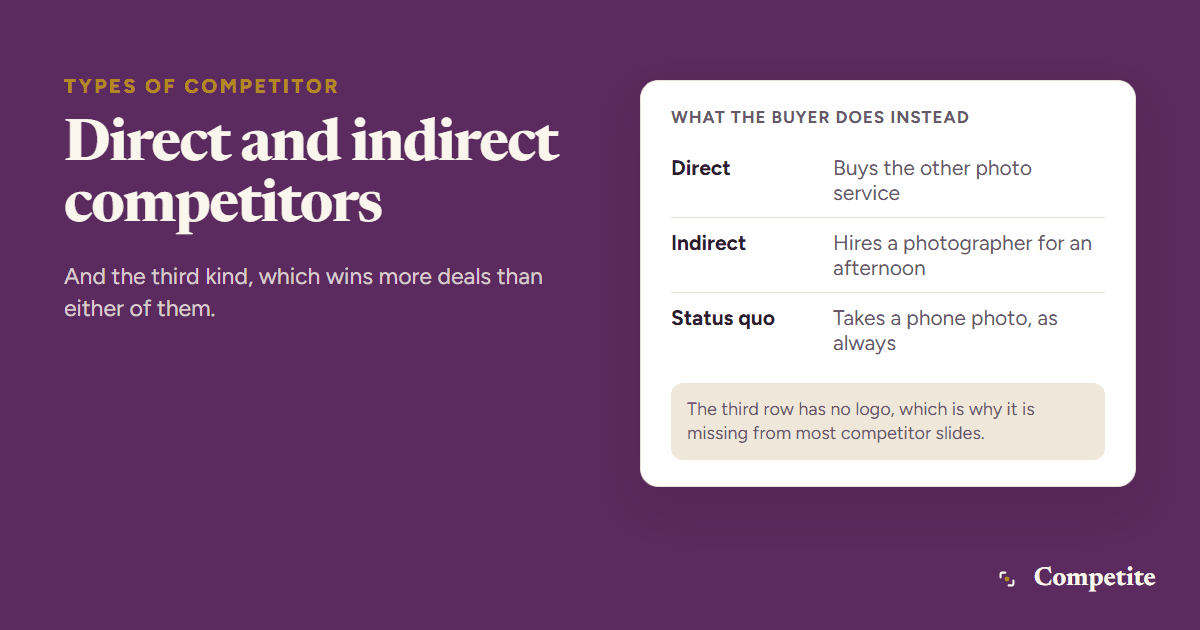
The three kinds, in one table
The test that separates them is not what the product is. It is what the buyer would have done if you did not exist.
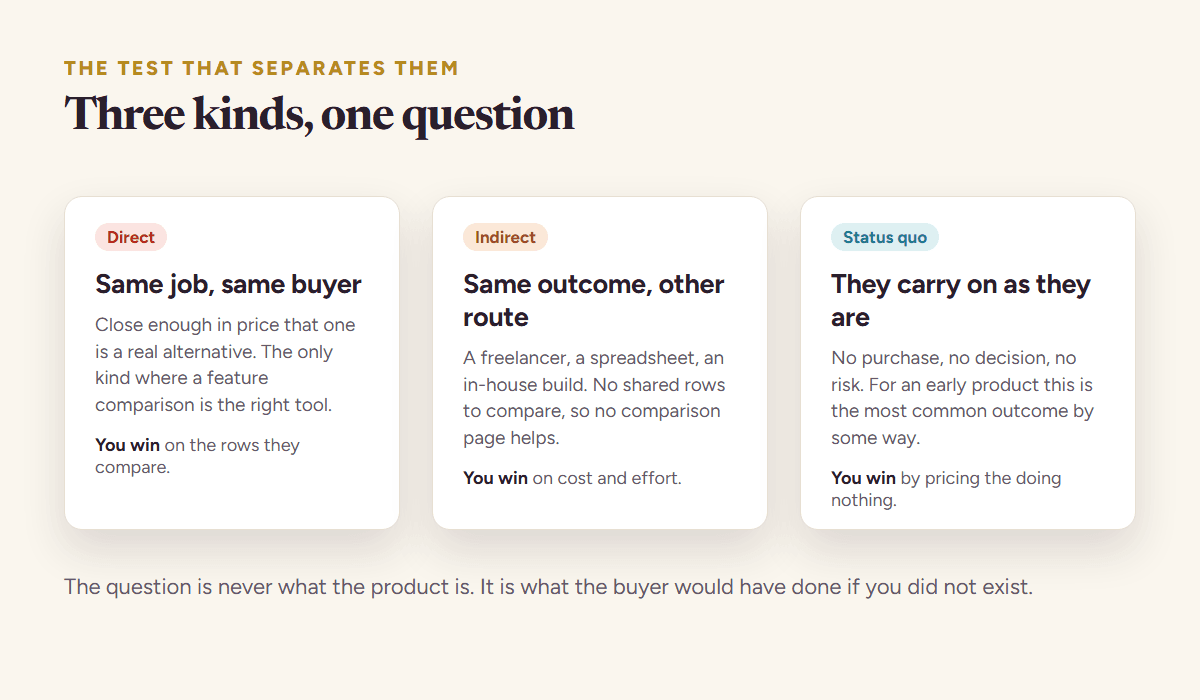
| Kind | The test | A restaurant wanting better menu photos | How you win |
|---|---|---|---|
| Direct | same job, same buyer, same price band | another photo service at a similar price | on the rows the buyer compares |
| Indirect | same outcome, different route | hiring a photographer for an afternoon | on cost, speed or effort, not features |
| Status quo | the buyer carries on as they are | a phone photo and a filter, as always | by making the cost of doing nothing visible |
Direct competitors: the same job, the same buyer
A direct competitor is on the buyer shortlist next to you. Same problem, same kind of buyer, close enough in price that one is a real alternative to the other. This is the only kind where a feature-by-feature comparison is the right tool, because the buyer is genuinely running one.
Two products can look identical and still not be direct competitors. A tenfold price gap or a different way of buying, self-serve against a sales call, puts them in separate fields, because the same person is never choosing between them. That test and the four questions behind it are in how to find competitors of a company.
The sign you have a direct competitor
You lose deals to it and the buyer says the name out loud. Nobody names an indirect competitor in a sales call; they just say they will think about it.
Indirect competitors: the same outcome, another route
An indirect competitor solves the same underlying problem with a different kind of thing. It does not appear in a feature comparison, because there are no shared rows to compare. Sometimes called an adjacent or substitute competitor, and the words matter less than the behaviour: the budget goes somewhere else and the problem is considered solved.
- A service instead of a product. An agency, a freelancer, a consultant. The buyer pays for the outcome and never touches a tool.
- A general tool instead of a specific one. A spreadsheet, a generic image editor, a document. Worse at the job, already paid for, already understood.
- An in-house build. Common the moment a buyer is large enough to have engineers with spare time, or believes they are.
- A different category entirely. Whatever else is competing for the same line in the same budget this quarter.
Indirect competitors are where most founders are blind, because they do not show up in any of the places a rival product does. No comparison page names them, no review site lists them next to you, and they never appear in a category ranking. They show up in one place only: in what a lost buyer tells you they did instead.
The status quo, which beats both
The buyer keeps doing what they were doing. No purchase, no decision, no risk. For most early products this is the most common outcome by a wide margin, and it is the one nobody puts on the competitor slide because it has no logo.
A competitor list with no status quo on it is a list that explains why you lose to rivals, and not why you lose.
You do not beat the status quo on features, because it has none. You beat it by making the cost of carrying on visible and specific: the hours, the missed bookings, the thing that goes wrong every month. That is a different page, a different sales conversation and often a different price than the one you would use against a direct rival.
Why the label changes what you do
Mislabelling is expensive because each kind is beaten differently, and the work does not transfer.
| If the real competitor is | The page that wins | What price does | What to watch |
|---|---|---|---|
| Direct | a comparison page, row by row | has to be defensible against theirs | their pricing page and their changelog |
| Indirect | a page about total cost and effort | compared against a day rate or a salary | nothing on their site; ask lost buyers |
| Status quo | a page about what it costs to do nothing | has to clear a risk threshold, not a rival | your own onboarding and time to value |
The common failure is building a comparison page against a direct rival while losing almost every deal to the status quo. The page is good work aimed at the wrong opponent, and nothing in the analytics will tell you, because the buyers who never started are not in them.
Sorting your own list in ten minutes
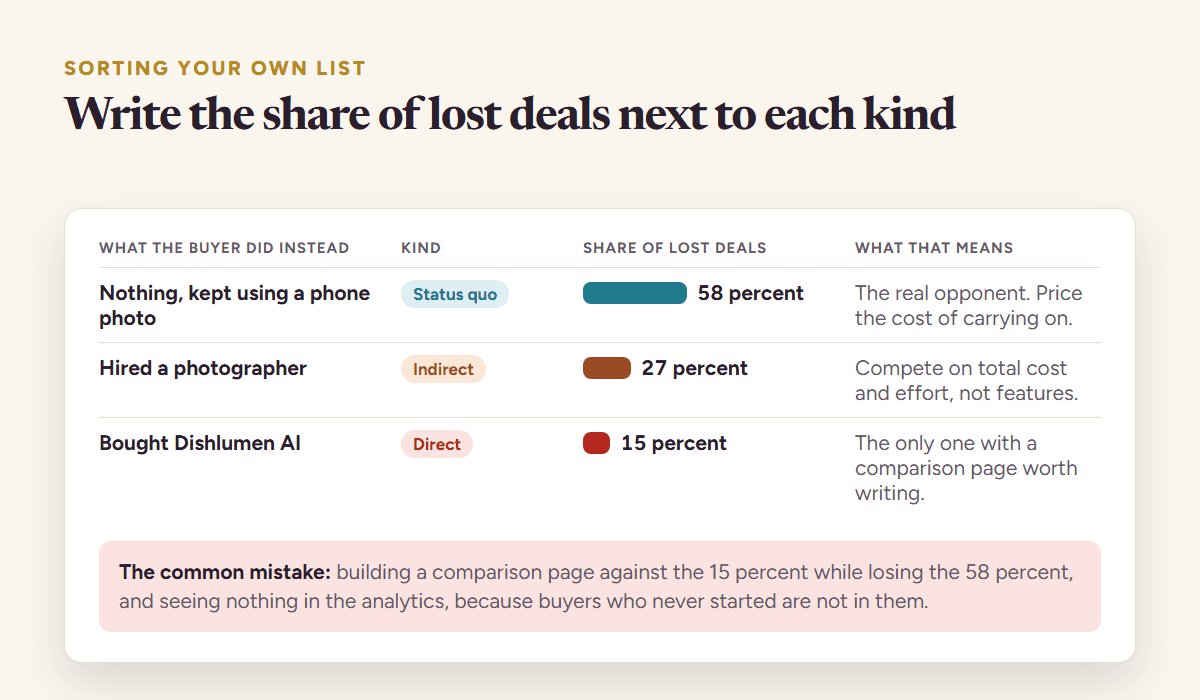
- Write every name you can think of, including things that are not products: a spreadsheet, an agency, an intern, nothing at all.
- Against each one, answer the question in the buyer words: what would they have done instead of paying you? That sentence decides the label.
- Put a rough share of your lost deals against each kind. Guess if you have to, then check it against your last ten losses.
- Keep three to seven names in total, and make sure the status quo is one of them.
- Write the date. Labels move: an indirect competitor that ships a product in your category becomes a direct one the same week.
The direct ones are the only kind you can watch automatically, because they are the only kind with a pricing page that moves. That is the job Competite does: it reads those pages on a schedule and tells you when one of them changes. The indirect ones and the status quo need the thing no tool does, which is asking a buyer who did not buy.
To build the list in the first place, start with how to find your competitors. To put the sorted list into a table you can keep, use the competitor analysis template.
Questions people ask
- What is the difference between a direct and an indirect competitor?
- A direct competitor does the same job for the same buyer at a comparable price, so the two appear on one shortlist and a feature comparison is meaningful. An indirect competitor gets the buyer to the same outcome another way, such as a freelancer, a spreadsheet or an in-house build, so there are no shared rows to compare and you compete on cost and effort instead.
- Can you give an example of an indirect competitor?
- For a product that makes menu photos, a photographer hired for an afternoon is an indirect competitor: a different kind of thing, the same outcome, the same budget line. So is a generic image editor the restaurant already pays for, and so is the owner taking a phone photo, which is the status quo.
- Is the status quo really a competitor?
- It is usually the one that wins. For an early product most buyers do not choose a rival, they choose to carry on as they are, because that needs no decision and carries no risk. Leaving it off the list is what makes an analysis explain why you lose to rivals rather than why you lose.
- Should I track indirect competitors?
- Watch them, but not the way you watch direct ones. An indirect competitor has no pricing page that moves in ways that matter to you, so there is nothing useful to monitor weekly. Re-check the category once a quarter, and pay attention when one of them ships something in your category, because that is the week it becomes a direct competitor.
See it on your own competitors
Add your product, or just describe the idea. Competite finds the competitors, reads their pages, and writes the comparison with a quote behind every claim. Free, in about three minutes, no card.
Keep reading
A direct competitor comparison that survives contact with a buyer
How to run a direct competitor comparison against one rival: picking the right one, making plans comparable, and the four habits that make a comparison useless.
19 September 2026 · 5 min read
How to find your competitors, even before you have a product
How to find competitors for a startup: who counts as one, six ways to find them from a job or an idea, how to score the overlap, and how many to keep.
15 September 2026 · 6 min read
Competitive landscape analysis: putting the whole field on one page
How to run a competitive landscape analysis: pick two axes that decide deals, place every competitor from its own pages, and read the gap that is left.
17 September 2026 · 6 min read