No competitors for your product? What it usually means, and how to check
· 8 min read · by the Competite team
If you looked for competitors for your product and found none, the likeliest explanation is not that you are alone. It is that the search looked for companies, and what an early product competes with is mostly not a company. This guide covers the four things “no competitors” usually means, five searches that settle it in about an hour, whether it is good news, and what to say when an investor, a form or a customer asks.
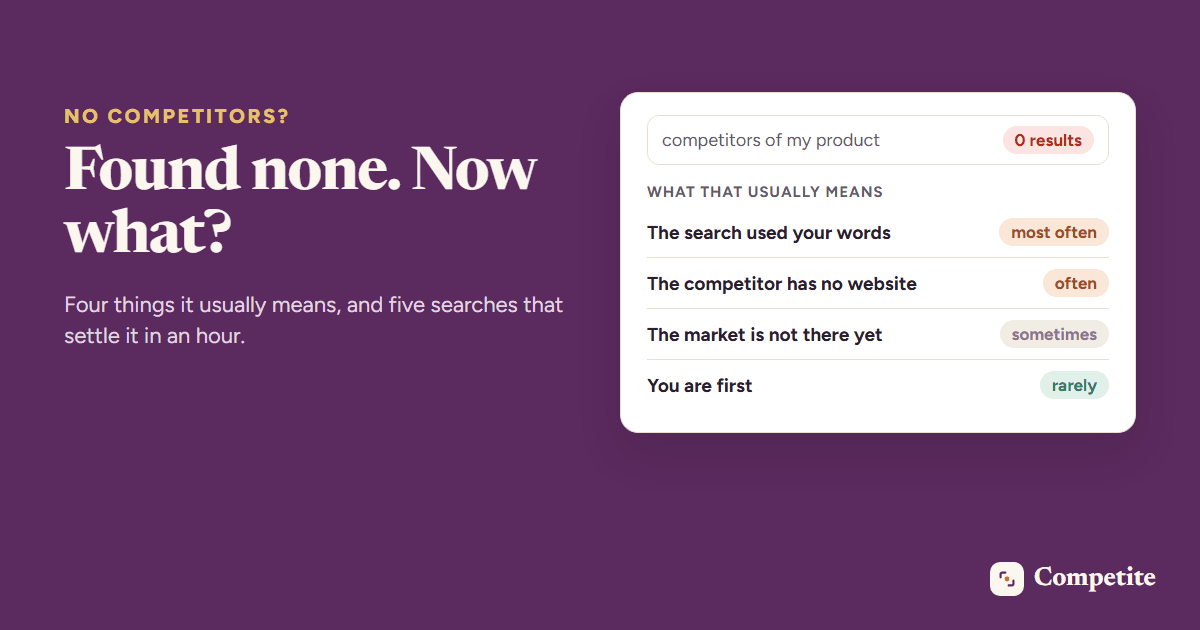
What does it mean when you find no competitors?
One of four things, in rough order of how often each is true: you searched in words your buyers do not use, the competitor is something with no website, the market is too early or too small for anyone to have built for it, or you really are first. Only the last is the answer founders hope for, and it is the rarest of the four.
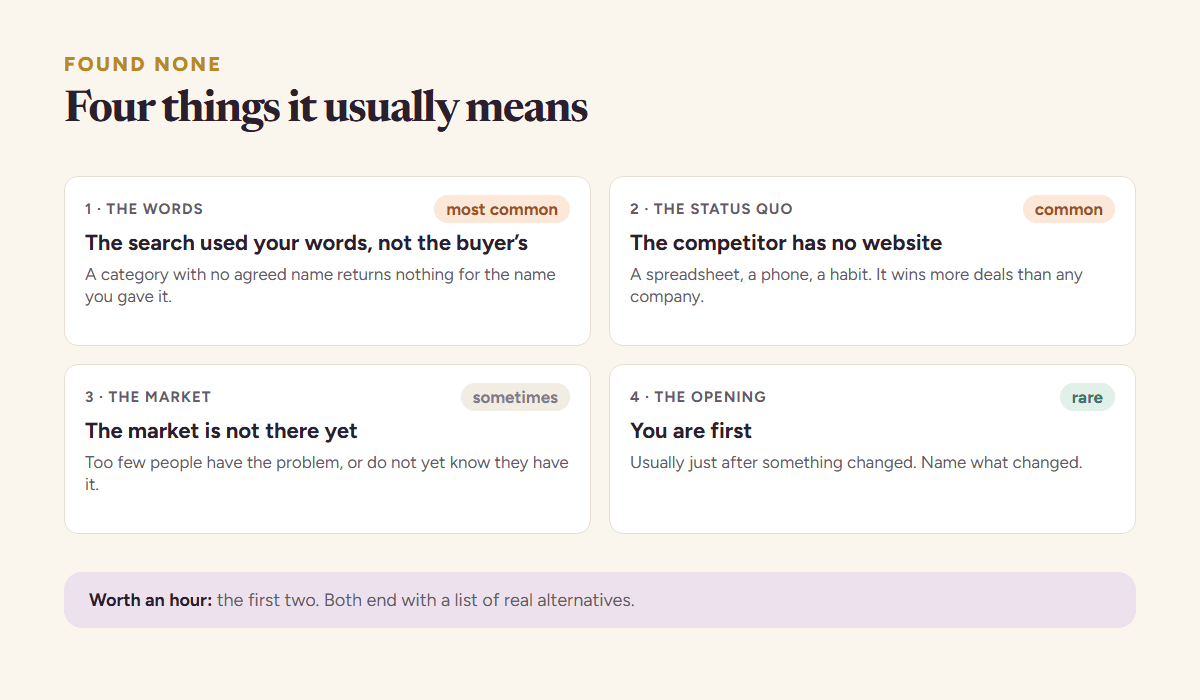
- The search used your words, not the buyer’s. A category with no agreed name returns nothing for the name you gave it. The buyer is typing the problem, not your description of the solution.
- The competitor has no website. A spreadsheet, a phone, an assistant, a habit. It never appears in a search for companies, and for an early product it wins more deals than any company would.
- The market is not there yet, or is very small. Nobody has built for it because too few people have the problem, or because they do not yet know they have it. That is a finding about demand, not about rivals.
- You are first. It happens, usually just after something changed: a cost fell, a rule changed, a platform opened up. If you cannot name what changed, look at the first three again.
The first two are worth an hour of work, because both end with a list of real alternatives. Company competitor search names the three things no search will find, and identifying early-stage competitors covers the places a rival shows up before it can be searched for.
How to check for competitors in an hour
Run five searches, each from the buyer’s side instead of yours: the problem in their words, “alternative to” the nearest product you know, the forums where they complain, the directories of the tools they already use, and three messages to people who have the problem. An hour is enough to tell an empty market from a market you were describing in the wrong words.
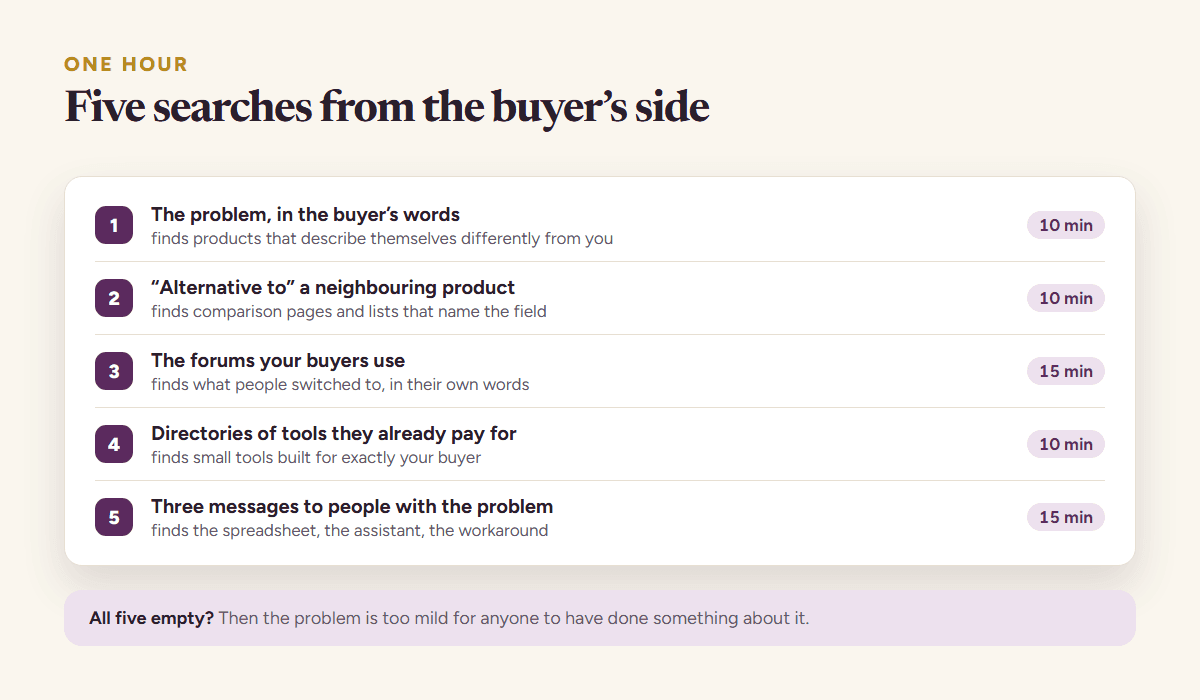
| Search | What to type or do | What it finds | Minutes |
|---|---|---|---|
| The problem, in the buyer’s words | the complaint as a customer would say it, not your product’s name | products that describe themselves differently from you | 10 |
| “Alternative to” a neighbour | the nearest product you know of, plus “alternative” or “vs” | comparison pages and lists that name the field | 10 |
| The forums buyers use | the problem, inside the community sites of your buyers’ trade | what people switched to, in their own words | 15 |
| Directories of tools they already pay for | the app or integration directory of the product your buyers live in | small tools built for exactly your buyer | 10 |
| Three messages to people with the problem | “What do you use for this today?” | the spreadsheet, the assistant, the workaround | 15 |
Write down every name and every workaround, with where you found it. Then run each name through the overlap test in how to find competitors: the same job, the same customers, the same features, the same pricing model. Most of what the searches return is adjacent, and adjacent is still an answer to the question.
If all five come back empty, the three messages included, the honest reading is the third explanation: the people you asked do not have the problem badly enough to have done anything about it. That is worth knowing before you build more.
Is having no competitors good or bad?
Mostly it is a warning, and occasionally an opening. Competitors are evidence that buyers pay to make the problem go away; none at all usually means the problem is not painful enough, or that you have not found the people it hurts. It is good news only when you can say what changed recently to make the product possible now and not three years ago.
| What you found | What it suggests | What to do next |
|---|---|---|
| Rivals under another name | a real market, described in other words | adopt the buyer’s words, then compare yourself with what you found |
| Only workarounds | a real problem that nobody has turned into a product | price against what the workaround costs in hours, and sell against it |
| Nothing, and buyers shrug | a problem too mild to pay for | talk to ten more people before building more |
| Nothing, and something just changed | a new opening | move quickly, and expect company |
The second row is the most common place for an early product to be, and it is a good one. A workaround has a cost, usually an hour or two of somebody’s week, and that cost is your price anchor. How to price a SaaS product covers setting a price from what buyers already pay, in money or in time.
What to say when someone asks about your competitors
Never “we have none”. Say what your buyers use today, name the nearest product even if it is only adjacent, and say why a buyer would move to you. An investor, a form and a customer are all asking the same thing underneath: do you know what you are up against. “Nobody does this” answers a question they did not ask.
- To an investor. Name the status quo and one or two adjacent products, and say what changed that lets you do it now. The pitch deck competition slide guide has an alternatives format built for exactly this case.
- On a form or in a business plan. When the question is “are there any competitors for your product or service?”, answer yes, in four sentences: the nearest products, the indirect ones, what customers do today, and why they would pick you. The competitor analysis in a business plan has an answer you can adapt.
- To a customer. They are comparing you with what they already do. Ask what that is, and answer that, not a rival they have never heard of.
A sentence that works in all three
“Today most [buyers] handle this with [the workaround], which costs them about [time or money] a [week or month]. The closest product is [name], which is built for [someone else]. We do [the job] in [a number], which is why they switch.”
How will you know when the first competitor appears?
It rarely arrives as a launch announcement. It arrives as a company you already knew about, doing something next door, that ships one thing and lands in your market. Watch three places once a month: the pricing pages of the two or three adjacent products, the launch boards your buyers read, and job adverts that name your buyer.
- A job advert naming your buyer. Somebody is being hired to sell to the same person. It is the earliest sign, months ahead of a product.
- A landing page in your buyer’s words. The positioning moves before the product does.
- A new plan in your price band. An adjacent product that adds a plan at your price is now on the same shortlist.
- A comparison page that names you. They are already losing deals to you, and answering in public.
When one does appear, do not react on the first day. A new competitor in your market has the four questions that decide whether it matters, and the responses that are actually open to you.
Competite is built for the stage where the list is short or empty. Describe the idea in a few sentences and it searches the web, opens each candidate’s own page, keeps only the companies it could confirm there and scores how closely each one overlaps with you, with a sentence behind every figure. When a rival does appear, add it, and you are emailed when it changes something notable. Start free with one competitor search.
Questions people ask
- Is it possible for a product to have no competitors?
- Almost never in the sense that matters. A product can have no company doing the same thing, but its buyers are still doing something about the problem today, with a spreadsheet, a general tool, a person or patience, and that is what it competes with. The exception is a market that opened very recently, and it rarely stays empty for long.
- Why can I not find any competitors for my product?
- Usually because the search used your words. A new category has no agreed name, so searching your own description returns nothing, while buyers are typing the problem. Search the complaint as a customer would say it, look for “alternative to” the nearest product, and ask three people with the problem what they use today.
- Is no competition a red flag for investors?
- Saying there is none is. Investors read “no competitors” as a founder who has not looked, or as a market with no demand. Name what buyers do today and the nearest adjacent products, and say what changed that makes the product possible now. That turns the same fact into evidence that you know the market.
- What do I compare my price with if I have no competitors?
- With the cost of the workaround. If buyers spend two hours a week on a spreadsheet, the price of those hours is the anchor a buyer will use whether you mention it or not. Adjacent products give a second anchor: what the same buyer already pays for a tool of similar weight.
- How often should I check for new competitors?
- Once a quarter, with the same five searches and the same wording, and keep the date and what came back. A market that was empty in spring may not be by autumn, and the record shows you when that changed.
See it on your own competitors
Add your product, or just describe the idea. Competite finds the competitors, reads their pages, and writes the comparison with a quote behind every claim. Free, in about three minutes, no card.
Keep reading
How to identify early-stage competitors, before anyone has named the category
How to identify early-stage competitors before the category has a name: seven places a rival shows up first, and the signal that it just became direct.
19 September 2026 · 6 min read
How to find your competitors, even before you have a product
How to find competitors, even before you have a product: six free ways that start from a job or an idea, how to score the overlap, and how many to keep.
15 September 2026 · 9 min read
Competitor search: the eight searches that find a company’s real rivals
A competitor search that returns companies instead of listicles: eight searches to run in order, what each one returns, and what no search can find.
20 September 2026 · 7 min read
A new competitor just launched in your market. What to do first
A new competitor launched in your market: how to read what they actually shipped, decide whether it threatens you, and the four responses worth making.
17 September 2026 · 7 min read
The competitor analysis in a business plan: what to write, with an example
How to write the competitor analysis in a business plan: who to name, what to say about each, how to answer when a form asks about competitors, and an example.
15 November 2026 · 11 min read