A competitor analysis example, start to finish, with the decision it produced
· 6 min read · by the Competite team
Most competitor analysis examples are a blank template with the word Example on it. This one is filled in: a real method run end to end on an invented company, showing what each step actually returned, what got thrown away, the two rows where they came out ahead of us, the decision it produced, and what was already wrong about it three months later. The company is fictional so the numbers can be specific.
The company, and the question
Forkvane makes photographs of dishes from a phone photo, for independent restaurants putting menus on delivery apps. One location, one founder, 29 dollars a month, about 90 paying customers. The analysis was not run because competitor analysis is good practice. It was run because two deals in a row said they were "looking at a couple of options" and then went quiet, and nobody knew what the options were.
Start from a question, not a habit
An analysis with no question behind it produces a document. The question here was narrow enough to answer: what are people choosing instead of us, and is our price wrong? Everything below either serves that or was cut.
Step one: the list, and what was thrown away
Eight searches, forty minutes, and two messages to the last two buyers who did not buy. Eleven names came back. Six were dropped immediately.
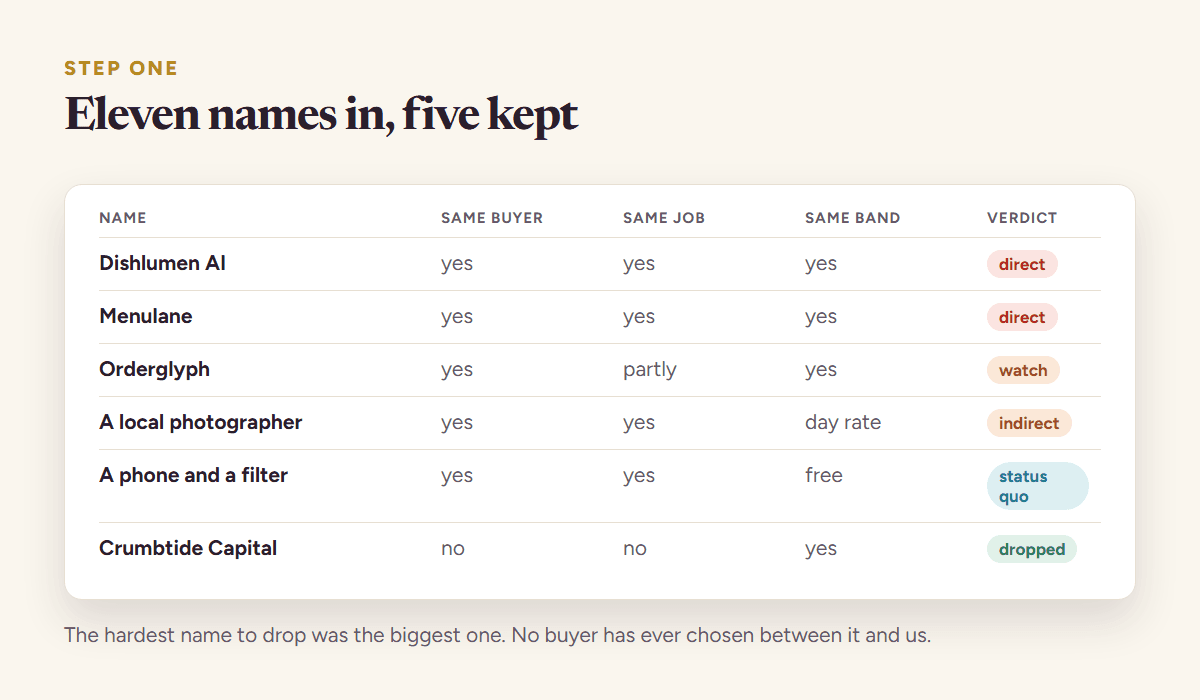
| Name | Same buyer | Same job | Same price band | Verdict |
|---|---|---|---|---|
| Dishlumen AI | yes | yes | yes | keep, direct |
| Menulane | yes | yes | yes | keep, direct |
| Orderglyph | yes | partly | yes | keep, watch |
| A local photographer | yes | yes | no, day rate | keep, indirect |
| A phone and a filter | yes | yes | free | keep, the status quo |
| Crumbtide Capital | no | no | yes | drop, different buyer |
| A generic image editor | partly | no | yes | drop, not the job |
The name that was hardest to drop was the big one, because dropping it feels like flinching. It sells to restaurant chains through a sales team at roughly forty times the price. No buyer has ever chosen between it and Forkvane, so every row of a comparison would have come back "they have more", which teaches nothing.
Step two: both pricing pages, for the same buyer
Plan names were ignored entirely. Instead: one named buyer, priced on both lists. A restaurant with one location and forty dishes, refreshing its menu twice a year.
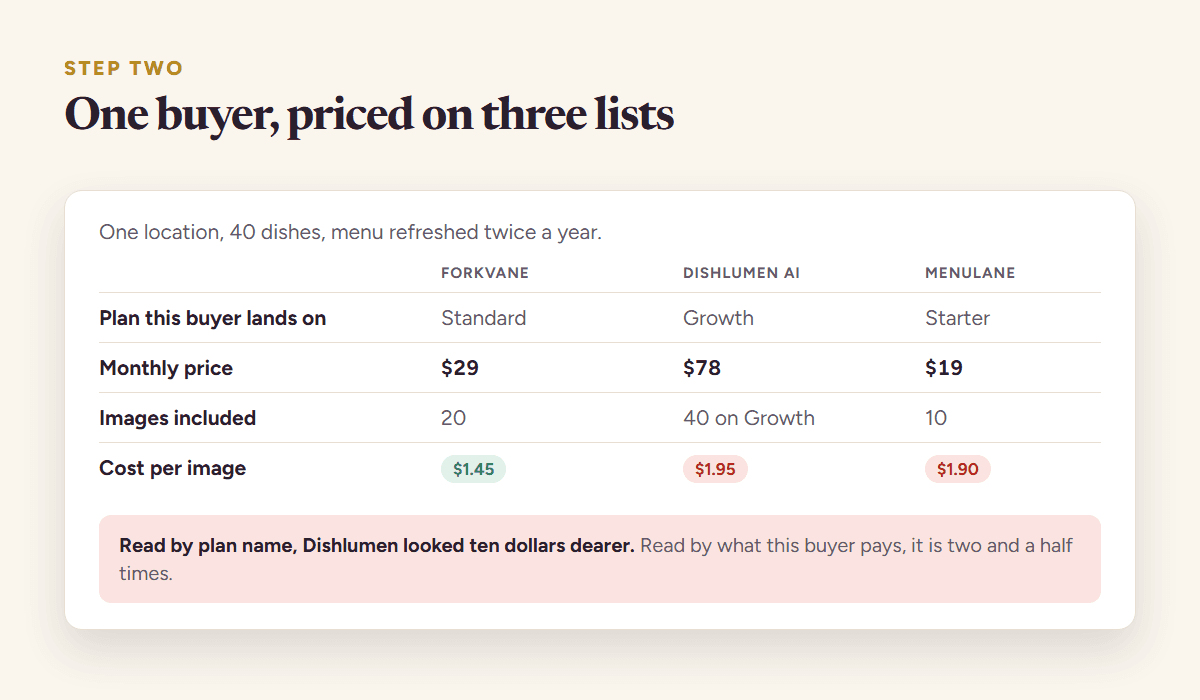
| Forkvane | Dishlumen AI | Menulane | |
|---|---|---|---|
| Plan this buyer lands on | Standard | Growth | Starter |
| Monthly price | 29 dollars | 78 dollars | 19 dollars |
| Images included | 20 | 8 on entry, 40 on Growth | 10 |
| Cost per image | 1.45 dollars | 1.95 dollars | 1.90 dollars |
| Where the cap was stated | the plan table | a footnote | the plan table |
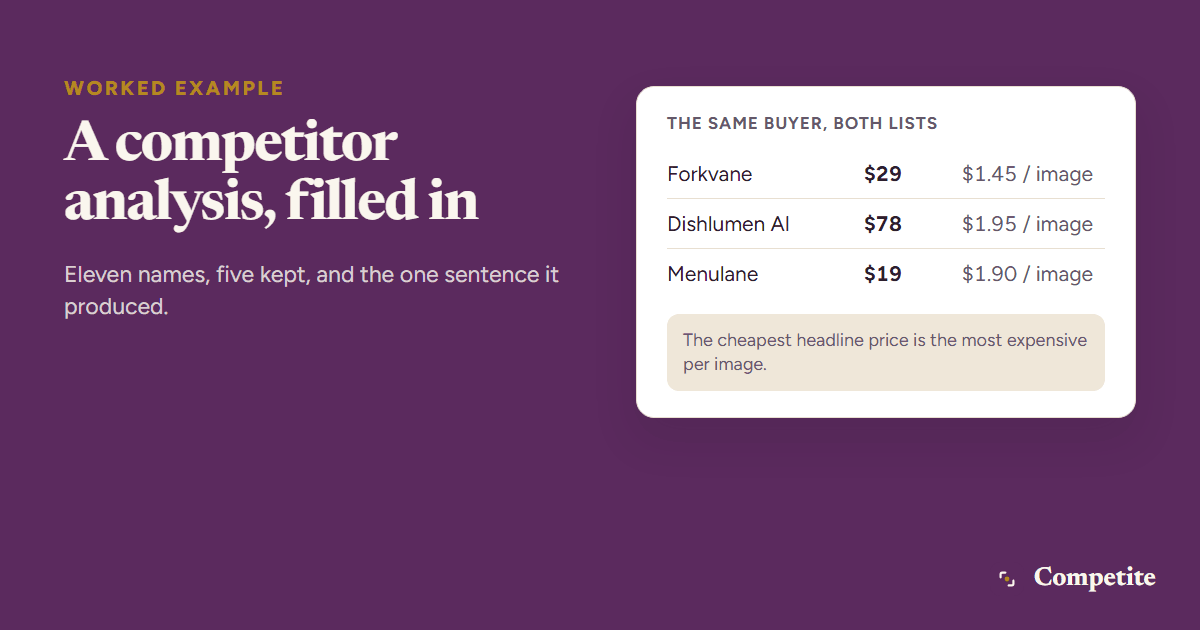
This is where the analysis earned its morning. Read by plan name, Dishlumen looked ten dollars more expensive. Read by what this buyer actually pays, it is two and a half times. Menulane launched at a headline price below ours and is more expensive per image, which is a different problem and a smaller one.
Step three: the table, including the rows we lost
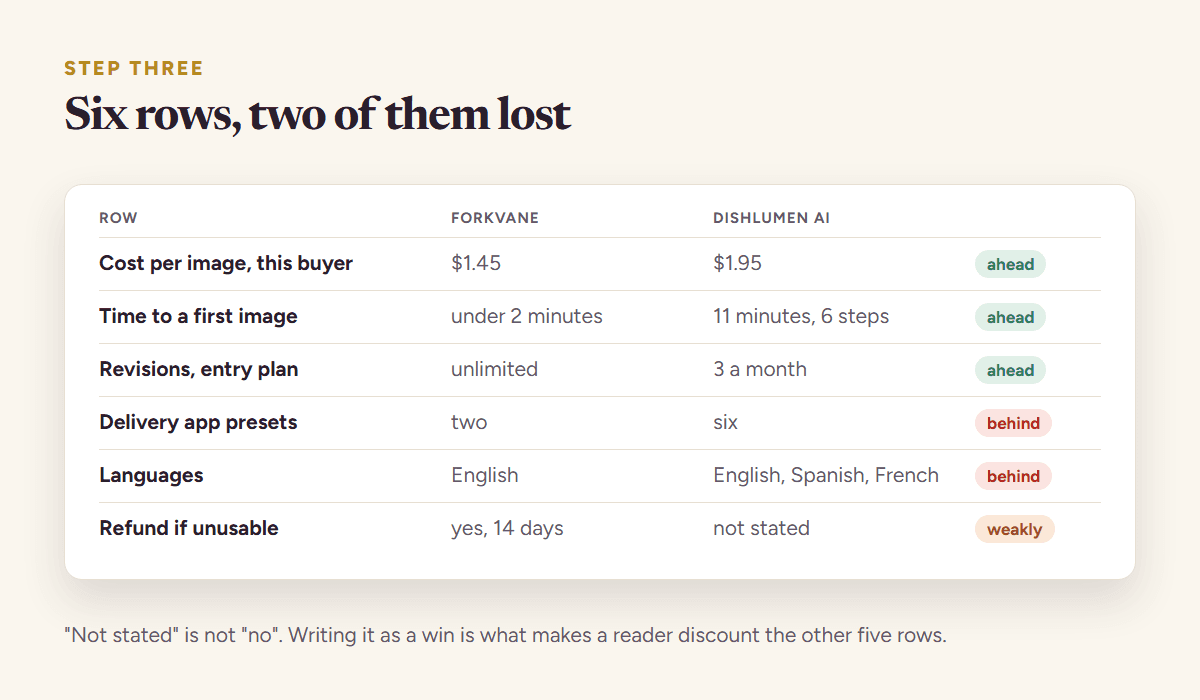
Six rows, chosen because a buyer had asked about each one unprompted in a sales conversation or a support message. Nothing was included because we were proud of it.
| Row | Forkvane | Dishlumen AI | Verdict |
|---|---|---|---|
| Cost per image, this buyer | 1.45 dollars | 1.95 dollars | ahead |
| Time to a first usable image | under 2 minutes | 11 minutes, 6 steps | ahead |
| Revisions on the entry plan | unlimited | 3 a month | ahead |
| Delivery app presets | two | six | behind |
| Languages | English | English, Spanish, French | behind |
| Refund if unusable | yes, 14 days | not stated | ahead, weakly |
The last row is marked weakly on purpose. "Not stated" is not the same as "no", and writing it as a win would be the kind of small dishonesty that makes a reader discount the other five rows. The method behind the table is in the competitor analysis template, and the deeper one-rival version is here.
The decision, which was smaller than the work
Three things, one of which was to do nothing.
- The price stayed at 29 dollars. The instinct after seeing Menulane at 19 was to match it. Per image we were already cheaper, so matching would have given away margin to fix a problem that did not exist.
- One line went under the price. "20 images included, unlimited revisions." Both facts were already true and neither was on the pricing page, which is the most common finding of any competitor analysis.
- Delivery app presets went on the roadmap. Not because the table said behind, but because two of the customers interviewed had asked for it before the analysis started. The table confirmed it; it did not decide it.
The most common right answer to a competitor analysis is one sentence on a pricing page.
What was wrong three months later
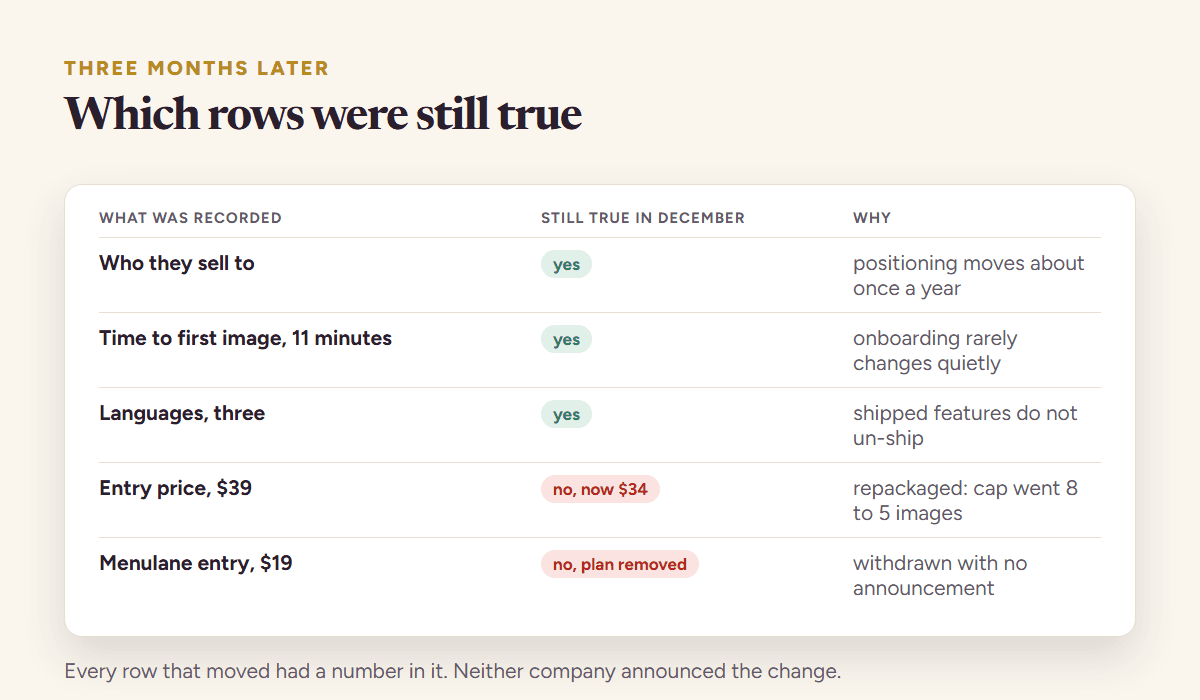
Dishlumen repackaged: the entry plan went from 39 to 34 dollars and the image cap went from 8 to 5, which is a price rise wearing a discount. Menulane quietly removed its 19 dollar plan. The positioning, the buyer and the onboarding step count were all still accurate.
That is the shape of it every time. The rows about who a company is for hold for a year; the rows with a number in them hold for about a quarter. Which is the argument for doing the analysis once properly and then watching two or three pages, rather than repeating the whole exercise. Competite does the watching part, and that repackage is exactly the kind of change it exists to catch, because nobody announces one.
Questions people ask
- What does a good competitor analysis example look like?
- Five names rather than twenty, four to six rows that a buyer actually asked about, a quote and a date in every cell, at least one row where you come out behind, and a decision at the end that is small enough to act on. If it ends without a decision, it was a document rather than an analysis.
- How long does a competitor analysis take?
- About half a day for three to five competitors if you are reading their own pages: roughly forty minutes to build and score the list, an hour on the two pricing pages, and the rest on the table and the sources. The expensive part is not the reading, it is asking buyers who did not buy what else they looked at.
- How many competitors should a competitor analysis include?
- Three to seven, and one of them should be the status quo of doing nothing. In the example here, eleven candidate names produced five worth keeping: two direct, one to watch, a freelancer as the indirect one, and a phone camera.
- How often does a competitor analysis need redoing?
- The whole thing, about once a year. The rows containing a number, roughly once a quarter, because that is how fast a pricing page moves. In this example two of six rows were wrong after three months and both were prices.
See it on your own competitors
Add your product, or just describe the idea. Competite finds the competitors, reads their pages, and writes the comparison with a quote behind every claim. Free, in about three minutes, no card.
Keep reading
A competitor analysis template that fits on one page, with the table
A free competitor analysis template on one page: the twelve-row table, the rules for filling it with quotes and dates, a scoring key, and a worked example.
15 September 2026 · 7 min read
Competitor analysis for startups: a founder’s guide
How to do a competitor analysis as an early-stage founder: find the real competitors, read their pricing, quote their claims, and keep it alive every week.
9 September 2026 · 7 min read
A direct competitor comparison that survives contact with a buyer
How to run a direct competitor comparison against one rival: picking the right one, making plans comparable, and the four habits that make a comparison useless.
19 September 2026 · 5 min read