How to identify early-stage competitors, before anyone has named the category
· 6 min read · by the Competite team
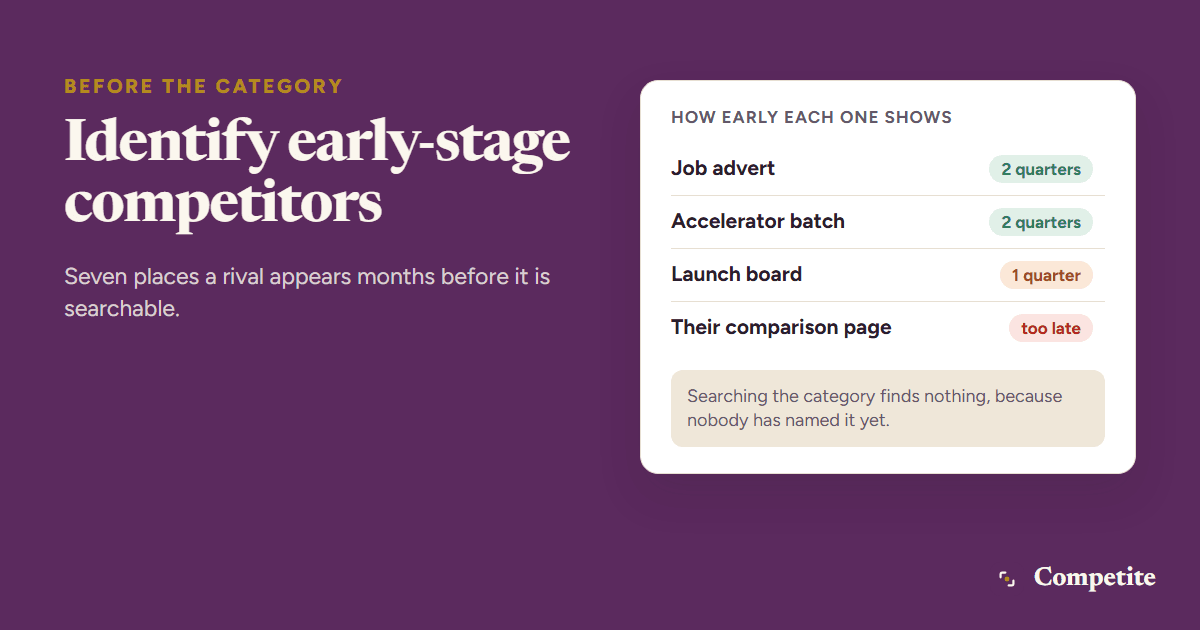
Searching your category works when your category has a name. Before that, the companies most likely to take your buyers describe themselves in words you would never type, and the ordinary way of finding competitors returns nothing while three of them are already selling. This is about the other places they appear first: launch boards, job adverts, accelerator batches, forum threads and your own lost deals, and about the one signal that tells you an adjacent company has just become a direct one.
Why the usual method returns nothing
Finding competitors normally starts with a search for the category, then review sites, then comparison pages. Every one of those steps assumes the category exists as a phrase somebody optimises for. Early on, none of it holds.
| The normal step | Why it fails early | What to do instead |
|---|---|---|
| Search the category | nobody has agreed on a name for it yet | search the problem, in the words a buyer would use |
| Review site listings | a category page needs enough products to exist | launch boards and forum threads, which need one |
| Their comparison pages | nobody writes one until they lose deals | their job adverts, which come first |
| Analyst reports | they cover segments, not three companies | accelerator batches and funding notes |
The consequence is specific and worth naming: at this stage, the absence of competitors in a search is not evidence that there are none. It is usually evidence that the search was the wrong instrument.
Seven places they show up first
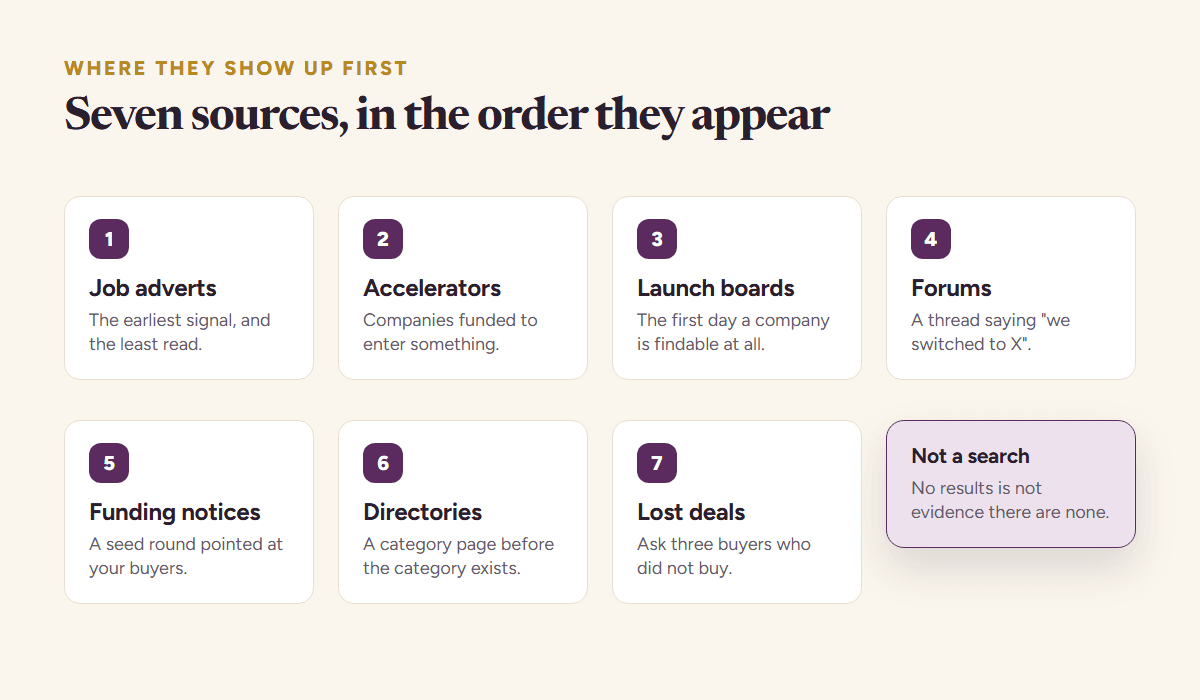
- Job adverts, theirs and their neighbours. The earliest signal there is, and the least read. A company hiring its first person for a problem is a company that has decided to attack it, and the advert usually describes the product before the website does.
- Accelerator batches and demo days. A published list of companies that have just been funded to enter something. Read the one-line descriptions rather than the names.
- Launch boards. Product Hunt and its equivalents. A launch is the first day a company is findable at all, and the comments underneath are buyers saying what they used before.
- The forums where your buyers complain. Search the problem, not the product. Somebody answering "we switched to X" in a thread is the most reliable competitor discovery there is, because it is a real switch.
- Funding notices. A seed round in your problem space is six to nine months of runway pointed at your buyers. The round is the announcement; the hiring that follows is the substance.
- Marketplace and integration directories. If your buyers live inside another product, its directory is a category page that exists before the category does.
- Your own lost deals. Last and most valuable. Three messages to the last three buyers who did not buy will name companies no amount of searching would have found.
Search the problem, not the product
Write the sentence a frustrated buyer would type at eleven at night, in their words, with no product category in it. For a menu-photo product that is "restaurant photos look bad on delivery apps", not "AI food photography platform". The first finds competitors. The second finds people writing about the market.
The week an adjacent company becomes a competitor
Most early competitors do not arrive as new companies. They arrive as companies you already knew about, doing something next door, that ship one thing and land in your market. The question is not whether to watch them, which is obvious, but what specifically to watch for.
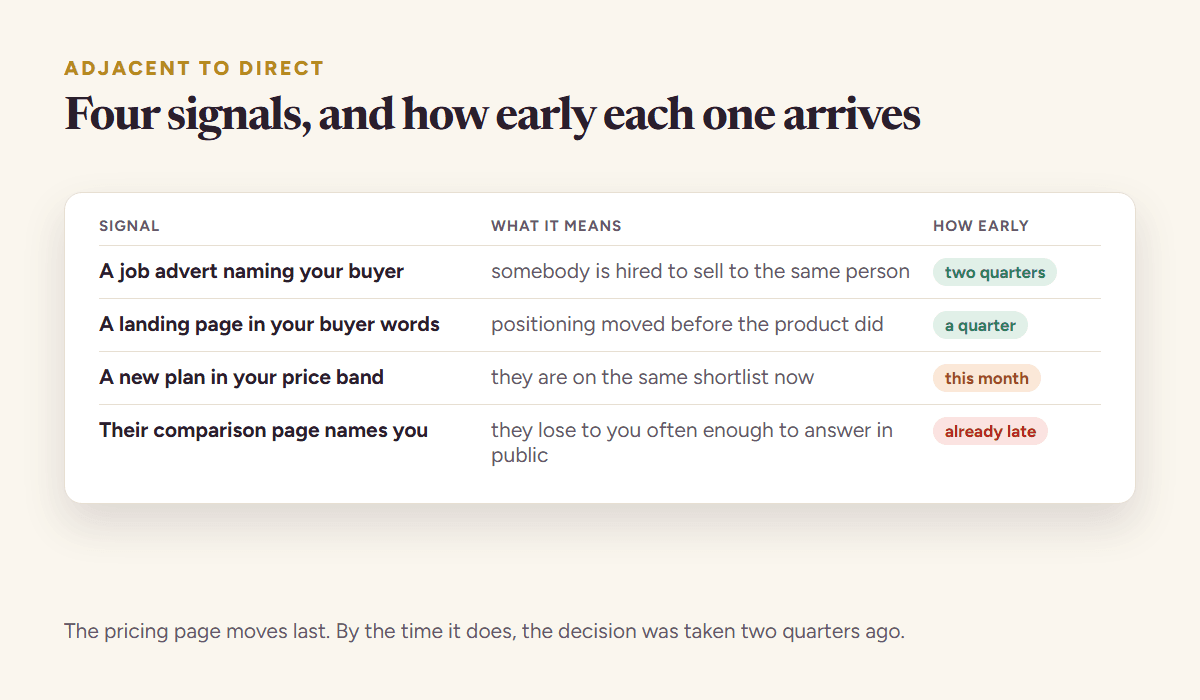
| Signal | What it means | How early |
|---|---|---|
| A job advert naming your buyer | somebody is being hired to sell to the same person | two quarters out |
| A landing page in your buyer words | the positioning has moved before the product has | a quarter out |
| A new plan in your price band | they are now on the same shortlist | the same month |
| Their comparison page names you | they are losing deals to you often enough to answer in public | you are already competing |
The last row is worth sitting with. By the time a company writes a comparison page against you, the competition has been running long enough to show up in their sales calls. It is a useful signal and a late one, and the three above it are all free to watch.
How many to keep, and what to do with the rest
Early on the temptation is to keep everything, because everything might matter. That produces a list nobody re-reads, which is the same as no list. Three to five names in the front list, everything else in a second list with a date against it.
The second list is the one that pays here, more than in a mature market. A company that scores one out of four today is a company that can score three by spring, and the only reason you would notice is that you wrote it down with a date and looked again. Scoring the four questions is covered in how to find competitors of a company; the difference between a direct and an indirect one is here.
And the thing that beats all of it: the status quo. In a market with no category, most buyers are not choosing between you and a rival, they are carrying on with a spreadsheet and a phone camera. A list of emerging competitors with no status quo on it is measuring the wrong race.
Keeping watch without it becoming a job
The seven sources above are a quarterly exercise, not a weekly one. New companies do not appear fast enough to justify checking launch boards every Monday, and doing so is how the habit dies.
What does deserve a weekly rhythm is the small number of names already on the list: their pricing page, their plans, their positioning line. Those move on their own schedule, without an announcement, and finding out late is the expensive failure. That part is what Competite does, which is also the honest limit of it: a tool watches the companies you already named, and finding the ones you have not named is still reading and asking. Nothing on this page is automated by us, and it is the more important half.
Questions people ask
- How do I identify competitors when my category does not exist yet?
- Stop searching the category and search the problem in the words a buyer would use at eleven at night, with no product noun in it. Then read job adverts, accelerator batches, launch boards, the forums where your buyers complain, funding notices and marketplace directories. Job adverts are usually months ahead of anything findable by search.
- I searched and found no competitors. Is that good?
- Usually it means the search was the wrong instrument rather than that the market is empty. Very early, nobody has agreed a name for the category, so the phrase you are searching has not been optimised for by anyone. Ask three buyers what they do today instead; if the honest answer is a spreadsheet, that is your competitor and it is a real one.
- How do I know when an adjacent company becomes a direct competitor?
- Four signals, in the order they arrive: a job advert naming your buyer, about two quarters early; a landing page written in your buyer words, about a quarter early; a new plan in your price band, the same month; and their comparison page naming you, by which point you have been competing for a while.
- How often should I look for new competitors?
- Once a quarter for discovery, because new companies do not appear fast enough to justify more, and checking weekly is how the habit dies. Weekly is for the names already on your list, whose prices and positioning move without an announcement.
See it on your own competitors
Add your product, or just describe the idea. Competite finds the competitors, reads their pages, and writes the comparison with a quote behind every claim. Free, in about three minutes, no card.
Keep reading
How to find your competitors, even before you have a product
How to find competitors for a startup: who counts as one, six ways to find them from a job or an idea, how to score the overlap, and how many to keep.
15 September 2026 · 6 min read
A new competitor just launched in your market. What to do first
A new competitor launched in your market: how to read what they actually shipped, decide whether it threatens you, and the four responses worth making.
17 September 2026 · 5 min read
Direct and indirect competitors, and the one that beats both
Direct vs indirect competitors, with examples: what separates them, why the status quo beats both, and how to sort your own list in about ten minutes.
17 September 2026 · 6 min read