The competition slide in a pitch deck: what investors look for, and how to build it
· 10 min read · by the Competite team
The competition slide in a pitch deck answers a question every investor is already asking: who else could win this market, and why will it be you? Sequoia’s outline of a pitch puts it in two sentences: “Who are your direct and indirect competitors. Show that you have a plan to win.” This guide covers what investors read the slide for, who belongs on it, the formats that work, the mistakes that cost trust, and one worked example.
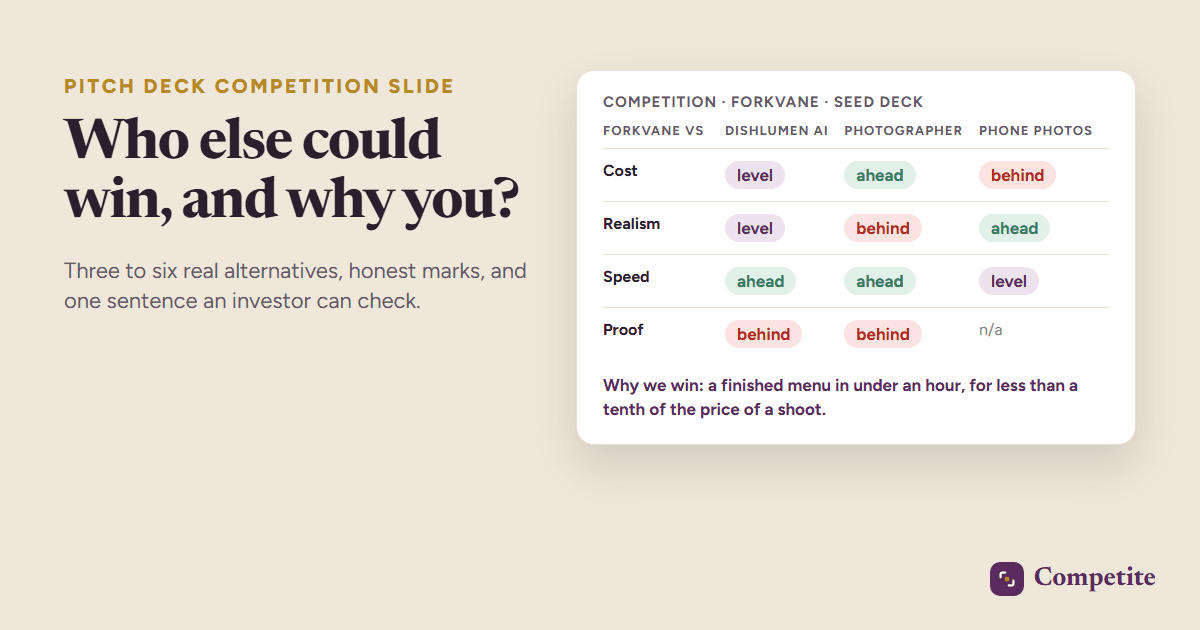
What do investors look for on the competition slide?
Three things: that you know the market better than they do, that you have a reason to win which a competitor cannot copy next quarter, and that you are honest about where you are behind. The slide is a test of judgement more than a map. An investor who has seen dozens of decks in your category already knows most of the names on it.
The first point is the one founders underestimate. An investor learns little from the names on the slide and a lot from which names you chose and what you say about each. Leaving out the competitor they were going to ask about tells them you either do not know it or hoped they would not notice, and neither helps.
The second is the one founders overstate. A reason to win is not a feature list. It is the one thing about how you build, sell or price that a better-funded competitor would struggle to copy: a buyer they cannot reach cheaply, a cost they cannot match without hurting their existing business, a channel they do not have.
Who belongs on a pitch deck competition slide?
Between three and six names, taken from the alternatives a buyer really considers: one or two direct competitors, one or two indirect ones, and the way buyers solve the problem today without buying anything. Add the biggest name an investor will think of, even if it is not a real competitor, and say in one line why it is not.
- Direct competitors. Same job, same buyer, a similar price. The ones you lose deals to.
- Indirect competitors. A different kind of product or service doing the same job: an agency, a freelancer, a general tool with a feature that covers part of it.
- The status quo. A spreadsheet, a phone, doing nothing at all. For an early startup it is usually the competitor that wins most often.
- The giant in the room. The large company an investor will mention if you do not. One line on why it does not compete for this buyer, or why it will not soon.
The direct vs indirect competitors guide has the test that separates the first two, and how to find competitors covers building the list from scratch. The best source is still your buyers: the names they mention when you ask what else they looked at belong on the slide before any name you found yourself.
Four competition slide formats, and when each one works
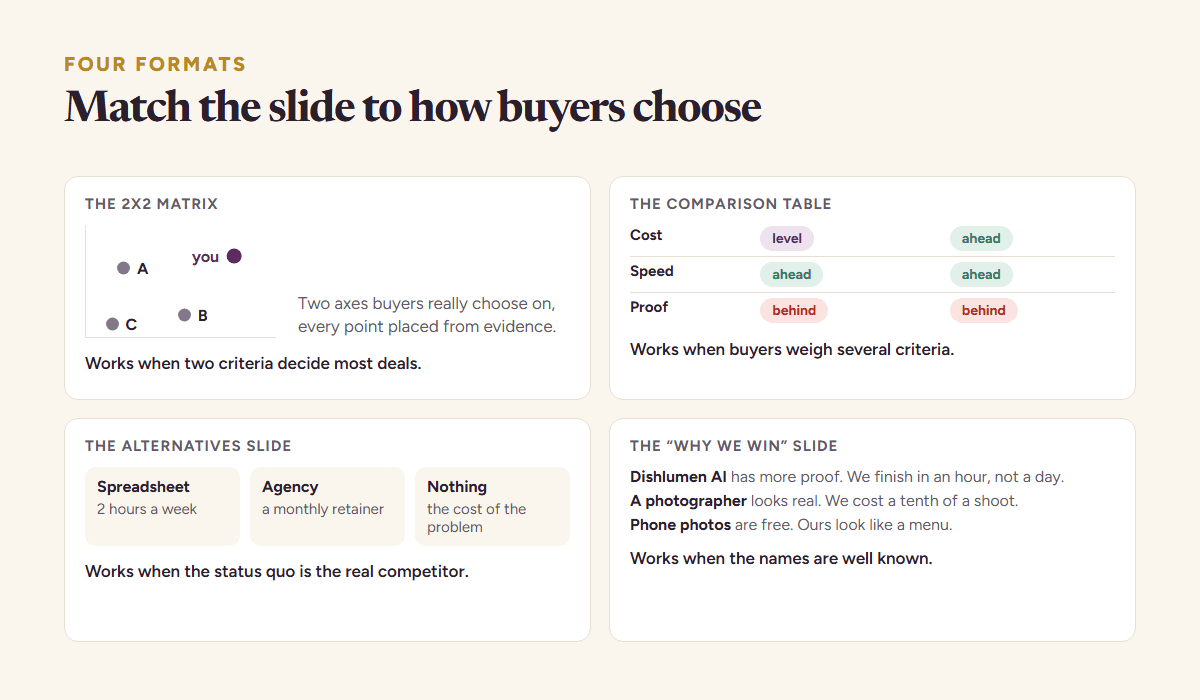
A 2x2 matrix, a comparison table, an alternatives slide and a “why we win” slide. The matrix works when two buying criteria decide most deals; the table when buyers weigh several; the alternatives slide when the status quo is the real competitor; and the “why we win” slide when the competitors are well known and the argument is what you do differently.
The 2x2 matrix
Two axes, each a criterion buyers choose on, with every competitor placed from evidence. It is the most common format and the most abused one: axes chosen so that you sit alone in the top-right corner tell an investor more about the founder than about the market. When the axes are real, an empty quadrant is worth a conversation, and competitive landscape analysis covers how to choose them.
The comparison table
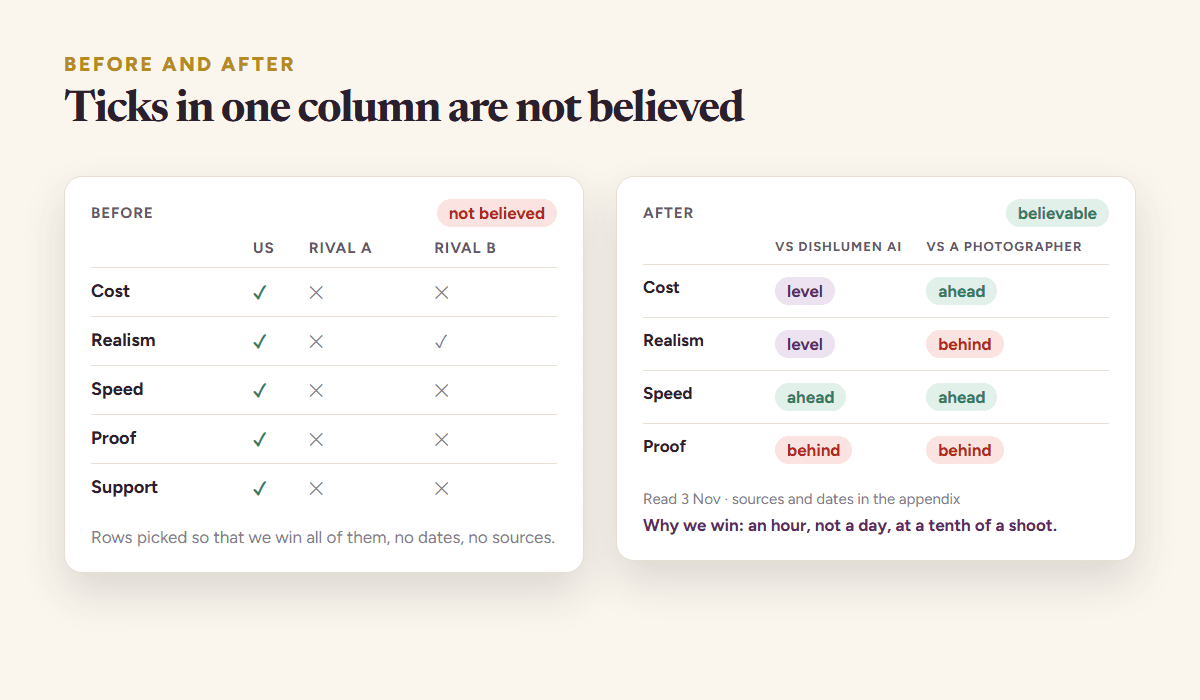
The rows are the four to six criteria a buyer compares on, the columns are you and the alternatives, and each cell says ahead, level or behind instead of showing a tick. A table in which you win every row is not believed. Two rows where you are honestly behind make the rows where you are ahead credible.
The alternatives slide
For a startup whose real competitor is the way things are done today. Each column is one alternative, the spreadsheet, the agency or the add-on in a tool the buyer already pays for, with what it costs in money or hours and where it fails. It answers whether buyers will pay at all, which matters more to an early investor than who else is selling.
The “why we win” slide
One line per competitor: what they are strong at, and what you do that they would struggle to copy. It works when the competitors are well known and an investor would rather hear your argument than read a chart. It fails when the lines are adjectives, faster, easier, better, which every competitor’s deck claims too.
Competition slide mistakes investors notice
The most common is claiming there are no competitors, which tells an investor that the founder has not looked or that nobody wants the product. Close behind come axes picked so you win alone, ticks in your column only, logos with nothing said about them, a competitor’s price from last year, and your roadmap written into today’s column.
- “We have no competitors.” Every buyer solves the problem somehow, even if the solution is a spreadsheet or putting up with it. Name what they do today.
- Axes chosen to win. If no buyer would recognise the two axes as the way they choose, the chart is decoration.
- Ticks in one column. Nobody believes a product that wins every row. Mark ahead, level and behind.
- Logos without a sentence. A wall of logos proves you can find logos. Say one thing about each.
- Old facts. A competitor’s price or plan that changed last month, shown as current, costs more credibility than the row was worth.
- The roadmap in today’s column. Mark what ships today. Put what is coming on a separate, labelled line.
Old facts deserve their own warning, because a raise takes months and competitors keep moving while it runs. A slide built in March and still in the deck in June can show a price that a competitor changed in May. An investor who looks it up during the meeting, and some do, now doubts the rest of the slide as well.
How to build the competition slide from evidence
Start from buyers rather than from a template: ask five recent prospects what else they looked at and what they use today. Then read each competitor’s pricing and features pages and note what each says, with the date. Choose the four to six criteria buyers compare on, mark each row honestly, and write one sentence on why you win.
- Ask buyers what else they considered. Five recent prospects or customers is enough. The names they give belong on the slide; the names you would have guessed may not.
- Read each competitor’s pages, and date them. Pricing, features and the home page. The competitor analysis template has the rows to fill.
- Choose the criteria buyers compare on. Four to six, in the buyer’s own words. Price is almost always one of them.
- Mark each row ahead, level or behind. Keep the source and the date in your notes, not on the slide.
- Write the sentence on why you win. One line, specific enough that no competitor’s deck could use it.
- Keep the evidence in an appendix. A backup slide with the sources and dates answers the follow-up question before it is asked.
The sources stay off the main slide, which should be readable in ten seconds, but they belong in the appendix and in your head. “Their entry plan is $29 a month, as of last week” is an answer; “I think they are around thirty” is a guess an investor can hear. The direct competitor comparison guide goes deeper on reading one rival closely.
A competition slide example
Here is one for Forkvane, the fictional startup used across this blog, which turns a phone photo of a dish into a menu photo for independent restaurants. Its buyers compare on four things: what a menu costs, how real the photos look, how long it takes, and proof that other restaurants use it. The slide sets it against one direct competitor, one indirect one and the status quo.
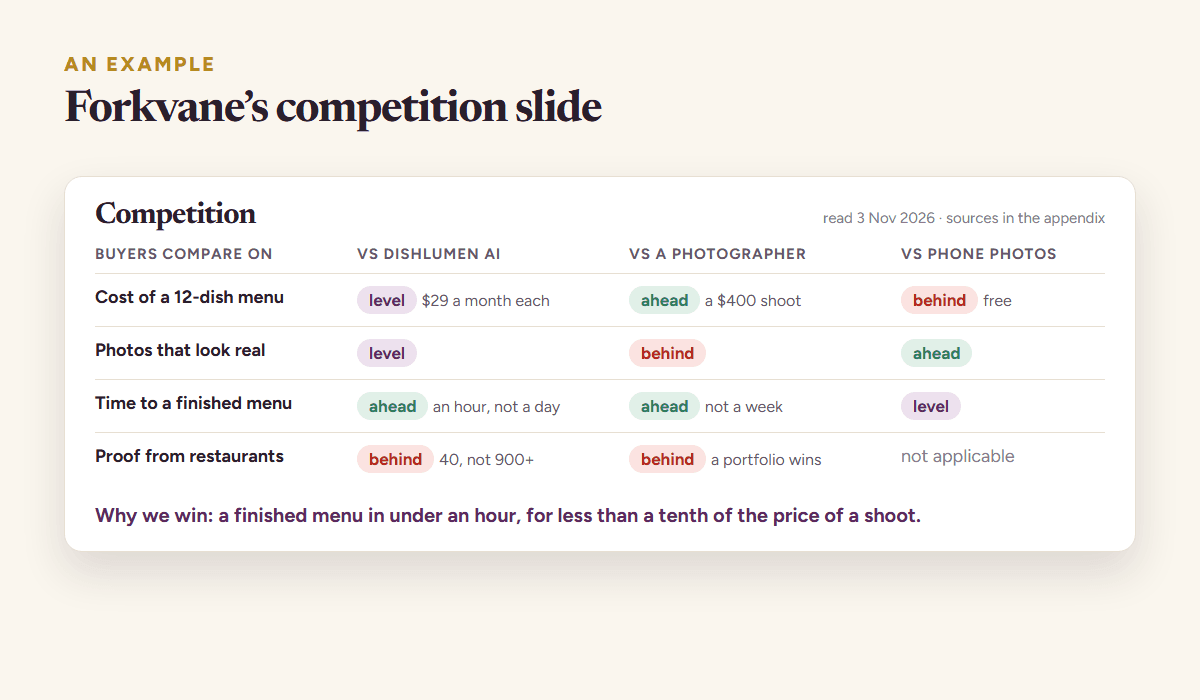
| Buyers compare on | Forkvane vs Dishlumen AI | vs a photographer | vs phone photos |
|---|---|---|---|
| Cost of a 12-dish menu | level: $29 a month each | ahead: a quoted $400 a shoot | behind: phone photos are free |
| Photos that look real | level | behind | ahead |
| Time to a finished menu | ahead: under an hour against a day | ahead: a week to book and shoot | level |
| Proof from other restaurants | behind: 40 against more than 900 | behind: a portfolio wins | not applicable |
Two things make it work. The behind rows stay: proof against the established competitor, and realism against a photographer, which an investor would have guessed anyway. And the closing line is specific: “a finished menu in under an hour, for less than a tenth of the price of a shoot”, a claim built from the rows where Forkvane is ahead instead of from adjectives.
Questions investors ask after the competition slide
Expect four: who is your closest competitor, why has nobody done this already, what happens when a big company builds it, and why will you win. Each has a short, honest answer that works better than a confident, vague one. Prepare them before the meeting; the slide gets ten seconds, and the questions about it get ten minutes.
- “Who is your closest competitor?” Name one, and say where they beat you. Answering “nobody, really” ends the conversation you wanted to have.
- “Why hasn’t anyone done this?” Usually somebody has, and failed or stayed small. Know who, and what is different now: a cost that fell, a channel that opened, a habit that changed.
- “What if a big company builds this?” Say why this buyer is not worth their attention yet, or why building it would hurt their existing business. “We will move faster” is not an answer on its own.
- “Why will you win?” The sentence from the slide, with the evidence behind it. If it needs a second sentence to make sense, the slide needs more work.
The second question connects to the slide Sequoia’s outline puts just before the market: why now, meaning what changed recently that makes the company possible. A competition answer and a why-now answer that contradict each other are exactly the inconsistency an investor is listening for.
Keeping the competition slide current during a raise
Read the competitors’ pages again before every investor meeting, or at least every two weeks while the raise is running. Prices, plans and headlines change during the months a raise takes, and the slide carries the date of your last reading whether or not you print it. Update the cells that moved and keep the old version for the appendix.
Competite keeps that reading current: it reads the pricing, features and home pages you confirm for each competitor, keeps every claim with the sentence it came from and the date it was read, and emails you when a competitor changes something notable, so the slide is checked before each meeting instead of rebuilt. Start free with one competitor.
Questions people ask
- What should be on a competition slide in a pitch deck?
- Three to six alternatives a buyer really considers, including the way they solve the problem today, compared on the criteria buyers choose on. Mark honestly where you are ahead, level and behind, and finish with one sentence on why you will win. The sources and the dates go on an appendix slide.
- How many competitors should be on a competition slide?
- Three to six. Fewer looks as if you have not looked, and more turns the slide into a wall of logos nobody reads. In a crowded market, group the rest into categories such as agencies or general tools, and name the two or three that buyers actually compare you with.
- Should you say you have no competitors in a pitch deck?
- No. Every buyer solves the problem somehow today, even with a spreadsheet or by doing nothing, and investors read “no competitors” as a sign that the founder has not looked or that there is no demand. Name the alternatives and say why buyers will switch.
- Where does the competition slide go in a pitch deck?
- Usually after the problem, the solution and the market, and before the business model. Sequoia’s outline of a pitch puts competition and alternatives after market potential and before the business model, and that order works for most decks.
- What is the best format for a competition slide?
- The one that matches how your buyers choose: a 2x2 matrix when two criteria decide most deals, a comparison table when buyers weigh several, an alternatives slide when the status quo is the main competitor, and one line per competitor when the names are well known.
See it on your own competitors
Add your product, or just describe the idea. Competite finds the competitors, reads their pages, and writes the comparison with a quote behind every claim. Free, in about three minutes, no card.
Keep reading
Competitive landscape analysis: putting the whole field on one page
How to run a competitive landscape analysis: pick two axes that decide deals, place every competitor from its own pages, and read the gap that is left.
17 September 2026 · 6 min read
Direct vs indirect competitors: what each one is, and the one that beats both
What a direct competitor is and what an indirect one is, with examples: the test that separates them, why the status quo beats both, and how to sort a list.
17 September 2026 · 8 min read
A direct competitor comparison that survives contact with a buyer
How to run a direct competitor comparison against one rival: picking the right one, making plans comparable, and the four habits that make a comparison useless.
19 September 2026 · 6 min read
Startup funding stages explained: pre-seed to Series C and beyond
Understand startup funding stages from pre-seed through Series C, what investors expect, what each round should prove, and when not to raise.
7 October 2026 · 7 min read
The competitor analysis in a business plan: what to write, with an example
How to write the competitor analysis in a business plan: who to name, what to say about each, how to answer when a form asks about competitors, and an example.
15 November 2026 · 11 min read