The competitor analysis in a business plan: what to write, with an example
, updated · 11 min read · by the Competite team
The competitor analysis in a business plan answers one question for whoever reads the plan: who else could a customer choose, and why would they choose you? The U.S. Small Business Administration’s guide to a business plan asks it in three short questions: “What do successful competitors do? Why does it work? Can you do it better?” This guide covers who to name, what to write about each, how to answer when a form simply asks “are there any competitors for your product or service?”, the mistakes that cost trust, and one worked example.
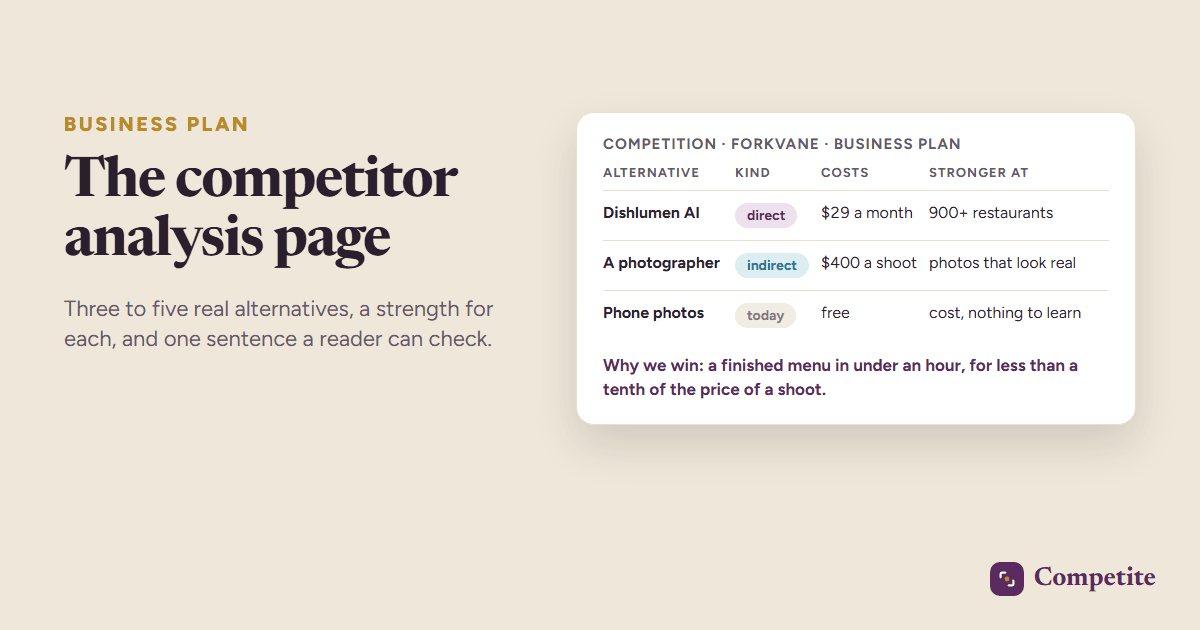
What is the competitor analysis in a business plan?
It is the part of the plan that names the alternatives a customer has, says what each one is good at, and shows where your business is ahead, level and behind. In a traditional plan it sits inside the market analysis, after the description of the company. A lender, an investor or a grant panel reads it to judge one thing: whether you know the market you are about to enter.
It is short. One page is enough for most plans: a paragraph, a small table and a sentence on why you win. What makes it convincing is evidence rather than length: a competitor’s price read from its own pricing page this month instead of remembered, and a row or two where you admit the competitor is stronger.
The same work goes by other names. A plan template may call it competitive analysis, competition, or market and competitors, and an application form may reduce it to a single question. The content is the same in each case, and so is the test the reader applies to it.
Are there any competitors for your product or service? How to answer
Yes, and say so in the first sentence. Every customer you hope to win is solving the problem somehow today, with another product, with a service, or by putting up with it, and each of those competes for the same money. A form that asks the question wants three things: that you have looked, that you can name names, and that you know why a customer would still pick you.
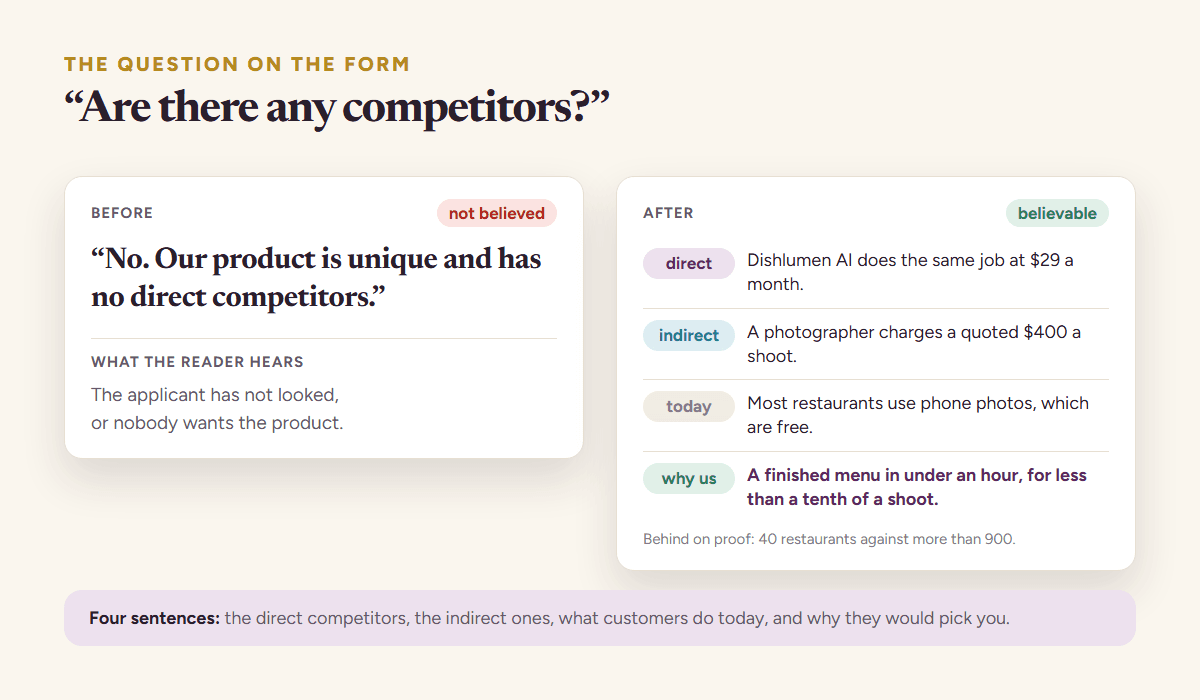
A good answer fits in four sentences, in this order.
- Name the direct competitors. One or two businesses that do the same job for the same customer at a similar price.
- Name the indirect ones. A different kind of product or service that gets the customer the same result: an agency, a freelancer, a general tool.
- Say what customers do today. The spreadsheet, the phone, the workaround. For a new business it is usually the alternative that wins most often.
- Say why a customer picks you. One specific sentence, built from a price, a time or a result that you can show.
An answer you can adapt
“Yes. Our closest competitor is [name], which does the same job at [price]. Customers also use [a service or a general tool], and most of them currently [what they do today]. We are [faster, cheaper, closer or more specific] for [which customer], because [the reason, with a number]. We are behind on [one honest thing].”
What does not work is “no, our product is unique”. The reader has seen that sentence before and takes it one of two ways: the applicant has not looked, or nobody wants the thing. If you searched and found nothing, say what you searched for and name what customers use instead. How to find competitors covers six ways to look, including for an idea with no product yet, and no competitors for your product covers what it usually means when the search stays empty.
What does the reader of a business plan look for?
It depends on what they are deciding. A lender is deciding whether the business will last long enough to repay, an investor whether it can win a large market, and a grant or accelerator panel whether the applicant has done the homework. All three read the competitor analysis as a test of judgement, and all three notice what is missing before they notice what is there.
| Who reads it | What they are deciding | What convinces them |
|---|---|---|
| A bank or another lender | whether the business lasts and repays | realistic prices against named rivals, and a reason customers will switch |
| An investor | whether you can win a large market | a reason to win that a better-funded competitor could not copy next quarter |
| A grant or accelerator panel | whether you understand the problem and the field | named alternatives, what customers do today, and what is different about your approach |
| You, a year from now | whether the plan was right | dates and sources, so the page can be held against what happened |
For an investor the page usually becomes a slide, and the pitch deck competition slide guide covers the formats that work there. The written version has more room than a slide and less forgiveness: a sentence can be checked, and the people who read plans check.
Which competitors belong in a business plan?
Three to five, chosen from what a customer would really consider: one or two direct competitors, one or two indirect ones, and the way customers solve the problem today. Leave out the names that only look impressive. A famous company that serves a different customer at ten times the price is not your competitor, and listing it tells the reader you could not tell the difference.
- Direct competitors. The same job for the same customer at a comparable price. The ones a customer would name.
- Indirect competitors. Another route to the same result. The direct vs indirect competitors guide has the test that separates the two.
- What customers do today. Doing it by hand, using something they already pay for, or doing nothing. It costs them time instead of money, and it is the hardest competitor to beat.
- The name the reader will think of. If there is a large company everybody knows, give it one line on why it does not compete for this customer.
For a local business the list is shorter and closer: the three or four places a customer could go instead, read from their own websites and, where it matters, a visit. For a product sold online the list comes from search, from comparison pages and from customers, and how to find the competitors of a company walks through the sources that name rivals by name.
What should the competitor analysis section contain?
Five things, in this order: the list of alternatives, a small comparison table on the criteria customers choose by, one line on what each competitor is good at, an honest mark of where you are ahead, level and behind, and a sentence on why you win. Sources and dates go in a footnote or an appendix, so the reader can check any line they doubt.
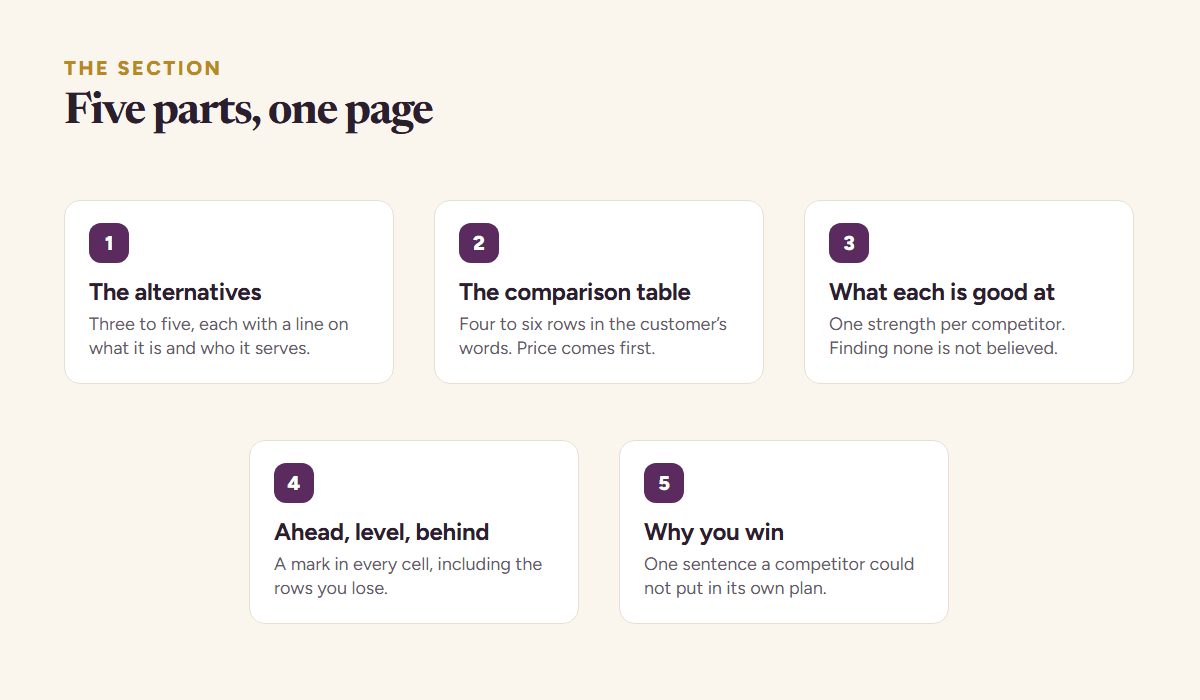
- The alternatives. Three to five, each with one line on what it is and who it serves.
- The comparison table. Four to six rows in the customer’s words. Price is almost always the first row, and competitor pricing analysis covers how to compare two price lists fairly.
- What each one is good at. One strength per competitor, stated plainly. A plan that finds nothing good in any rival is not believed.
- Ahead, level, behind. A mark in every cell. Two rows where you are behind make the rows where you are ahead credible.
- Why you win. One sentence that a competitor could not put in its own plan.
The competitor analysis template has the rows to fill and a file that opens in a spreadsheet. Fill it from the competitors’ own pages, their pricing, features and home pages, and write down the day you read each one. A price in a plan is a claim with a date on it, whether or not you print the date.
A competitor analysis example for a business plan
Here is the section for Forkvane, the fictional startup used across this blog, which turns a phone photo of a dish into a menu photo for independent restaurants. Its customers compare on four things: what a menu costs, how real the photos look, how long it takes, and proof that other restaurants use it. The page names one direct competitor, one indirect one and what restaurants do today.
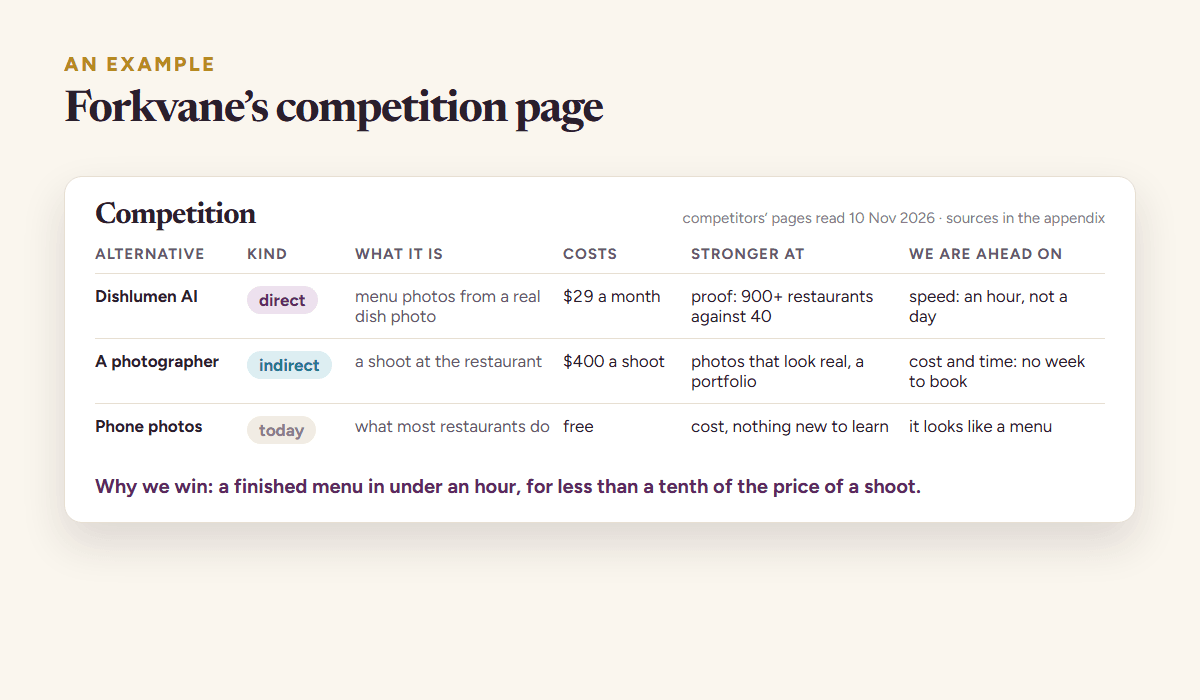
Restaurants that want better menu photos have three alternatives today. Dishlumen AI does the same job at the same price, $29 a month, and is ahead on proof: more than 900 restaurants against our 40. A photographer takes photos that look more real, for a quoted $400 a shoot and a week’s wait. Most restaurants do neither and use phone photos, which are free. We win where a restaurant needs a finished menu today: under an hour, for less than a tenth of the price of a shoot.
| Alternative | What it is | What it costs | Where it is stronger | Where Forkvane is stronger |
|---|---|---|---|---|
| Dishlumen AI | direct: menu photos made from a real dish photo | $29 a month | proof: more than 900 restaurants against 40 | speed: a menu in under an hour against a day |
| A photographer | indirect: a shoot at the restaurant | a quoted $400 a shoot | photos that look real, and a portfolio to show | cost and time: no week to book and shoot |
| Phone photos | what most restaurants do today | free | cost, and nothing new to learn | the result looks like a menu |
Three things make it work. Every alternative gets a strength, so the reader trusts the rest. The numbers are ones a reader could check: a price, a count, a time. And the last sentence is built from the rows where Forkvane is ahead, not from adjectives. The row it loses, proof, stays on the page, and the marketing section of the plan is where it says how that gap closes.
Mistakes that weaken the competition section
The most damaging is writing that there are no competitors. After it come lists of famous names that are not real alternatives, adjectives where a number should be, prices from memory, a table in which you win every row, and running a competitor down. Each one tells the reader something about the writer, and none of it is what the writer meant to say.
- “We have no competitors.” Every customer solves the problem somehow. Name what they do today and say why they would stop.
- Only the famous names. The competitor that matters is the one a customer would actually pick, which is often small and nearby.
- Adjectives instead of facts. “Better”, “easier” and “more affordable” are in every plan. A price, a time or a count is in very few.
- Prices from memory. A competitor’s price that changed last month, written as current, makes the reader doubt the numbers they cannot check.
- Winning every row. Nobody believes it. Say where the competitor is stronger and what you will do about it.
- Running competitors down. State what they do, in their own words where you can, and let the comparison speak.
Prices from memory are the easiest of these to avoid and the most common. Read the page, copy the price with the name of the plan it belongs to, and write the date beside it. A direct competitor comparison shows how to read one rival closely enough that every line in the section has a source.
How long should it be, and how often should it change?
One page, and it changes every time the plan goes to a new reader. A plan is written once and sent for months, and competitors change their prices and plans while it travels. Read their pages again before each submission, update the lines that moved, and change the date. A page that was true in spring and is sent in autumn is the one a careful reader catches.
Competite does that reading for you. It reads the pricing, features and home pages you confirm for each competitor, keeps every claim with the sentence it came from and the date it was read, and emails you when a competitor changes something notable, so the section is checked before each submission instead of written again. Start free with one competitor.
Questions people ask
- How do you answer “are there any competitors for your product or service”?
- Say yes, then name them: one or two direct competitors, an indirect one, and what customers do today instead of buying anything. Finish with one specific sentence on why a customer would still choose you, built from a price, a time or a result. Answering that there are none reads as not having looked.
- What if my product really has no competitors?
- Then the competitor is whatever customers do today: a spreadsheet, a general tool, a service, or living with the problem. Name it, say what it costs them in time or money, and say why they would switch. If you searched for rivals and found none, say what you searched for; that shows the looking, which is what the reader wants to see.
- How many competitors should a business plan include?
- Three to five. Fewer looks as if you have not looked, and more turns the section into a list nobody reads. Include one or two direct competitors, one or two indirect ones and the way customers solve the problem today, and group the rest into a category with one line.
- Where does the competitor analysis go in a business plan?
- Inside the market analysis, after the description of the company and before the sections on organisation, the product and marketing. That is the order of the traditional format the U.S. Small Business Administration describes, where market analysis is the third section. In a one-page plan it shrinks to two lines: the alternatives, and your advantage.
- Is a competitor analysis the same as a competitive analysis?
- Yes. Plan templates use competitor analysis, competitive analysis and competition for the same page: who else a customer could choose, how you compare, and why you will win. Use whichever heading the template or the form uses, and put the same content under it.
- Can I use the same competitor analysis in a pitch deck?
- The same evidence, in a different shape. A plan has room for a paragraph and a table with sources; a deck has ten seconds, so it becomes one slide with three to six alternatives and one sentence. Write the plan’s version first and cut the slide from it.
See it on your own competitors
Add your product, or just describe the idea. Competite finds the competitors, reads their pages, and writes the comparison with a quote behind every claim. Free, in about three minutes, no card.
Keep reading
The competition slide in a pitch deck: what investors look for, and how to build it
How to build the competition slide in a pitch deck: what investors read it for, who belongs on it, four formats, the mistakes that cost trust, and an example.
6 November 2026 · 10 min read
Competitor analysis for startups: a founder’s guide
How to do a competitor analysis as an early-stage founder: find the real competitors, read their pricing, quote their claims, and keep it alive every week.
9 September 2026 · 8 min read
How to find your competitors, even before you have a product
How to find competitors, even before you have a product: six free ways that start from a job or an idea, how to score the overlap, and how many to keep.
15 September 2026 · 9 min read
A competitor analysis template that fits on one page, with the table
A free competitor analysis template on one page: the twelve-row table, the rules for filling it with quotes and dates, a scoring key, and a worked example.
15 September 2026 · 8 min read
Direct vs indirect competitors: what each one is, and the one that beats both
What a direct competitor is and what an indirect one is, with examples: the test that separates them, why the status quo beats both, and how to sort a list.
17 September 2026 · 8 min read
No competitors for your product? What it usually means, and how to check
Found no competitors for your product? Four things that usually explains, five searches that settle it in an hour, and what to say when an investor asks.
15 November 2026 · 8 min read