Competitive landscape analysis: putting the whole field on one page
· 6 min read · by the Competite team
A competitive landscape analysis is the step after the list: instead of a row per competitor, the whole field goes on one page so you can see where you sit and what is missing. Most of them fail for the same reason, which is axes chosen because they flatter the product rather than because they decide deals. This guide covers what a landscape is for, how to choose the two axes, how to place each competitor from evidence rather than opinion, how to read an empty space honestly, and how often to redraw it.
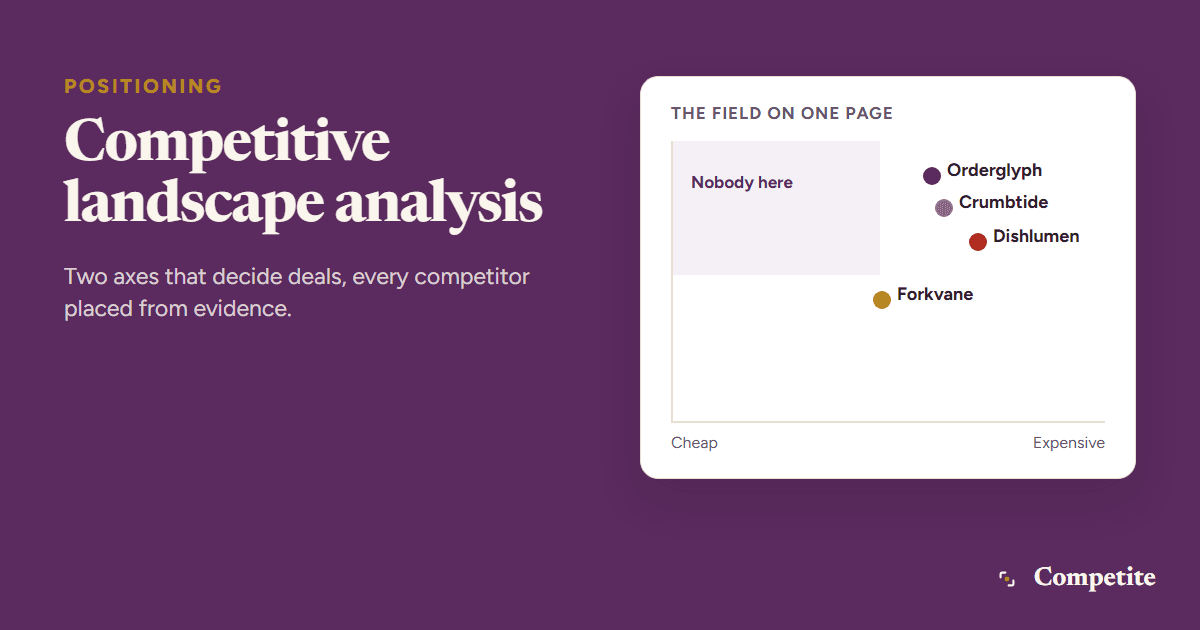
What a landscape is for, and what it is not
A per-competitor table answers "how do we compare to them". A landscape answers a different question: "what shape is this market, and where is nobody standing". They are not substitutes and the landscape is the one people get wrong, because it is the one that ends up in a deck.
| A landscape is good for | A landscape is bad for |
|---|---|
| Seeing which cluster you are in, and who is really next to you | Feature-by-feature comparison, which needs a table |
| Finding a position nobody is arguing for | Proving you are better, which needs evidence per row |
| Explaining the market to somebody in thirty seconds | Anything about a single competitor in detail |
| Noticing when two competitors drift into one cluster | Market sizing, which this cannot tell you |
The failure mode is famous enough to be a joke: every landscape ever drawn has its author alone in the top right. If your product lands in an empty corner on the first try, the axes were chosen to put it there.
Choosing two axes that decide deals
An axis earns its place if a buyer has ever changed their mind because of it. That rules out most of the ones people reach for first.
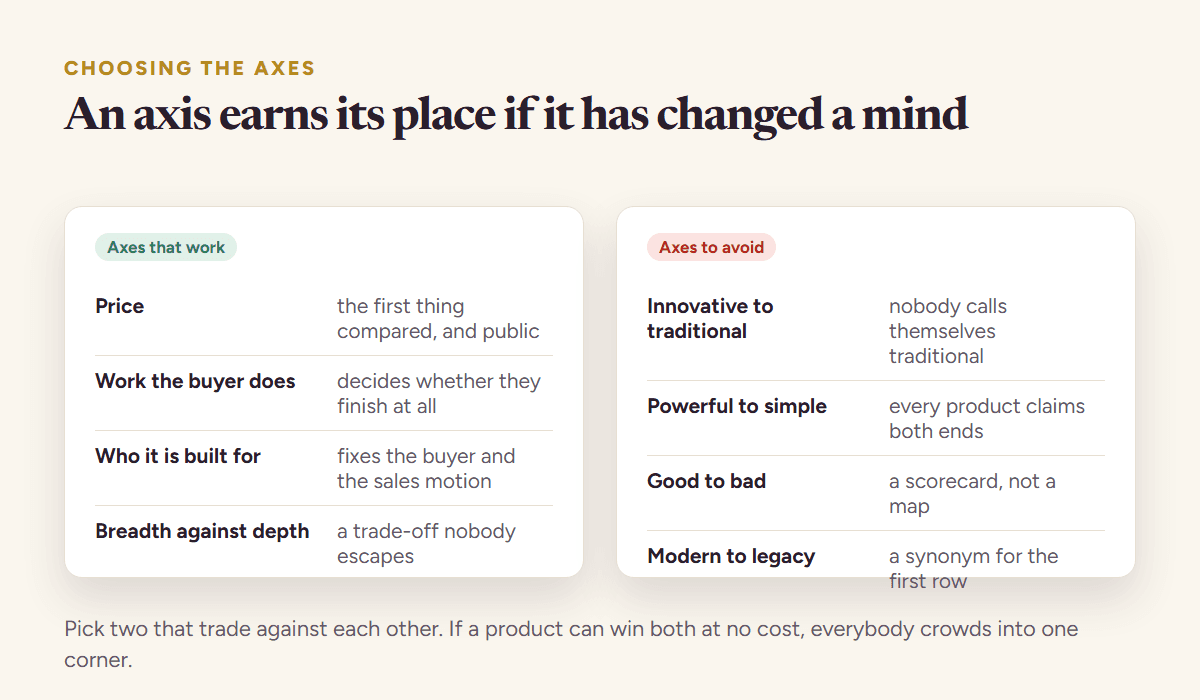
| Axes that work | Why | Axes to avoid | Why not |
|---|---|---|---|
| Price | the first thing compared, and public | Innovative to traditional | nobody self-identifies as traditional |
| How much work the buyer does | decides whether they finish at all | Powerful to simple | every product claims both |
| Who it is built for, by size | fixes the buyer and the sales motion | Good to bad | this is a scorecard, not a map |
| Breadth against depth | a real trade-off nobody escapes | Modern to legacy | a synonym for the first row |
Pick two that trade against each other. If a product can be at the good end of both axes with no cost, the landscape becomes a ranking with extra steps, and everybody crowds into one corner.
Placing each competitor from evidence
Every position needs a source you could show somebody. Not a feeling about the brand: a number or a sentence from their own site, with the date you read it.
- Price. The cheapest paid plan, from the pricing page. No public price is itself a position: put it at the sales-led end and note it.
- Work the buyer does. Count the steps between signing up and the first useful result, from their own onboarding or docs.
- Who it is for. The home page headline and the customer logos, not the category page.
- Breadth. The number of top-level items in their navigation is a crude but honest proxy.
Reading a pricing page for a position rather than a number is its own skill, and the eight things worth reading are in competitor pricing analysis. Place the status quo too, if the axes allow it. It usually sits at zero price and maximum buyer effort, and drawing it there explains more about the market than any of the logos.
Place yourself last
Put every competitor on the map before you put yourself on it. Placing yourself first turns the exercise into finding axes that leave room for you, which is how the empty top right corner gets manufactured.
Reading the empty space honestly
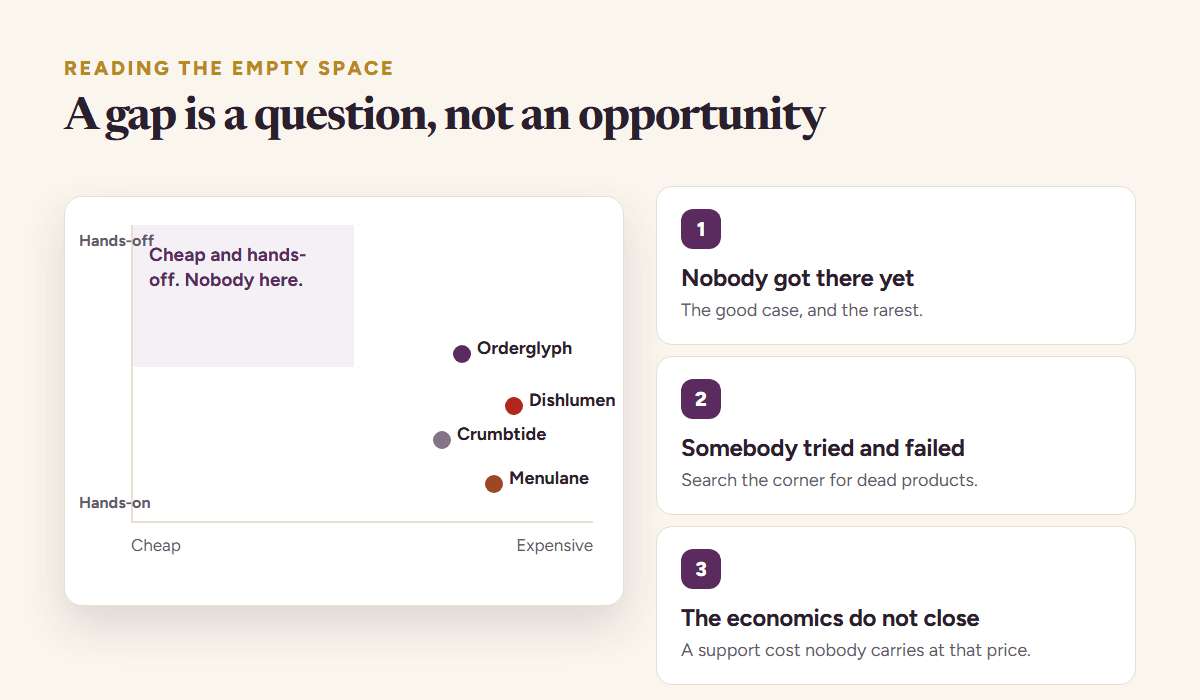
A space with nobody in it means one of three things, and only one of them is good news. Ask all three before building anything.
- Nobody has got there yet. The good case, and the rarest. Expect it in young categories and after a change in what technology costs.
- Somebody tried and it did not work. Search the corner for dead products. A company that shut down is evidence, and it is cheap to find.
- The economics do not close there. Cheap and hands-off usually means a support cost nobody can carry at that price. If the gap is at the cheap end, work out the unit cost before you celebrate.
The other thing worth reading is the crowd. Four competitors in one cluster means the buyer cannot tell them apart, which is an opportunity for whoever says one clear thing, and a warning that price is about to be the only argument left.
Redrawing it, and how often
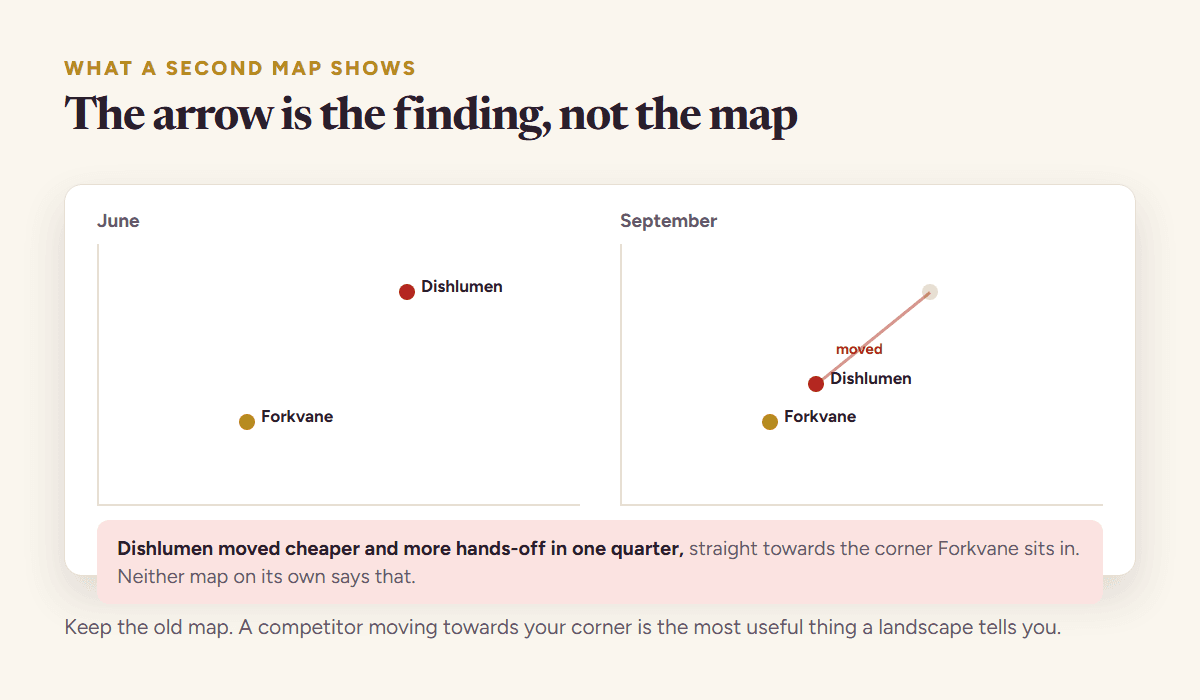
A landscape is a photograph, and it starts going out of date the moment it is drawn. Positions move for ordinary reasons: a price change slides a logo sideways, a simpler onboarding slides it down, a new plan splits one point into two.
Redraw once a quarter, and keep the old one. The interesting artefact is not this quarter map, it is the arrow between two of them: who moved, in which direction, and how fast. A competitor moving steadily towards your corner is the single most useful thing a landscape can tell you, and it is invisible in any one snapshot.
The inputs that move most often are prices and plans, which is the part worth automating rather than diarising. Competite keeps the history of those pages, so the arrows come from a record rather than from memory. The rest of the map, the axes and the judgement, is yours and should stay that way.
If you do not have the list of competitors yet, build it first with how to find your competitors, and sort it by kind with direct and indirect competitors, because indirect ones rarely belong on the same axes.
Questions people ask
- What is a competitive landscape analysis?
- It is the whole field on one page, usually as two axes with every competitor placed on them, so you can see which cluster you are in, who is genuinely next to you, and where nobody is standing. It answers what shape the market is, which a per-competitor table cannot.
- What axes should I use for a competitive landscape?
- Two that trade against each other and that a buyer has actually changed their mind over. Price and how much work the buyer does are the safest pair, because both are public and both decide deals. Avoid innovative against traditional or powerful against simple, which every product claims to win.
- How many competitors should be on the map?
- Between four and eight, plus the status quo. Fewer than four and the clusters are not visible; more than eight and the map becomes a logo wall that nobody reads. Use the direct competitors, since indirect ones rarely sit on the same axes.
- How often should a competitive landscape be updated?
- Once a quarter, keeping the previous version. The valuable thing is the arrow between two maps rather than either map on its own: who moved, which way and how fast. Prices and plans move most often, which is the part worth tracking automatically between redraws.
See it on your own competitors
Add your product, or just describe the idea. Competite finds the competitors, reads their pages, and writes the comparison with a quote behind every claim. Free, in about three minutes, no card.
Keep reading
Direct and indirect competitors, and the one that beats both
Direct vs indirect competitors, with examples: what separates them, why the status quo beats both, and how to sort your own list in about ten minutes.
17 September 2026 · 6 min read
A competitor analysis template that fits on one page, with the table
A free competitor analysis template on one page: the twelve-row table, the rules for filling it with quotes and dates, a scoring key, and a worked example.
15 September 2026 · 7 min read
Competitor pricing analysis: how to read a pricing page like a buyer
Competitor pricing analysis in an afternoon: the eight things to read on a pricing page, how to compare plans that are not alike, and how to set your price.
15 September 2026 · 8 min read