Competitive analysis frameworks: which one answers your question
· 9 min read · by the Competite team
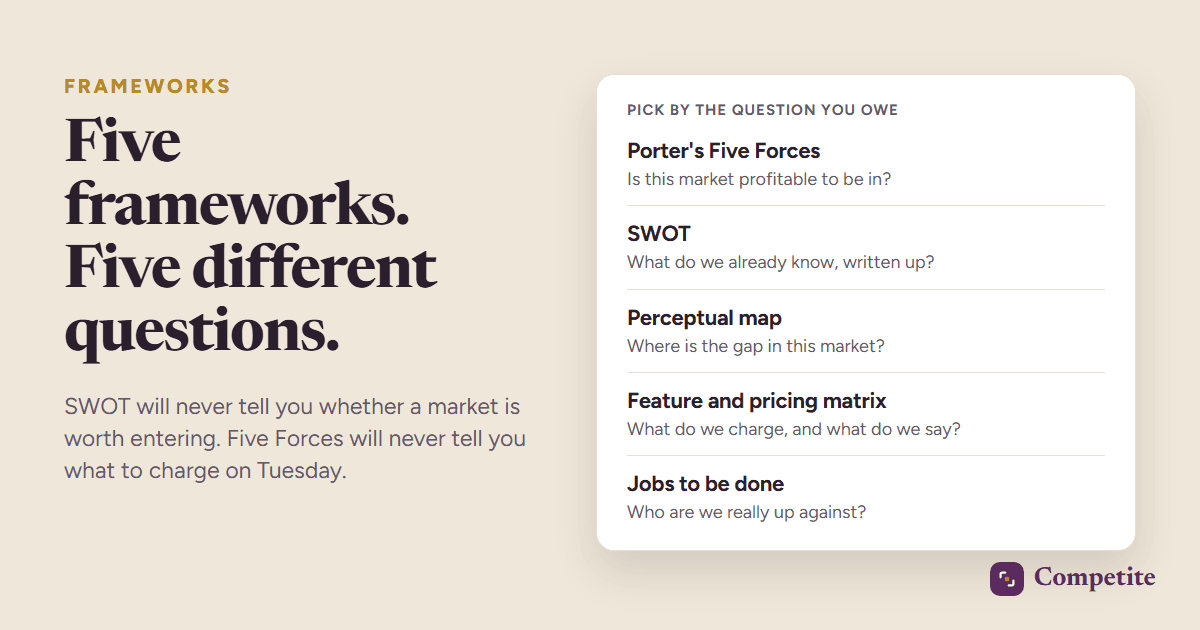
A competitive analysis framework is a set of boxes, and the boxes decide what you notice. That is the whole reason picking one matters: SWOT will never tell you whether a market is worth entering, and Porter’s Five Forces will never tell you what to charge on Tuesday. This compares the five you will actually meet by the question each answers, says when each is the wrong tool, and ends with the one most early-stage founders should use instead of any of them.
What is a competitive analysis framework?
It is a fixed set of questions you ask about every competitor, so that two of them can be compared and nothing is forgotten. That is all it is, and the fixedness is both the point and the trap.
A framework makes you notice what its boxes ask about, and quietly stops you noticing everything else. Choose one built for market structure and you will produce a market-structure answer even when your real question was a price. So the useful decision is not which framework is best; it is which question you are actually trying to answer this week.
Which is why the same five companies can produce two contradictory documents in one week. Run Five Forces and you get a page about how hard this market is to enter. Run a pricing matrix and you get a number you can put on a page by Friday. Neither is wrong, and only one of them was the question you had.
How do the five frameworks differ?
By the question each is built to answer, and by very little else. All five arrange the same public facts about the same companies. What separates them is which facts they send you out to find, and which they quietly let you leave out.
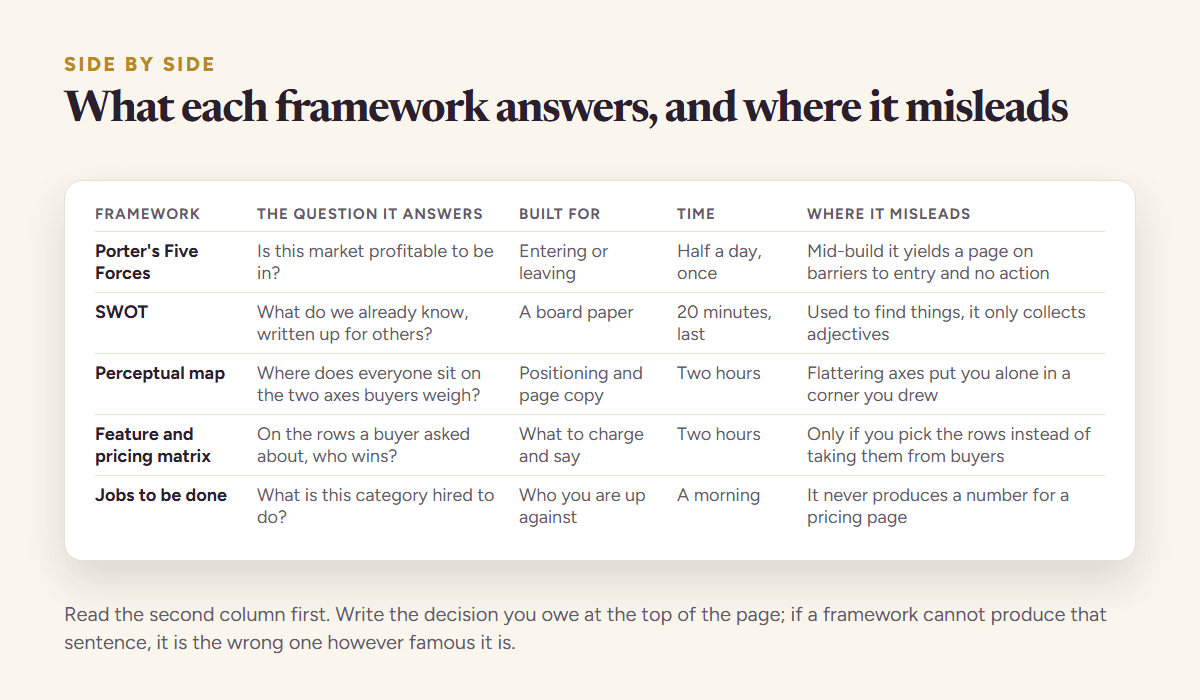
| Framework | The question it answers | When it is the wrong tool |
|---|---|---|
| Porter’s Five Forces | Is this market structurally profitable to be in? | Any week you are not deciding whether to enter or leave |
| SWOT | What do we already know, arranged for somebody who was not there? | When you need to find something out; it has no way to tell you where to look |
| Perceptual map | Where does everyone sit on the two things buyers weigh? | When you have not confirmed which two axes buyers actually weigh |
| Feature and pricing matrix | On the rows a buyer asked about, who wins? | When the question is strategic rather than about one deal |
| Jobs to be done | What are people hiring this category to do? | When you need a number to put on a pricing page |
The test that saves an afternoon
Before you draw any grid, write the decision at the top of the page: "should we enter this market", "what do we charge", "what do we say on the landing page". If the framework you are about to use cannot produce that sentence as an output, it is the wrong framework, however famous it is.
When is Porter’s Five Forces worth the afternoon?
When you are deciding whether to be in a market at all. Porter’s own framing asks how much power buyers have, how much suppliers have, how easily a new company can arrive, what could replace the category outright, and how hard the existing firms fight.
Those are structural questions with slow answers, which is exactly why it is misapplied. A founder already six months into building runs Five Forces, produces a page about barriers to entry, and has learned nothing they can act on before Friday. The framework was not wrong; the question was already settled.
Use it once, at the start, or when something structural moves: a platform changes its terms, a supplier consolidates, an incumbent starts giving your category away free.
Why does SWOT produce so little?
Because it asks four open questions with no test for what belongs in an answer. Anything fits, and the thing that fits most easily is an adjective. "Strong brand" goes in a box and nothing follows from it.
Compare that with a row in a pricing table. "Entry plan caps at 8 images, footnote on their pricing page, read 14 September" can be checked, dated and argued with. "Strong brand" can only be agreed with, which is why nobody ever disagrees with a SWOT and nothing ever comes of one.
SWOT is a summary instrument, not a discovery one. It is genuinely good at compressing an analysis for somebody who was not there, which is what a board paper needs. It is poor at producing findings, because none of its four questions tells you where to look. Two rules fix most of it, and they are in the competitor SWOT analysis guide.
What makes a perceptual map useful or useless?
The two axes, and nothing else. A map with the right axes shows you an empty quadrant worth occupying. A map with flattering axes shows you alone in a corner because you picked the two dimensions you happen to win.
The tell is where you end up. If the map puts you alone in the corner you were hoping for, you chose the axes after deciding the answer. A map that is doing its job usually puts you somewhere slightly uncomfortable, next to at least one company you would rather not be next to.
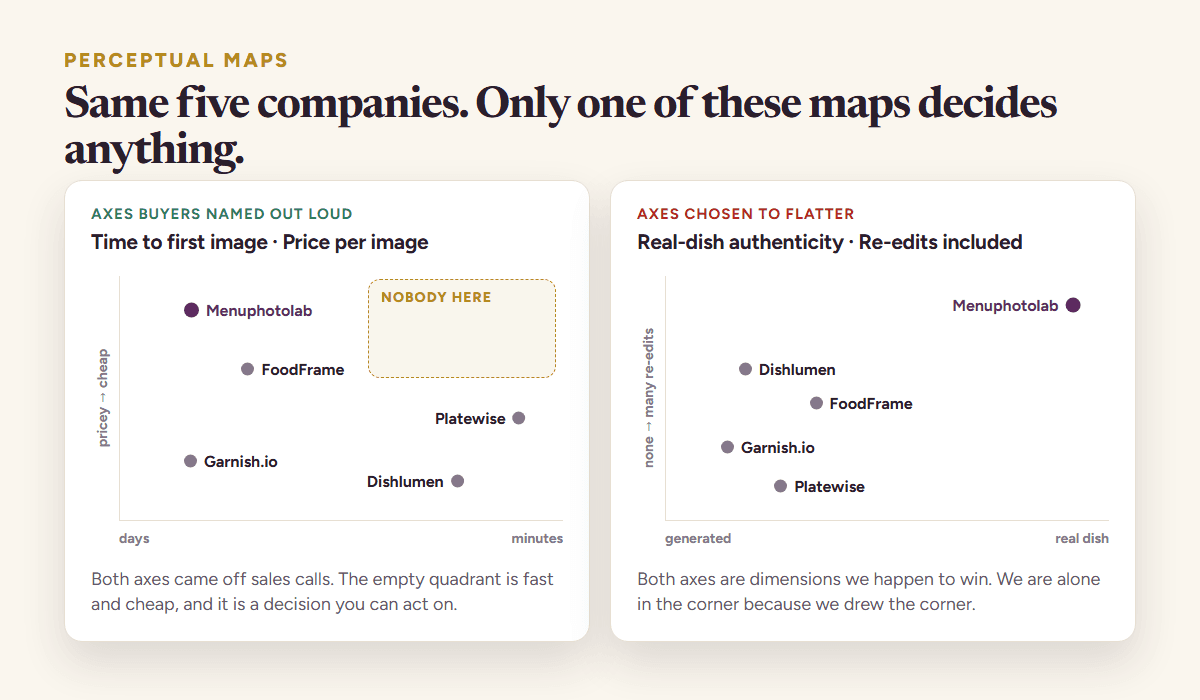
The honest way to pick axes is to take them from sales conversations rather than from a whiteboard: the two things buyers actually weighed out loud when they chose. If nobody has ever mentioned a dimension unprompted, it is not an axis. The longer version, including how to read an empty quadrant three ways, is in competitive landscape analysis.
When should you use a feature and pricing matrix?
Whenever the decision is about a real buyer choosing between you and somebody specific. It is the least fashionable framework on this page and the one that changes the most decisions.
It is also the only one here a buyer could read over your shoulder without wincing, because every cell is either their words or a competitor’s. That is a fair test for any competitive document: if showing it to a customer would embarrass you, it was written to reassure the team rather than to decide anything.
Its rules are simple and almost nobody follows them: rows are questions a buyer actually asked, every cell carries the quote and the date it was read, and at least one row says you are behind. A matrix where you win every row means you chose the wrong company or the wrong rows. There is a table to copy in the competitor analysis template and a filled example in this worked analysis.
Where does jobs to be done fit?
It reframes who the competition is. The question is not which companies sell what you sell, but what people are hiring to get the job done, which is usually a spreadsheet, a freelancer, or carrying on as they are.
That reframing is worth more early than any grid, because at an early stage the status quo wins more deals than every named company put together. What it cannot do is produce a number. It tells you who you are really up against; it does not tell you what to charge. Pair it with a pricing read rather than using it alone, and see direct and indirect competitors for how the kinds differ.
Which framework should an early-stage founder use?
Usually none of them, in the form they are taught. The decision in front of a founder is almost always what to charge or what to say, and the fastest route to both is a short matrix on three to five real competitors with a quote in every cell.
| Your question this week | Use | Roughly how long |
|---|---|---|
| Should we be in this market at all? | Five Forces, once | Half a day, then leave it alone for a year |
| What do we charge? | Pricing matrix, one named buyer priced on every list | Two hours |
| What do we say on the landing page? | Matrix rows where you are ahead, with evidence | Two hours |
| Who are we really competing with? | Jobs to be done, then three calls with buyers who did not buy | A morning |
| Where is the gap in this market? | Perceptual map, axes from sales calls | Two hours |
| Somebody needs the summary | SWOT, written last, from work already done | Twenty minutes |
Note the order that implies. SWOT last, not first. It is a way of writing up an analysis, and using it as a way of doing one is the single most common mistake in this category.
How often should a competitive analysis be redone?
The structural parts about once a year. Anything with a number in it about once a quarter, because that is how fast a pricing page moves.
This is the part no framework covers, and it is the part that decides whether the work was worth doing. A framework produces a document with a date on it; four months later the rows about who a company sells to are still right and the rows with prices are quietly wrong, and nobody announced it. Reading the same pages on a schedule is what keeps it true, which is what Competite is for: it watches the pages the numbers came from and tells you the day one moves.
A framework decides what you notice. Pick it from the decision you owe, not from the one you have heard of.
Questions people ask
- What is the best competitive analysis framework?
- There is no best one, because each answers a different question. Five Forces answers whether a market is worth being in. A pricing and feature matrix answers what to charge and what to say. A perceptual map answers where the gaps are. Pick from the decision you owe this week, and if the framework cannot produce that decision as an output, it is the wrong one.
- What is the difference between SWOT and a competitive analysis framework?
- SWOT summarises what you already know; a competitive analysis framework is supposed to help you find things out. SWOT has no mechanism for telling you where to look, so it is best written last, from work already done, as a summary for somebody who was not there.
- Do early-stage startups need Porter’s Five Forces?
- Once, when deciding whether to enter a market, and then rarely again. Its answers are structural and slow, so running it while already building produces a page about barriers to entry and nothing you can act on this week. A short pricing and feature matrix on three real competitors is almost always the better use of the same afternoon.
- How many competitors should a framework be applied to?
- Three to seven, and one of them should be the status quo of doing nothing. Twenty names is a document nobody re-reads, which is the same as no document. The scoring that gets you to a short list is in the guide to finding competitors of a company.
- How often should you redo a competitive analysis?
- The structural parts about once a year, and anything containing a number about once a quarter. Prices, plans and quotas move a few times a year and nobody announces it, so the practical answer is to do the analysis once properly and then watch two or three pages on a schedule rather than repeating the whole exercise.
See it on your own competitors
Add your product, or just describe the idea. Competite finds the competitors, reads their pages, and writes the comparison with a quote behind every claim. Free, in about three minutes, no card.
Keep reading
A competitor analysis template that fits on one page, with the table
A free competitor analysis template on one page: the twelve-row table, the rules for filling it with quotes and dates, a scoring key, and a worked example.
15 September 2026 · 7 min read
Competitor SWOT analysis, and how to stop it producing four useless lists
A competitor SWOT analysis that ends in a decision: the two rules that fix it, a worked example, the traps in each box, and when to skip it entirely.
20 September 2026 · 6 min read
Competitive landscape analysis: putting the whole field on one page
How to run a competitive landscape analysis: pick two axes that decide deals, place every competitor from its own pages, and read the gap that is left.
17 September 2026 · 6 min read