Competitor SWOT analysis, and how to stop it producing four useless lists
· 5 min read · by the Competite team
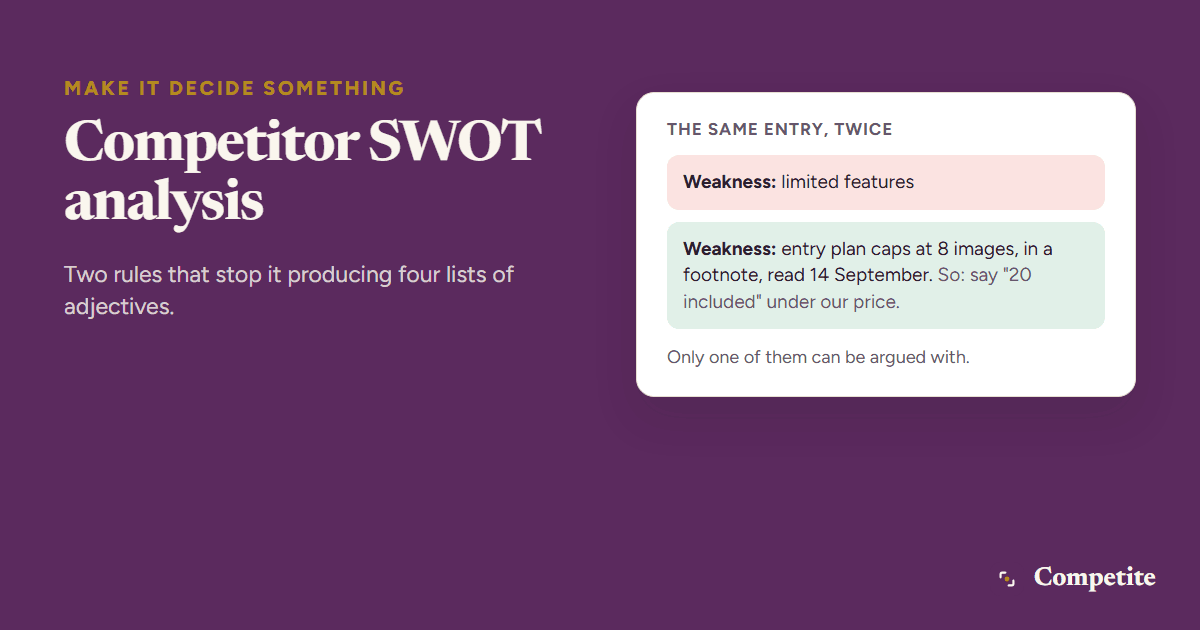
A competitor SWOT analysis usually produces four lists of adjectives and no decision. That is not because SWOT is a bad instrument; it is because almost nobody applies the two rules that make it one. Every entry needs the evidence it rests on, and every entry needs a consequence, in your words, for what you will do. Without both, you have written a vocabulary exercise. This covers the two rules, what goes wrong in each of the four boxes, a filled example, and the case for skipping it.
Why most of them are worthless
Open any competitor SWOT and you will find entries like "strong brand" under Strengths and "limited resources" under Weaknesses. Both are unfalsifiable, neither has a source, and no action follows from either. The grid gets filled because the grid has four boxes, and a box that looks empty feels like a gap in the work.
The failure is structural rather than lazy. SWOT asks four open questions with no test for what belongs in an answer, so anything fits, and the thing that fits most easily is an adjective. Two rules close that.
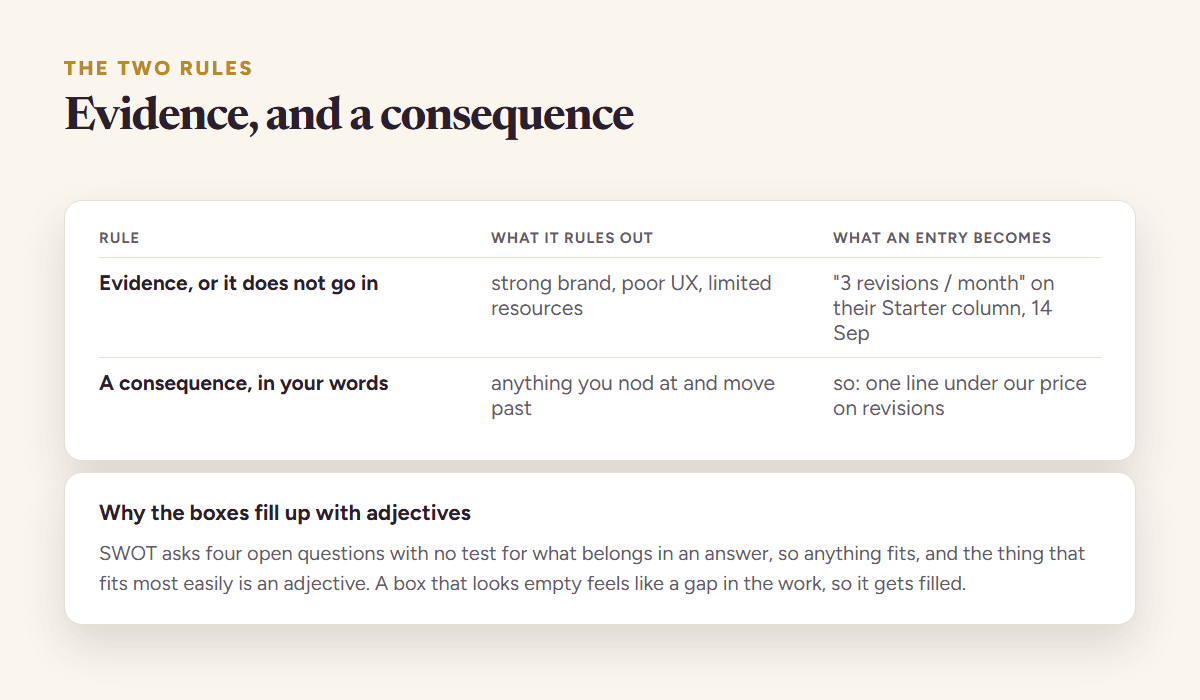
| Rule | What it rules out | What an entry looks like after it |
|---|---|---|
| Evidence or it does not go in | strong brand, poor UX, limited resources | "3 revisions / month" on their Starter column, read 14 September |
| A consequence, in your words | anything you can nod at and move past | so: one line under our price saying revisions are unlimited |
What goes wrong in each box
Each of the four has its own failure mode, and they are different enough to be worth naming.
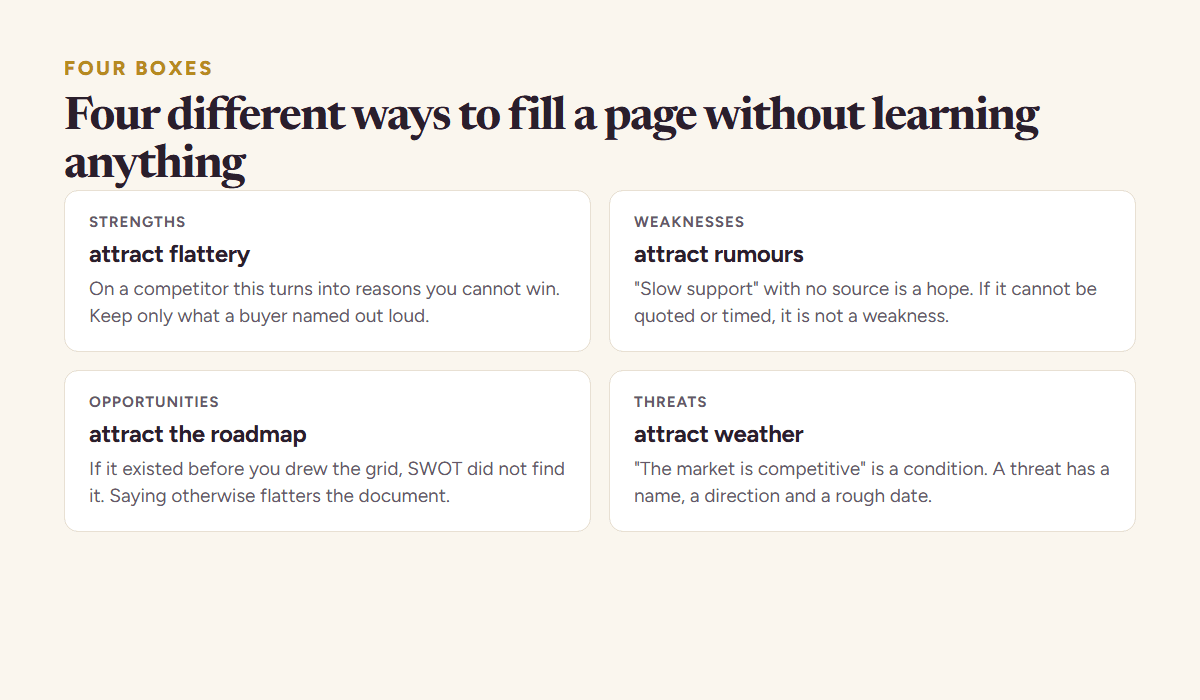
- Strengths attract flattery. When the subject is a competitor, this box quietly turns into reasons you cannot win. Keep only strengths a buyer has named out loud in a call.
- Weaknesses attract things nobody owns. "Slow support" with no source is a rumour. If it cannot be quoted or measured, it is not a weakness, it is a hope.
- Opportunities attract the roadmap you already wanted. The test is whether the opportunity existed before you wrote the grid. If it did, SWOT did not find it, and pretending otherwise makes the document look more useful than it was.
- Threats attract weather. "The market is competitive" is not a threat, it is a condition. A threat has a name, a direction and a rough date: this company is hiring sellers for our buyer, which lands in about two quarters.
A competitor SWOT, filled in
Forkvane makes menu photographs from a phone photo. The subject here is Dishlumen AI, its closest direct competitor. Six entries total, which is the right order of magnitude; a grid with twenty is a grid nobody re-reads.
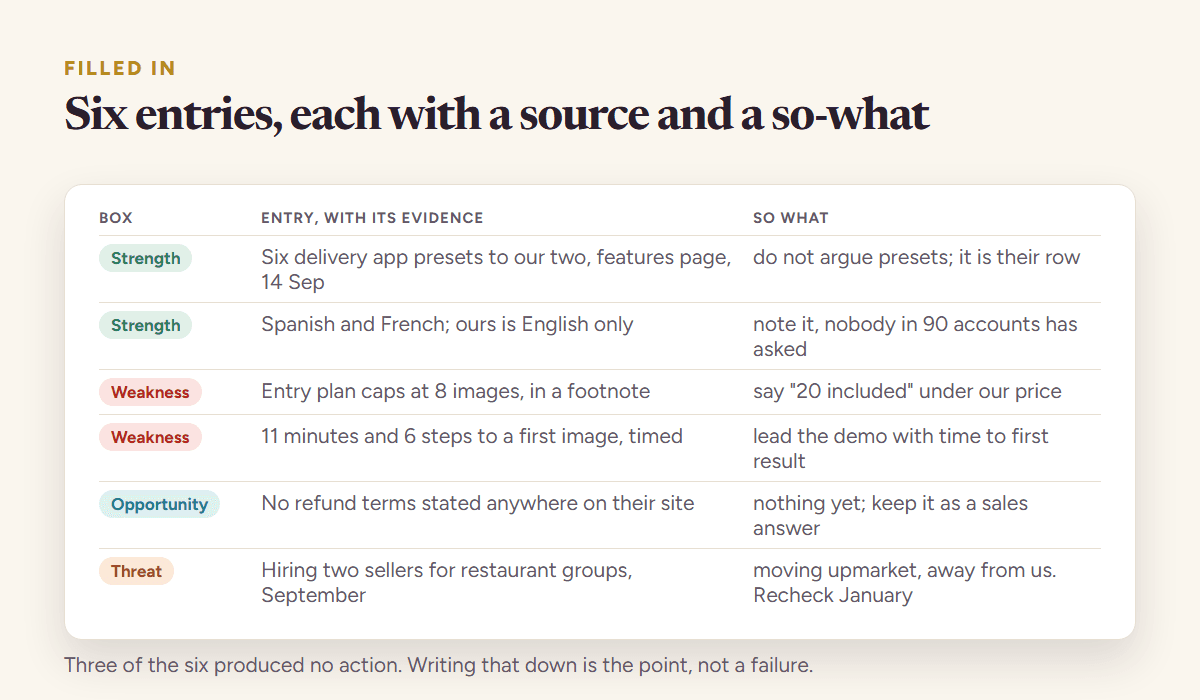
| Box | Entry, with its evidence | So what |
|---|---|---|
| Strength | Six delivery app presets to our two, listed on their features page, 14 September | do not argue presets on the landing page; it is their row |
| Strength | Spanish and French, ours is English only | note it; our buyers have not asked once in 90 accounts |
| Weakness | Entry plan caps at 8 images, in a footnote under the table | say "20 included" under our price, where theirs is hidden |
| Weakness | 11 minutes and 6 steps to a first image, timed on their trial | lead the demo with time to first result |
| Opportunity | No refund terms stated anywhere on their site | nothing yet; ours are stated, leave it as a sales answer |
| Threat | Hiring two sellers for restaurant groups, jobs page, September | they are moving upmarket, which is away from us. Recheck January |
Three of the six produced no action, and writing that down is the point rather than a failure. A grid where every entry demands work is a grid that was written to justify the exercise.
On a competitor, or on yourself
The two are different exercises and mixing them is the third common way this goes wrong. Opportunities and Threats belong to you: they are about the market moving. Strengths and Weaknesses can belong to either, but only if you say which.
| Doing it on | Useful for | Where it misleads |
|---|---|---|
| A competitor | deciding which rows to argue and which to concede | their weaknesses are only useful where your buyers care |
| Yourself | deciding what to say on a page and what to build | strengths drift into flattery with nobody to check them |
| Both in one grid | nothing | every entry becomes ambiguous about whose it is |
When to skip it
SWOT is a summary instrument. It is good at compressing an analysis for somebody who was not there, which makes it genuinely useful for a board paper or a pitch appendix. It is poor at producing findings, because none of its four questions tell you where to look.
So if the question is "what should we charge" or "why are we losing these deals", do the work that answers it and write the SWOT afterwards if somebody needs the summary. The pricing method is in competitor pricing analysis, the table that holds the findings is here, and a full worked analysis with the decision it produced is here.
One more thing that applies whichever way you use it: the entries with a number in them go stale in about a quarter, because they come off a pricing page. Two of the six above would be wrong by January, and neither company will announce it. That is the part worth watching rather than redoing, which is what Competite is for.
A SWOT box you cannot argue with is a box you did not need to fill.
Questions people ask
- How do you do a SWOT analysis of a competitor?
- Take one direct competitor and write no more than six entries across the four boxes, with two rules. Every entry carries the evidence it rests on, quoted from their own pages with the date you read it. And every entry carries a consequence in your words. An entry that fails either rule does not go in.
- What is the difference between a SWOT on a competitor and on yourself?
- Opportunities and threats are always yours, because they are about the market moving. Strengths and weaknesses can be either, but a single grid must say which, or every entry becomes ambiguous about whose it is. Doing both at once in one grid is the most common way this goes wrong.
- Is SWOT analysis useful for startups?
- As a summary, yes: it compresses an analysis for somebody who was not there, which is what a board paper or a pitch appendix needs. As a way of finding things, no, because none of its four questions tells you where to look. Do the analysis that answers your actual question, then write the SWOT if somebody needs it.
- How many entries should a competitor SWOT have?
- About six across all four boxes. A grid with twenty is one nobody re-reads. Expect several entries to produce no action at all, and write that down rather than inventing work, because a grid where everything demands a response was written to justify the exercise.
See it on your own competitors
Add your product, or just describe the idea. Competite finds the competitors, reads their pages, and writes the comparison with a quote behind every claim. Free, in about three minutes, no card.
Keep reading
A competitor analysis example, start to finish, with the decision it produced
A worked competitor analysis example: the list, the scoring, both pricing pages compared, the filled table, the decision it produced and what changed after.
20 September 2026 · 6 min read
A competitor analysis template that fits on one page, with the table
A free competitor analysis template on one page: the twelve-row table, the rules for filling it with quotes and dates, a scoring key, and a worked example.
15 September 2026 · 7 min read
Competitor pricing analysis: how to read a pricing page like a buyer
Competitor pricing analysis in an afternoon: the eight things to read on a pricing page, how to compare plans that are not alike, and how to set your price.
15 September 2026 · 8 min read