How to identify early-stage competitors before they become obvious
· 10 min read · by the Competite team
An early-stage competitor is a company that could enter the same buying decision before it is widely indexed, reviewed, or described with your category name. To identify one, search the buyer’s problem and workaround rather than the product category, collect names from launches, hiring, accelerator directories, marketplaces, funding records, communities, and lost deals, then score each candidate on buyer, problem, price, and channel overlap.
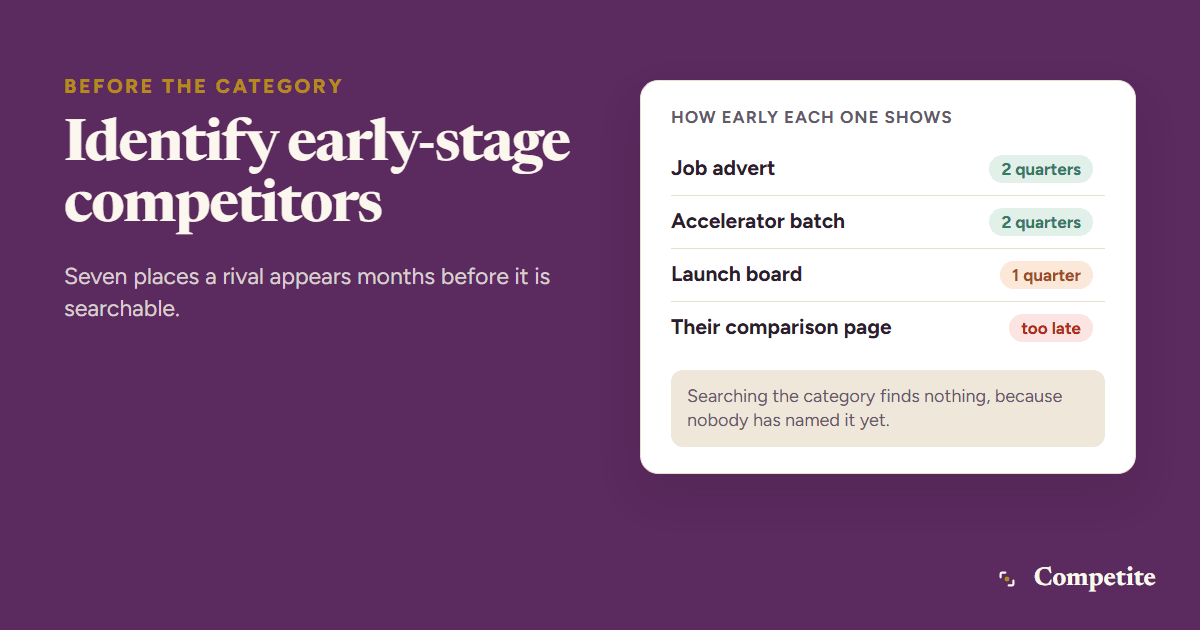
What is an early-stage competitor?
An early-stage competitor is an emerging company or adjacent product that is beginning to target the same buyer and job but has not yet accumulated the category rankings, reviews, comparison pages, or brand awareness that make mature rivals easy to find. Its evidence is a pattern of weak signals, not one announcement.
| Type | What exists now | What makes it competitive |
|---|---|---|
| New entrant | small team and early product | same buyer, job, and buying moment |
| Adjacent company | established product next door | new page, plan, or role aimed at your buyer |
| Open-source project | repository and community | hosted offer or commercial support appears |
| Service substitute | agency or manual workflow | productizes the same outcome at your price band |
| Status quo | spreadsheet, staff, or doing nothing | already wins the budget and requires no vendor switch |
No search results does not mean no competition
It can mean the market has not agreed on a noun. Buyers still solve the problem—with another product, a service, a spreadsheet, an employee, or by accepting the pain. Those alternatives are the starting set.
What are the earliest competitor signals?
The earliest reliable signals are changes in intent: hiring for your buyer, launching a relevant workflow, adding a plan in your price band, integrating with the system your buyers use, or appearing in a real switch conversation. A logo, funding round, or broad AI claim alone is not enough.
- Buyer signal: a role description, landing page, or case study names the same role and company profile you target.
- Problem signal: the company describes the same painful before-state or desired outcome in buyer language.
- Packaging signal: a self-serve plan, trial, or entry price makes it eligible for the same shortlist.
- Distribution signal: it appears in the marketplace, community, integration directory, or search path your buyers already use.
- Switch signal: a buyer says they replaced, shortlisted, or compared an existing solution with the candidate.
Treat one signal as a lead and two independent signals as a candidate. Promote a company to active tracking only when buyer overlap is verified. This keeps a launch feed from becoming a competitor list and prevents a funding headline from driving product strategy.
Why category searches miss emerging competitors
Category search assumes competitors use the same noun you use. Early companies often describe the outcome, the workflow, or a narrow customer instead. Review sites and analyst categories arrive later because they need enough products, demand, and language stability to create a category page.
| Normal research step | Why it fails early | Better starting point |
|---|---|---|
| Search the category | nobody agrees on the category name | search pain, workaround, outcome, and switch phrases |
| Open a review category | the candidate has too few customers or reviews | launch boards and buyer communities |
| Read comparison pages | nobody has enough head-to-head demand yet | job pages, changelogs, docs, and integrations |
| Read market-share reports | the segment is below reporting thresholds | accelerator cohorts and public filings |
The practical fix is query diversity. If ten searches are variations of your category keyword, they share the same blind spot. A pain query, a workaround query, an outcome query, and a switch query reveal different companies and substitutes.
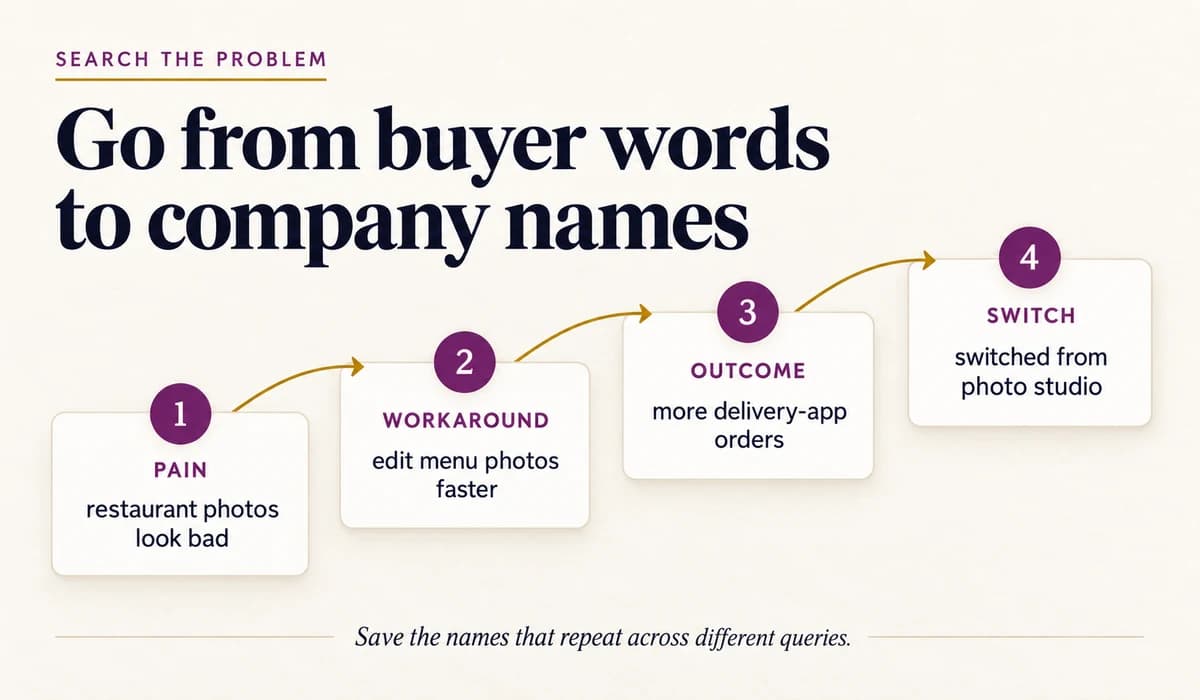
Search the problem with a query ladder
A query ladder moves from the buyer’s pain to the way they solve it, the outcome they want, and language that reveals switching. Write three queries at each level. Record company names that recur across levels; repetition is a stronger signal than one high-ranking result.
| Query family | Formula | Example |
|---|---|---|
| Pain | how to fix [pain] for [buyer] | how to fix bad menu photos for restaurants |
| Workaround | [manual task] faster / without [resource] | edit menu photos faster without a studio |
| Outcome | increase [outcome] with [asset or workflow] | increase delivery orders with better photos |
| Switch | switched from / alternative to [current method] | switched from food photography agency |
| Integration | [platform] app for [job] | Shopify app for competitor price monitoring |
| Role | [buyer role] tool for [job] | product marketer tool for competitor tracking |
Search results are only one source. Use them to harvest vocabulary, communities, directories, and company names. Then verify each company on its own website, documentation, product, job pages, and public customer evidence rather than relying on a search snippet.
Where do early-stage competitors appear first?
Early competitors usually appear first where builders recruit, launch, integrate, raise money, and answer buyers. Use seven source groups and require confirmation from a second group before promoting a name to the active watchlist.
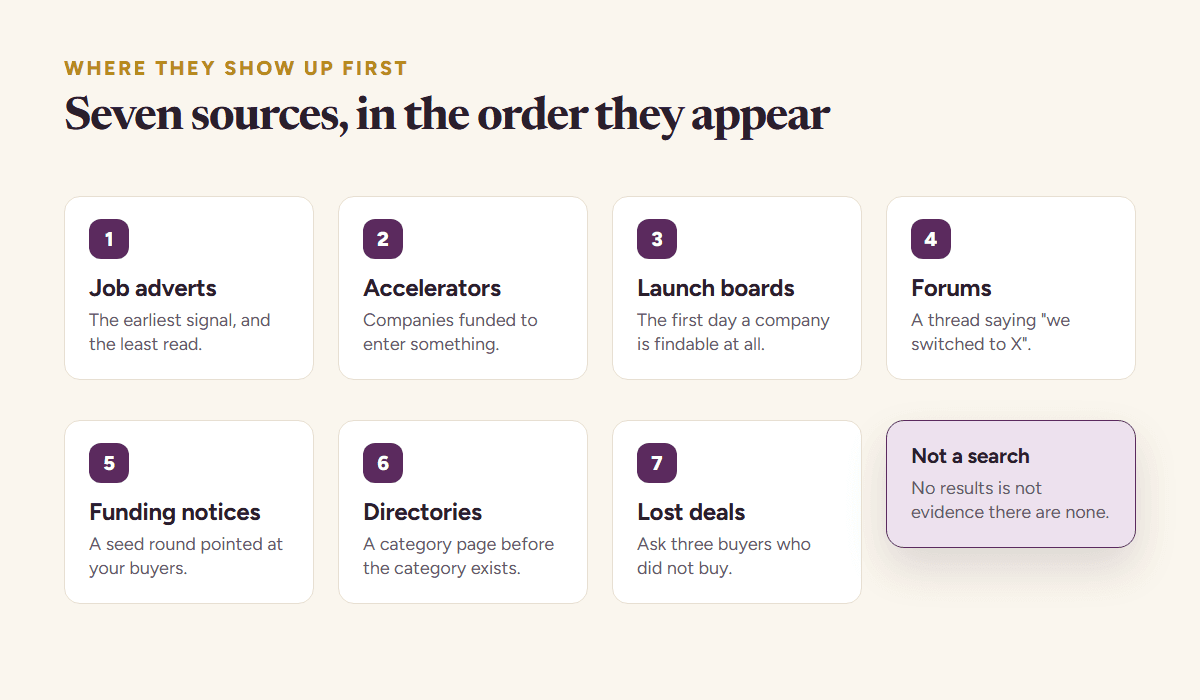
- Job adverts and careers pages. A first product, sales, partnerships, or customer-success hire can name the buyer, market, workflow, and expansion plan before the homepage does.
- Accelerator and portfolio directories. Search descriptions and tags in directories such as the Y Combinator company directory, then verify the current product on the company site.
- Launch boards and changelogs. The Product Hunt launch feed surfaces live products and the comments often reveal alternatives, use cases, and buyer vocabulary.
- Buyer communities and switch threads. Search the pain inside professional groups, forums, Reddit, Slack communities, and niche newsletters. Save statements of use, comparison, and switching—not mentions alone.
- Funding and public company records. A round is a lead, not proof. Read the company announcement, investor portfolio, and where relevant SEC EDGAR filings for the buyer, use of funds, and product direction.
- Marketplaces and integration directories. Search the ecosystem your buyer already inhabits. New apps can earn distribution there before they rank for a category term.
- Lost deals, support calls, and customer interviews. Ask what the buyer compared, what they use today, what nearly stopped the purchase, and what would make them switch. This is the highest-quality evidence because it comes from the buying decision itself.
A 45-minute competitor discovery workflow
Run discovery as a bounded research sprint. Forty-five minutes is enough to create a candidate list without falling into endless browsing. The output is names, source links, overlap notes, and unanswered questions—not a finished competitive analysis.
- Minutes 0–5: define the buyer and job. Write role, company, trigger, desired outcome, current workaround, and budget band.
- Minutes 5–15: run the query ladder. Use three pain, workaround, outcome, and switch queries; save repeated names.
- Minutes 15–25: scan launch and company directories. Search descriptions and tags, not only category labels.
- Minutes 25–35: inspect careers, integrations, and changelogs. Look for movement toward the same buyer and channel.
- Minutes 35–40: check buyer evidence. Search for comparisons, reviews, community mentions, and switching statements.
- Minutes 40–45: score and triage. Park weak names, schedule quarterly review for adjacent names, and validate high-overlap candidates.
Keep a search log
Record the date, query, source, candidate, and the sentence that made it relevant. A list of names cannot be audited. A search log shows where each candidate came from and makes the next discovery pass faster.
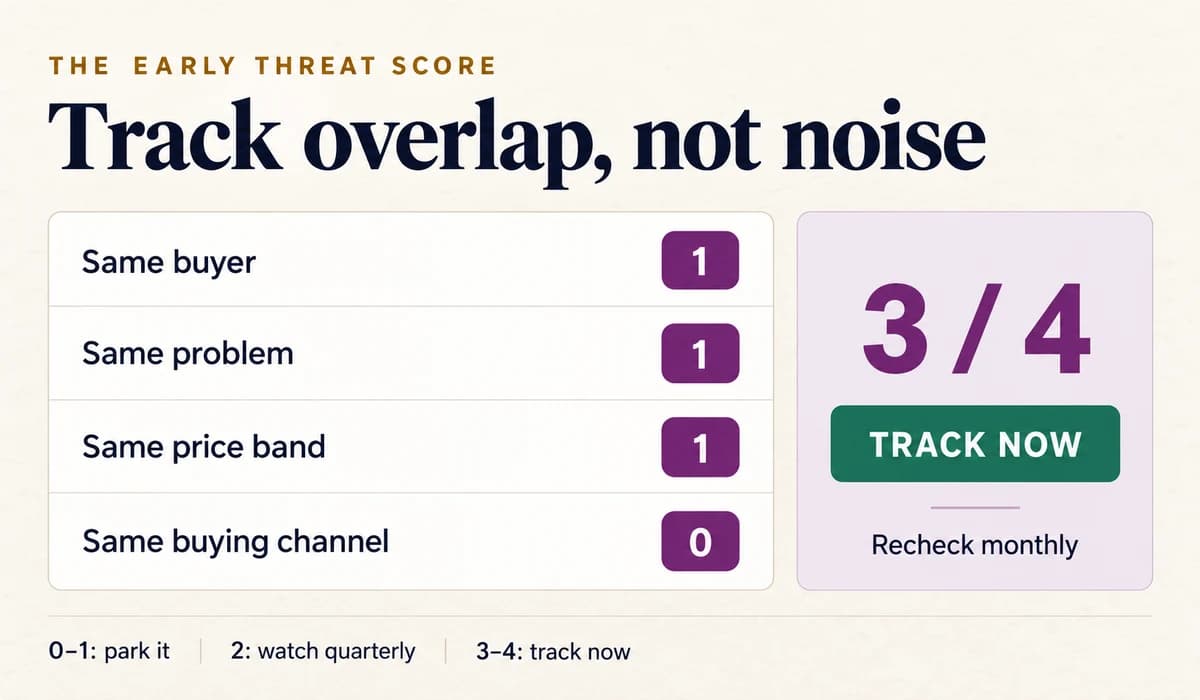
Score early competitors by overlap
Give one point for the same buyer, same problem, overlapping price band, and same buying channel. Three or four points means track now; two means watch quarterly; zero or one means park the candidate until new evidence appears. The score controls attention, not truth.
| Overlap test | Evidence that earns the point | Weak evidence |
|---|---|---|
| Same buyer | landing page, role, case study, or buyer quote | broad industry tag |
| Same problem | same before-state and desired outcome | shared technology such as AI |
| Same price band | complete cost for the same buyer overlaps | a free trial with no public price |
| Same channel | same marketplace, search, partner, or sales motion | same social network presence |
Add confidence separately: verified, plausible, or unknown. A 3/4 candidate built from four vague snippets is weaker than a 2/4 candidate named by two lost buyers. Preserve both overlap and confidence so a neat score does not hide poor evidence.
Validate the candidate with buyers
A candidate becomes a confirmed competitor when buyer evidence shows it enters the same decision. Ask neutral questions about alternatives and sequence; do not lead with the company name. Three recent conversations are more useful than fifty unqualified web mentions.
- What do you use today to solve this problem?
- What else did you try or shortlist before choosing?
- Which option did you rule out first, and why?
- What would have to change for you to switch?
- Who else participates in the decision, and where do they look for options?
Classify the answer carefully. “I have heard of them” is awareness. “I tested them” is evaluation. “I replaced them” is switch evidence. The last two confirm competitive pressure; the first does not.
When does an adjacent company become a direct competitor?
An adjacent company becomes direct when it crosses into the same buying decision. The transition often starts with a job advert or buyer-specific landing page, continues with packaging and distribution, and ends with explicit comparison or switch evidence.
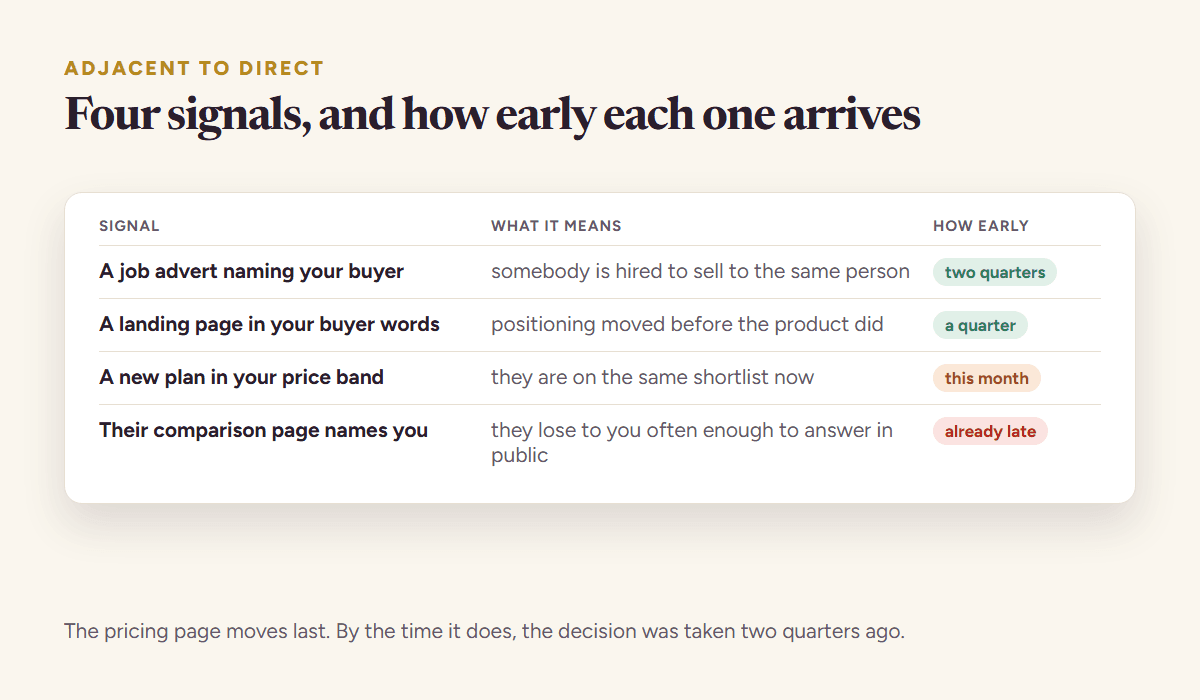
| Signal | What it suggests | Response |
|---|---|---|
| Job advert names your buyer | the expansion has an owner | add to monthly watchlist |
| Landing page uses buyer’s problem language | positioning has entered your segment | re-score buyer and problem overlap |
| Integration enters your buyer ecosystem | distribution can reach the same accounts | test channel overlap |
| Plan enters your price band | the candidate can join the shortlist | normalize pricing and track weekly |
| Buyer or comparison page names both products | the same decision is happening now | confirm as direct and build a full comparison |
How often should you look for emerging competitors?
Run broad discovery monthly in a fast-moving market and quarterly in a stable one. Track confirmed and high-overlap competitors weekly. The two cadences solve different problems: discovery finds names you do not know; monitoring detects changes in names you already approved.
| List | Size | Cadence | What to check |
|---|---|---|---|
| Confirmed direct | 3–7 | weekly | pricing, features, positioning, launches |
| High-overlap candidate | up to 10 | monthly | buyer, plan, integration, customer evidence |
| Adjacent watchlist | 10–25 | quarterly | new segment, channel, hiring, acquisition |
| Discovery sources | query log | monthly or quarterly | new names and repeated signals |
Competite can start from a product URL or a specific idea, propose competitor candidates, and ask you to approve the relevant names and pages before deeper analysis. That approval matters: discovery should broaden the field, while tracking should stay focused on competitors that could actually change a decision.
Mistakes that hide early competitors
Most misses come from a narrow definition, not a lack of tools. Teams search one category phrase, collect famous logos, treat funding as validation, and ignore the status quo. The fix is a repeatable source mix and a strict overlap test.
- Searching only your category name. Use pain, workaround, outcome, switch, integration, and role queries.
- Treating every launch as a competitor. A launch earns investigation; buyer overlap earns tracking.
- Confusing shared technology with shared market. Two AI products can sell different outcomes to different buyers.
- Counting funding as demand. Funding expands capacity. Customer and switch evidence shows competition.
- Ignoring services and the status quo. Buyers compare outcomes and switching costs, not your software taxonomy.
- Building a list with no dates. Early companies change quickly; every score needs a source and review date.
- Tracking too many names weekly. Keep direct tracking narrow and the adjacent watchlist broad but infrequent.
Questions people ask
- What is an early-stage competitor?
- It is an emerging company or adjacent product beginning to target the same buyer and job before it has strong category rankings, reviews, comparison pages, or broad awareness. It is identified through several weak signals plus verified overlap.
- How do I find competitors when the category does not exist?
- Search the buyer’s pain, workaround, desired outcome, switch language, role, and ecosystem instead of a product noun. Then scan launches, accelerator directories, careers pages, marketplaces, communities, funding records, and lost-deal notes.
- What are the earliest signs of a new competitor?
- The earliest useful signs are a hire responsible for your buyer, a landing page using the buyer’s problem language, an integration into the buyer’s ecosystem, a plan entering your price band, or a buyer reporting that they evaluated or switched to the product.
- How do I score an emerging competitor?
- Give one point each for the same buyer, same problem, overlapping price band, and same buying channel. Track 3–4 points now, review 2 points quarterly, and park 0–1 points. Record evidence confidence separately.
- Does a funding round make a startup a competitor?
- No. Funding is a lead because it gives a company capacity to hire and build. It becomes competitive evidence only when hiring, product, positioning, pricing, distribution, or buyer behavior shows movement into the same purchase decision.
- How often should I search for new competitors?
- Run broad discovery monthly in fast-moving markets and quarterly in stable ones. Monitor confirmed direct competitors weekly. Discovery finds unknown names; monitoring detects changes in already-approved competitors.
See it on your own competitors
Add your product, or just describe the idea. Competite finds the competitors, reads their pages, and writes the comparison with a quote behind every claim. Free, in about three minutes, no card.
Keep reading
How to find your competitors, even before you have a product
How to find competitors for a startup: who counts as one, six ways to find them from a job or an idea, how to score the overlap, and how many to keep.
15 September 2026 · 7 min read
A new competitor just launched in your market. What to do first
A new competitor launched in your market: how to read what they actually shipped, decide whether it threatens you, and the four responses worth making.
17 September 2026 · 7 min read
Direct and indirect competitors, and the one that beats both
Direct vs indirect competitors, with examples: what separates them, why the status quo beats both, and how to sort your own list in about ten minutes.
17 September 2026 · 6 min read
Competitor tracking: how to monitor competitors’ prices, features and funding every week
Competitor tracking for founders: the six signals to monitor, how often each one moves, where they live, and what a good alert looks like.
9 September 2026 · 6 min read