Direct competitor comparison: a buyer-led, evidence-backed guide
· 9 min read · by the Competite team
A direct competitor comparison is a head-to-head evaluation of your product and one rival that targets the same buyer, solves the same job, and appears on the same shortlist. The useful version does not begin with feature checkboxes. It begins with a buyer scenario, compares equivalent offers, links every factual claim to evidence, names where the rival is better, and ends with a pricing, positioning, product, or sales decision.
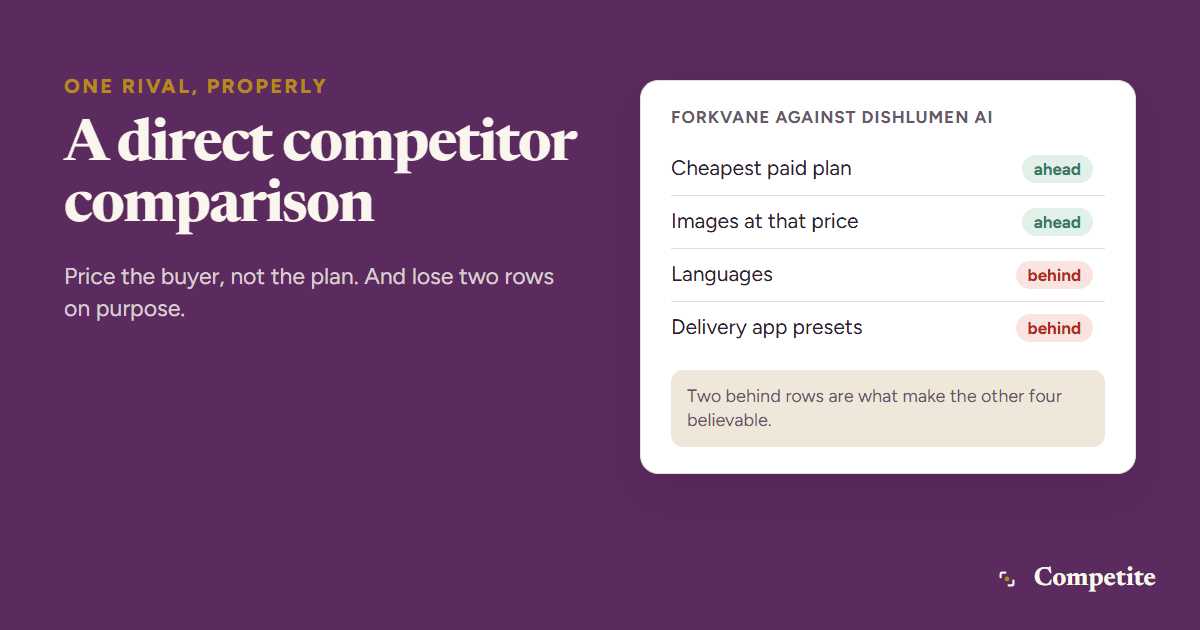
What is a direct competitor comparison?
A direct competitor comparison measures two businesses that compete for the same customer and the same purchase. It answers a practical question: if a qualified buyer considered both products today, which differences would change the decision? That is narrower than a market landscape and deeper than a feature matrix.
| Comparison type | Question it answers | Useful scope |
|---|---|---|
| Direct comparison | Why would the same buyer choose us or them? | one rival, five to eight criteria |
| Competitor matrix | How is the category structured? | three to seven competitors |
| Indirect comparison | What other way can the buyer solve the job? | substitutes and the status quo |
| SEO comparison page | Which option fits a specific searcher? | one named rival, public evidence |
The one-sentence test
If you cannot finish “A buyer choosing between us and them is usually…” with one specific buyer and situation, the rival is not direct enough for a head-to-head comparison.
How to choose the right direct competitor
Choose the rival buyers actually evaluate, not the largest company you admire. The strongest evidence is a lost deal, a sales call, a review that names both products, or a search for “your product vs their product.” Market fame alone does not make two offers comparable.
- Same buyer. Both products target the same role, company size, use case, and level of urgency.
- Same job. The buyer hires both products to achieve the same outcome, even if the feature lists differ.
- Same buying motion. Self-serve should usually be compared with self-serve; enterprise procurement with enterprise procurement.
- Overlapping price band. The same buyer can realistically afford either option after required seats, usage, and add-ons are counted.
- Real shortlist evidence. A prospect, customer, review, or search pattern shows that the two names appear in the same decision.
Score one point for each test. Four or five points means a direct comparison is justified. Two or three means the company belongs on an adjacent watchlist. Zero or one means it is probably an aspirational benchmark, not a competitor. For the wider classification, use direct vs indirect competitors.
Build the evidence ledger before the comparison table
An evidence ledger is a list of every claim, its source URL, the date read, and its verification status. Build it before writing verdicts. It separates facts from assumptions and makes future updates cheap: when a source changes, you know exactly which row needs review.
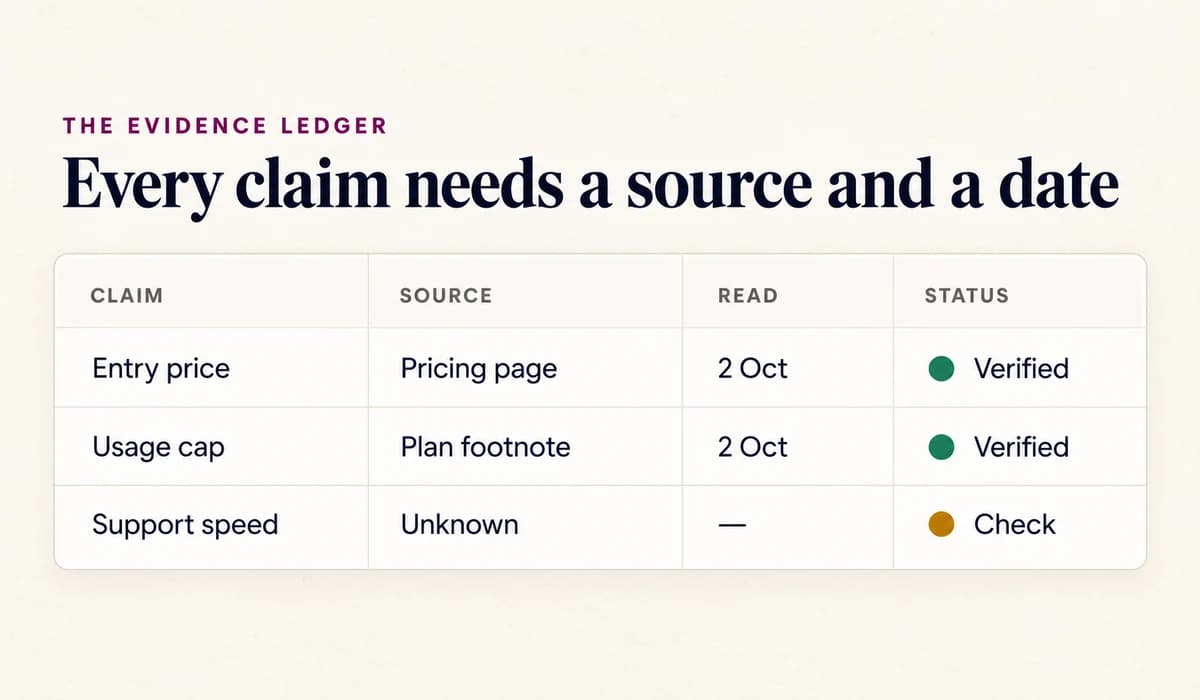
- Use the rival’s pricing, feature, documentation, security, and policy pages as primary sources.
- Quote the shortest passage that proves the claim; do not save only your interpretation.
- Record the page URL and the date read beside every price, limit, and availability claim.
- Mark information that came from a sales call, trial, or support reply differently from public information.
- Write “unknown” where evidence is missing. Do not convert silence into “they do not offer it.”
This is also the safer standard for a public comparison. The FTC policy on comparative advertising supports truthful comparisons when the basis is clear and the presentation is not deceptive. That is not legal advice, but it is a useful editorial rule: compare objectively measurable attributes, disclose material limits, and preserve the evidence behind the claim.
Make competitor pricing comparable
Compare the price paid by the same buyer, not plans with similar names. A “Pro” plan can be one company’s entry tier and another company’s middle tier. Normalize seats, usage, required add-ons, billing period, implementation fees, and limits before declaring either product cheaper.
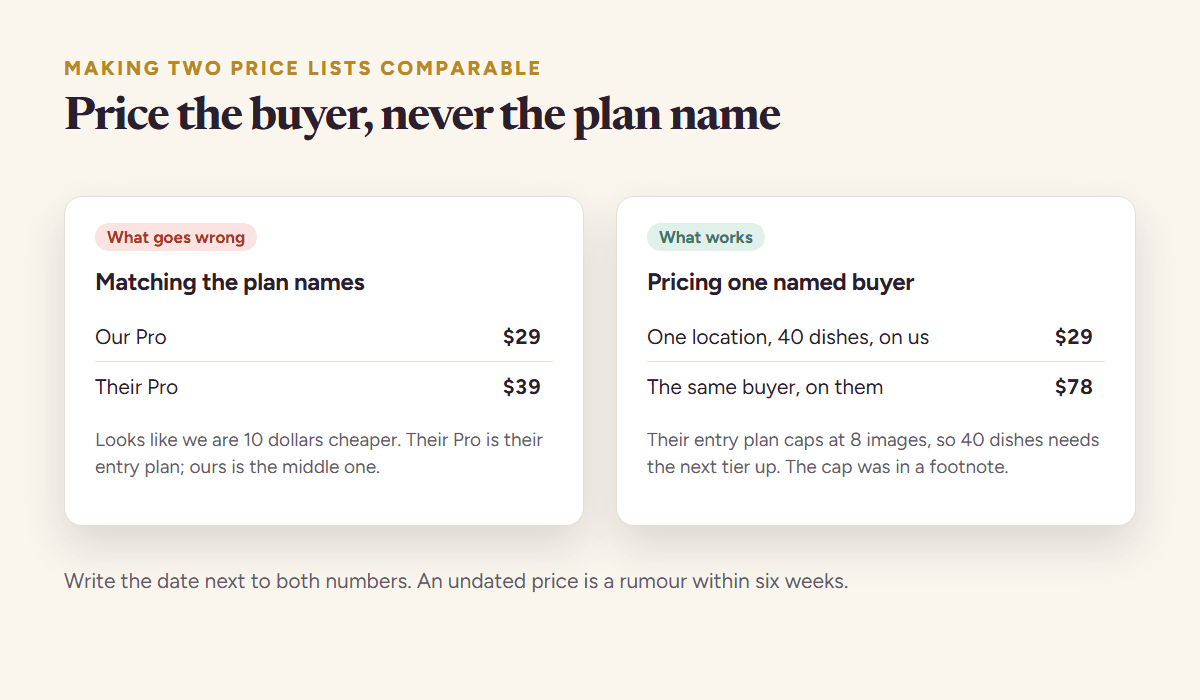
- Define buyer A precisely: team size, monthly usage, required workflow, integrations, support level, and contract preference.
- Calculate the complete monthly and first-year cost on your product, including mandatory add-ons.
- Price the identical buyer on the rival, reading caps, overages, annual-only discounts, and implementation terms.
- Repeat for buyer B, whose size or usage crosses a meaningful packaging boundary.
- Write the date, currency, tax treatment, and assumptions next to both results.
| Normalize | Record | Common mistake |
|---|---|---|
| Seats | required seats × price per seat | comparing one seat with a team bundle |
| Usage | included units and overage price | using the advertised starting price |
| Billing | monthly equivalent and commitment | treating annual prepay as monthly flexibility |
| Add-ons | features required for the buyer scenario | comparing a complete plan with a base plan |
| Services | setup, migration, training, support | ignoring first-year cost |
Choose criteria from the buying decision
Use five to eight criteria that buyers mention without prompting. Price and feature breadth usually belong, but implementation time, proof, integrations, support, risk, and the status quo may matter more. A row exists only if it can change a purchase decision.
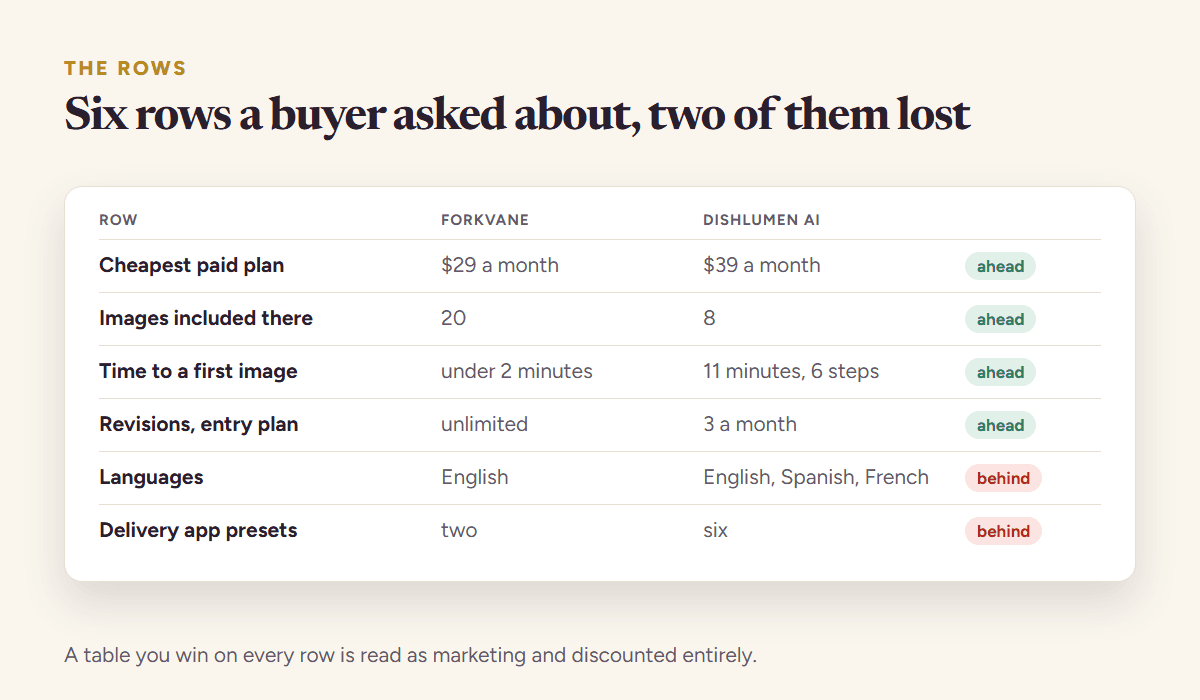
| Criterion | Your product | Direct competitor | Verdict |
|---|---|---|---|
| Buyer A monthly cost | $29 including required usage | $78 after the usage cap | ahead |
| Time to first result | under 2 minutes in a test | 11 minutes across 6 steps | ahead |
| Languages | English | English, Spanish, French | behind |
| Required integrations | 2 of buyer’s 2 | 2 of buyer’s 2 | level |
| Support evidence | published 4-hour target | not publicly stated | unknown |
| Migration risk | CSV import and guided setup | API migration with services team | depends on buyer |
Do not force every row into a winner. “Level,” “unknown,” and “depends on buyer” are legitimate outcomes. A matrix where you win every line looks like advertising because it probably is. The rows where the rival wins reveal roadmap gaps; the conditional rows improve qualification and sales honesty.
Score the comparison without false precision
Weight criteria only when the weight comes from buyer evidence. Ask five recent prospects to rank their top three decision factors, or extract frequency from win-loss notes. A decimal-heavy model built from founder opinion adds precision without adding truth.
- Give each criterion a weight from 1 to 3: useful, important, or decision-critical.
- Rate each product 0, 1, or 2: does not meet, partly meets, or meets the buyer requirement.
- Multiply rating by weight and keep the evidence link beside the rating.
- Run the score for buyer A and buyer B separately instead of averaging unlike customers.
- Read the losing high-weight rows first; they contain the useful decision.
The score summarizes the evidence. It cannot repair evidence chosen to produce the score you wanted.
Turn the comparison into decisions
A finished direct comparison changes a decision. Translate the highest-weight differences into one pricing action, one positioning sentence, one product question, and one sales response. If the output is only a table, the analysis stopped before the valuable part.
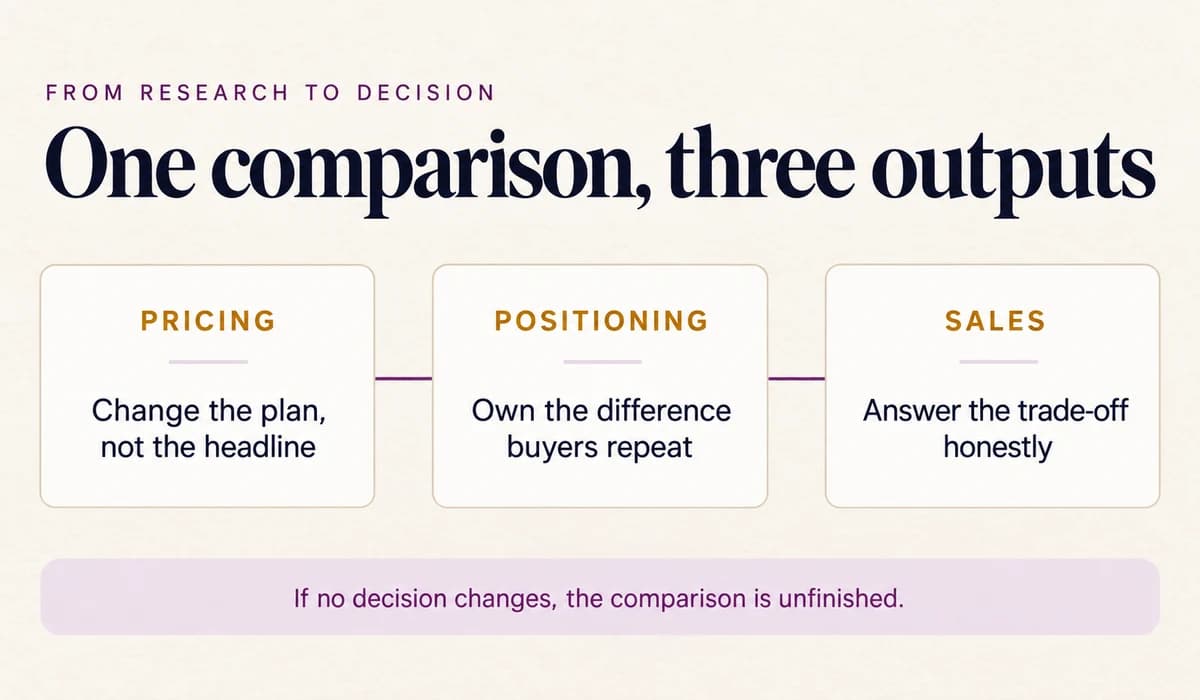
| Finding | Do not conclude | Useful decision |
|---|---|---|
| You are cheaper for buyer A | lower every price | make buyer A’s complete cost obvious |
| They win on three languages | copy three languages immediately | test whether your target buyer needs them |
| Your onboarding is faster | say “easier” | publish the measured time and steps |
| Their support is unknown | say their support is poor | keep the row unknown and verify it |
| Both solve the job equally | add more feature rows | sharpen who each product is best for |
How to write a public competitor comparison page
A public comparison page should help a buyer choose, including buyers who should choose the rival. Lead with who each product is best for, show the material trade-offs, link factual claims, and display a “last verified” date near changing information. Do not publish an internal battlecard with softer adjectives.
- Answer “Which is better for whom?” in the first paragraph.
- Give a short verdict before the detailed table so a reader and an answer engine can extract it.
- Use descriptive headings such as pricing, onboarding, integrations, support, and best fit.
- Link every competitor price, limit, and policy to the primary source.
- State test conditions for performance, setup time, or service claims.
- Name one or two situations where the competitor is the better choice.
- Show the author, updated date, and a visible correction path.
This structure also aligns with Google’s guidance for AI search features: important information should exist in text, useful images should support it, internal links should make the page discoverable, and structured data should match the visible page. There is no special GEO schema that substitutes for a clear, sourced answer.
Direct competitor comparison template
Use this compact template for an internal comparison or as the research layer beneath a public page. Keep the buyer scenario and evidence ledger attached; without them, the verdicts cannot be audited or updated.
- Scope: rival, buyer scenario, purchase trigger, date, researcher.
- Qualification: same buyer, job, buying motion, price band, shortlist evidence.
- Evidence ledger: claim, quote or observation, source URL, date read, status.
- Normalized pricing: buyer A and buyer B, complete monthly and first-year cost.
- Comparison rows: criterion, weight, your evidence, their evidence, verdict.
- Best fit: who should choose you, who should choose them, who should choose neither.
- Actions: pricing, positioning, product, sales, owner, due date.
- Refresh: page owner, next review date, trigger events that require an immediate check.
How often should the comparison be updated?
Check volatile evidence weekly and review the full comparison monthly. Pricing, limits, packaging, and availability can change without an announcement. Buyer priorities and strategic conclusions change more slowly, so they need a monthly or quarterly review rather than a daily one.
| Evidence | Routine cadence | Immediate trigger |
|---|---|---|
| Pricing and limits | weekly | new plan, discount, cap, or billing model |
| Feature and integration pages | weekly | launch or deprecation |
| Positioning and homepage | monthly | new buyer, use case, or category language |
| Reviews and win-loss notes | monthly | the same objection appears three times |
| Weighted score and decisions | quarterly | a high-weight row changes |
Competite can keep the evidence layer alive: add your product or idea, approve the relevant competitor and pages, and the weekly analysis revisits those sources. The point is not a longer report. It is knowing when a changed fact invalidates an old action.
Questions people ask
- What is a direct competitor comparison?
- It is a head-to-head evaluation of your product and one rival competing for the same buyer and purchase. It compares equivalent offers using buyer-led criteria, cites evidence for factual claims, names trade-offs, and ends with a decision.
- What should be included in a competitor comparison?
- Include the buyer scenario, why the rival is direct, normalized pricing for the same buyer, five to eight purchase criteria, evidence links and verification dates, verdicts including unknowns, best-fit guidance, actions, and the next review date.
- How do I compare competitor pricing fairly?
- Price the same buyer on both products. Normalize seats, usage, required add-ons, billing commitment, implementation, and support. Compare complete monthly and first-year cost rather than plans with similar names or advertised starting prices.
- Should a comparison page say where the competitor is better?
- Yes. A useful page tells buyers who each option is best for. Naming credible situations where the rival wins makes the rest of the comparison more trustworthy and helps you qualify customers who are a poor fit.
- Is comparative advertising allowed?
- Rules vary by jurisdiction, so obtain legal advice for your situation. In the United States, the FTC supports truthful, non-deceptive comparisons whose basis is clear. Keep primary evidence, disclose material limits, and avoid turning unknown information into negative claims.
- How often should a direct competitor comparison be updated?
- Check pricing, limits, feature, and integration pages weekly; review the complete comparison monthly; revisit weights and strategic decisions quarterly. Recheck immediately when a high-weight fact changes.
See it on your own competitors
Add your product, or just describe the idea. Competite finds the competitors, reads their pages, and writes the comparison with a quote behind every claim. Free, in about three minutes, no card.
Keep reading
A competitor analysis template that fits on one page, with the table
A free competitor analysis template on one page: the twelve-row table, the rules for filling it with quotes and dates, a scoring key, and a worked example.
15 September 2026 · 7 min read
Competitor pricing analysis: how to read a pricing page like a buyer
Competitor pricing analysis in an afternoon: the eight things to read on a pricing page, how to compare plans that are not alike, and how to set your price.
15 September 2026 · 9 min read
Direct and indirect competitors, and the one that beats both
Direct vs indirect competitors, with examples: what separates them, why the status quo beats both, and how to sort your own list in about ten minutes.
17 September 2026 · 6 min read
Competitor tracking: how to monitor competitors’ prices, features and funding every week
Competitor tracking for founders: the six signals to monitor, how often each one moves, where they live, and what a good alert looks like.
9 September 2026 · 6 min read