AI agent startups in 2026: market map, business models, and funding signals
· 6 min read · by the Competite team
AI agent startups are moving from “chat with your data” toward systems that plan, call tools, complete multi-step work, and ask for approval at the risky moments. The 2026 market is crowded, but it is not one category. Infrastructure agents, horizontal work agents, and vertical agents face different buyers, margins, reliability thresholds, and routes to defensibility. This map helps founders decide where a real company can still be built.
What counts as an AI agent startup in 2026?
An AI agent startup sells software that can pursue a goal through multiple steps, use external tools or systems, observe the result, and continue or escalate. A single prompt that produces text is an AI feature. A system that resolves an invoice exception, updates the accounting record, requests approval, and logs the decision behaves more like an agent.
The distinction matters commercially. Agent products inherit responsibility for execution, not only suggestion. Buyers therefore care about permissions, audit logs, failure recovery, evaluation, and the exact boundary between automatic work and human approval. Those operational details often determine whether a pilot reaches production.
| Product type | Typical output | Primary risk | Common pricing |
|---|---|---|---|
| Copilot | Suggestion or draft | Incorrect advice | Per seat |
| Workflow automation | Predetermined task sequence | Broken integration | Per workflow or run |
| AI agent | Adaptive multi-step outcome | Incorrect action | Per outcome, usage, or capacity |
| Agent infrastructure | Tools to build and govern agents | Platform reliability | Usage plus platform fee |
The AI agent startup market map
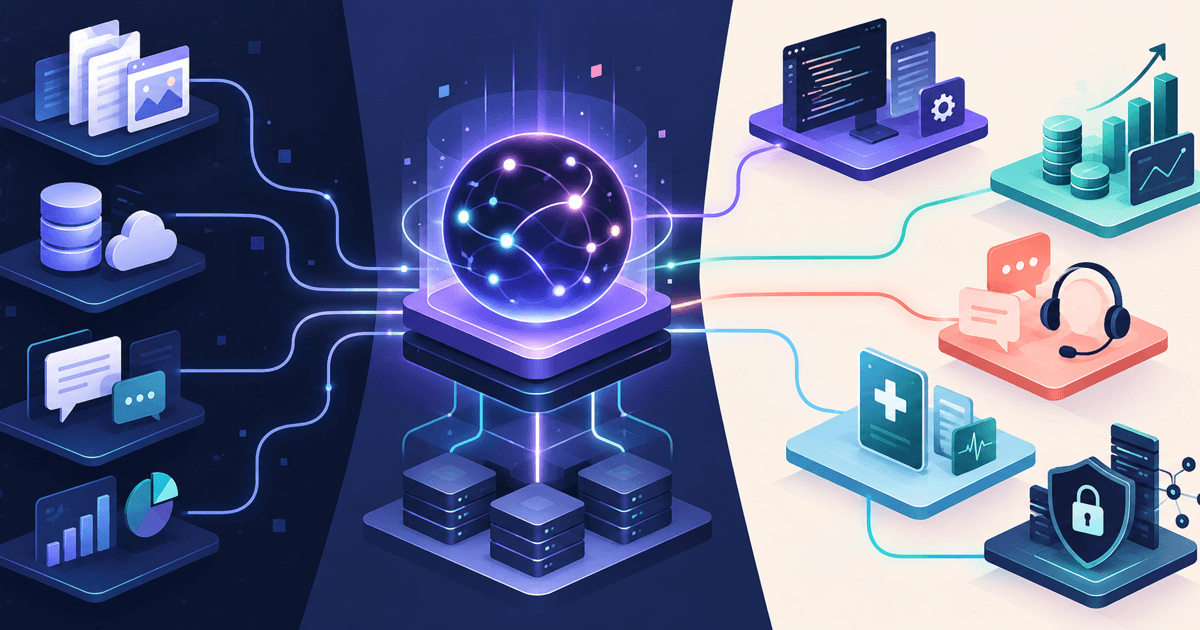
The market separates into six layers: model and compute infrastructure, agent development platforms, horizontal work agents, customer-facing agents, vertical agents, and control systems. A startup should know which layer it owns because the buyer, proof requirement, and competitive set change at every boundary.

- Agent infrastructure. Memory, orchestration, tool access, testing, observability, identity, and secure execution. The customer is usually a technical team building agents into another product.
- Horizontal enterprise agents. Cross-company work in HR, finance, IT, procurement, or research. Ema, for example, describes teams of agents automating corporate processes across multiple functions.
- Customer interaction agents. Sales, service, onboarding, scheduling, and support. These products compete with software seats, outsourced labor, and internal teams at the same time.
- Developer and security agents. Code generation, testing, incident response, vulnerability work, and infrastructure operations. Buyers can measure output, but mistakes can create large downstream costs.
- Vertical agents. Domain-specific work in healthcare, legal, insurance, logistics, defense, and financial services. They trade a smaller market for deeper workflow ownership and higher switching costs.
- Control and accountability. Evaluation, policy enforcement, permissions, traceability, and human review. As agents act across systems, this layer becomes part of deployment rather than optional governance.
What 2026 funding says about the agent market
Funding is concentrating around agent systems that replace expensive work, own a difficult deployment environment, or supply the controls needed for production. The signal is not that every task will become autonomous. It is that investors expect software budgets and service budgets to overlap as agents complete more of the work behind a software screen.
In September 2026, Ema reported a $77 million Series B for enterprise agent teams. Aslan disclosed $20.8 million for national-security agents. A current funding tracker counted more than one hundred agent companies financed during 2026, but category totals should be treated as directional because databases use different definitions of “agent.”
Follow the unit of value
A seat price assumes a human operates the software. An outcome price assumes the product completes work. The stronger the agent claim, the more precisely the startup must define a successful outcome, an exception, and who pays when the action is wrong.
Four business models AI agent startups are testing
Agent pricing is unsettled because model usage creates variable cost while completed work creates variable value. Founders are experimenting with seat, usage, capacity, and outcome-based models. The correct model depends on whether the buyer experiences the agent as software, infrastructure, or labor.
| Model | Works when | Main weakness | Metric to watch |
|---|---|---|---|
| Per seat | A human directs the agent frequently | Automation can reduce the number of seats | Expansion per team |
| Per action or token | Usage maps cleanly to cost | Buyer cannot predict the invoice | Gross margin by workflow |
| Per agent or capacity | Buyer wants a stable monthly budget | Capacity can feel abstract | Utilization and overage |
| Per outcome | Success is objective and valuable | Exceptions and attribution create disputes | Accepted outcomes and rework |
Hybrid pricing is common for a reason: a platform fee covers the fixed product and governance layer, while usage or outcomes capture variable work. A founder should model the expensive path, not only the average one. Long contexts, repeated tool failures, human reviews, and customer-specific integration work can turn attractive revenue into services-heavy margin.
Where an AI agent startup can build a moat
The model alone is rarely the moat for an application startup. Durable advantage is more likely to come from workflow position, proprietary feedback, permissions, distribution, and trust. Each completed task can improve the product only if the startup captures structured evidence about what succeeded, what failed, and what the user corrected.

- Workflow access: integrations, permissions, and embedded placement that take time to reproduce.
- Outcome data: labeled corrections and accepted results tied to a specific job, not a generic transcript archive.
- Evaluation assets: real test cases, failure taxonomies, and regression suites that make each release safer.
- Distribution: a channel, community, marketplace, or incumbent partnership that repeatedly delivers the right buyer.
- Trust: security evidence, auditability, predictable escalation, and a track record in a high-cost workflow.
For a deeper treatment, see AI startup moats. The practical test is simple: if a well-funded competitor gained access to the same frontier model tomorrow, what would still take them twelve months to reproduce?
Where there is still room for a new AI agent startup
Opportunity remains in workflows that are frequent, expensive, digitally observable, and painful to coordinate, especially where an agent can begin as an assistant and earn authority gradually. The best early wedge is usually one bounded outcome for one role, not a universal employee for an entire company.
- Find a queue: claims, tickets, reconciliations, reviews, exceptions, requests, or investigations that already arrive one item at a time.
- Measure the current work: volume, handling time, error cost, escalation rate, and who approves completion.
- Automate the lowest-risk slice first and show every source, action, and uncertainty to the reviewer.
- Charge against an existing budget: software, outsourcing, headcount, loss prevention, or compliance.
- Expand only after the evaluation set proves that reliability survives new customers and edge cases.
Before building, map the companies already attacking the same queue. Competite can start from an idea, discover likely competitors, and compare the public pricing, product, and positioning evidence. The goal is not to prove the idea is unique. It is to find a narrower entry point buyers will pay to change.
Risks founders should design for on day one
Agent risk is operational: an incorrect action can change a record, contact a customer, move money, expose data, or trigger another automated system. Build permissions, confirmation thresholds, logs, rollback, and incident review into the product architecture rather than adding them after an enterprise buyer asks.
The NIST AI Risk Management Framework organizes AI risk work around governance, mapping, measurement, and management. A startup does not need an enterprise bureaucracy, but it does need explicit owners, known failure modes, test cases, and a decision about which actions the product will never take without a human.
Questions people ask
- What is an AI agent startup?
- It is a company whose product can pursue a goal through multiple steps, use external tools or systems, observe results, and continue or escalate. The commercial promise is a completed workflow, not only generated content.
- Are AI agents different from copilots?
- Usually. A copilot primarily suggests or drafts while a human remains the operator. An agent can take bounded actions and carry work across several steps, which creates higher value and higher operational risk.
- How do AI agent startups make money?
- Common models include per seat, per action, per agent capacity, per successful outcome, and hybrids that combine a platform fee with variable usage. The best model matches the buyer’s existing budget and a measurable unit of value.
- What makes an AI agent startup defensible?
- Workflow access, proprietary outcome feedback, evaluation data, distribution, integrations, permissions, and earned trust are stronger defenses than access to a generally available model.
See it on your own competitors
Add your product, or just describe the idea. Competite finds the competitors, reads their pages, and writes the comparison with a quote behind every claim. Free, in about three minutes, no card.
Keep reading
AI startups to watch in 2026: what the latest funding rounds reveal
A sourced look at AI startups funded in 2026, what they are building, why investors backed them, and the market signals founders should notice.
7 October 2026 · 6 min read
Vertical AI startups: where founders can still build durable companies
A founder-focused guide to vertical AI startups: promising markets, workflow selection, business models, moats, risks, and validation steps.
7 October 2026 · 7 min read
AI startup moats in 2026: what remains defensible when models improve
Seven AI startup moats that can compound beyond model access: workflow, data, evaluation, distribution, trust, cost, and network effects.
7 October 2026 · 7 min read
How to validate a startup idea with AI before you build it
Validate a startup idea with AI using a seven-day research plan for buyer pain, competitors, demand, pricing, interviews, and a paid test.
7 October 2026 · 7 min read